

The Scene Everyone Skips: George Edward Robertson's Lady of Shalott Arrives at Camelot (1900)
The Scene Everyone Skips: George Edward Robertson's Lady of Shalott Arrives at Camelot (1900)
Picture "The Lady of Shalott" and one image almost certainly comes to mind: a woman alone in a boat, hair loose, candles guttering, drifting down a river toward her death. That is John William Waterhouse's 1888 painting, reproduced on more posters and postcards than perhaps any other single scene from Tennyson. But Tennyson's poem does not end with her drifting alone. It ends with her arrival — already dead — at Camelot, and with the crowd of knights and ladies who come out to see what has washed up at their door, Lancelot among them. Almost nobody paints that part. George Edward Robertson, a Royal Academy regular better known for scenes of Julius Caesar and Mark Antony, did.
Quick facts
Artist: George Edward Robertson (British, 1864–1920)
Date: 1900
Medium: Oil on canvas
Dimensions: 137.8 × 194.3 cm (54¼ × 76½ in)
Location: Private collection; first exhibited at the Royal Academy of Arts, London (1900)
Notable fact: Exhibited at the Royal Academy's Summer Exhibition in 1900 (no. 375); one of the few paintings of the subject to show the boat's arrival at Camelot rather than the solitary journey downriver
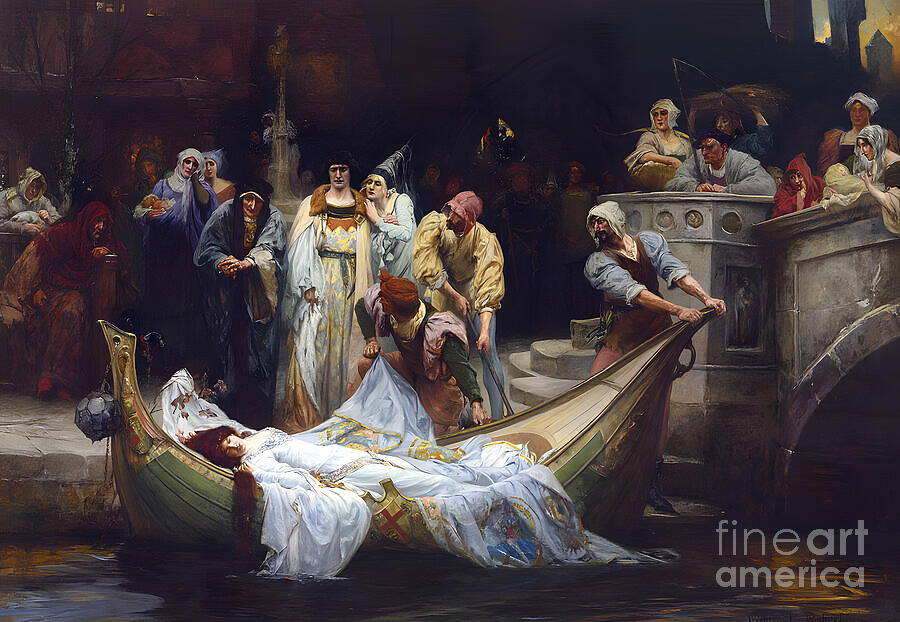
George Edward Robertson, The Lady of Shalott, 1900. Oil on canvas. Private collection. Image via the Sapiens Verbum print shop.
A Career Built on Caesar, Not Camelot
Robertson exhibited at the Royal Academy in London almost every year from 1885 to 1904, and the works he was best remembered for were Roman, not Arthurian — grand history paintings built around Julius Caesar and Mark Antony. His Lady of Shalott, shown at the 1900 Summer Exhibition, was something of a detour into the medieval revival that Tennyson's poem had helped fuel for half a century by then. By 1900 the subject had already passed through the hands of the Pre-Raphaelite Brotherhood and its followers, and painting it was less an act of discovery than of joining a very crowded field — which may be exactly why Robertson chose the one moment in the story almost no one else had used.
The Verse Everyone Quotes, and the One Nobody Paints
Tennyson's Lady is cursed to see the world only through a mirror, weaving what she sees into a tapestry, forbidden from looking directly out of her tower window. She breaks the curse the moment she looks straight at Sir Lancelot riding past; "the mirror crack'd from side to side," and she knows she is doomed. She goes down to the river, finds a boat, writes her own name on its prow, and lies down in it as it carries her, dying, toward Camelot. Almost every well-known painting of the subject stops at or before this point: Waterhouse's Lady rising from her loom, or adrift and already half-gone; Holman Hunt's Lady tangled in her own threads at the instant of the curse. Robertson instead paints the part of the poem that comes after all of that — the boat's arrival, and Camelot's reaction to it.
Camelot's Verdict
The canvas is crowded and dim, lit mainly by the pale glow of the Lady's own draped body and the elaborate, heraldic barge beneath her. On the bridge and quay above, a knot of knights, ladies, and townspeople in medieval dress lean in with expressions somewhere between solemnity and open curiosity — exactly the mixed reaction Tennyson describes: "Who is this? And what is here?" Conservators examining the canvas for its 2013 sale identified one figure in that crowd, retouched over the years, as Lancelot himself: the knight whose reflection first broke the Lady's curse, now the one reading her name on the boat and delivering the poem's famous, understated verdict — "She has a lovely face; / God in his mercy lend her grace, / The Lady of Shalott."
A Painting That Went Quiet
Robertson's Lady of Shalott never became a museum picture. After its 1900 Royal Academy showing, it passed through the New Orleans gallery Kurt E. Schon Ltd. and into private hands in 1988, then resurfaced briefly at a Sotheby's sale of Old Master and 19th-century paintings in 2013 before returning to private ownership, where it remains today. It is a useful reminder that the Victorian appetite for Arthurian subjects produced far more paintings than the handful that made it into public collections and postcard racks — and that some of the most interesting choices, like painting the poem's actual ending instead of its most photogenic line, were made by artists history mostly forgot to credit.
🖼️ Own This Painting
Get The Lady of Shalott as a museum-quality print, canvas, or poster from the Sapiens Verbum print shop.
Shop This Print →
Watch the full video essay on @SapiensVerbum on YouTube.


Comments
Post a Comment