
The Meeting on the Turret Stairs by Frederic William Burton: Ireland's Favourite Painting (1864)
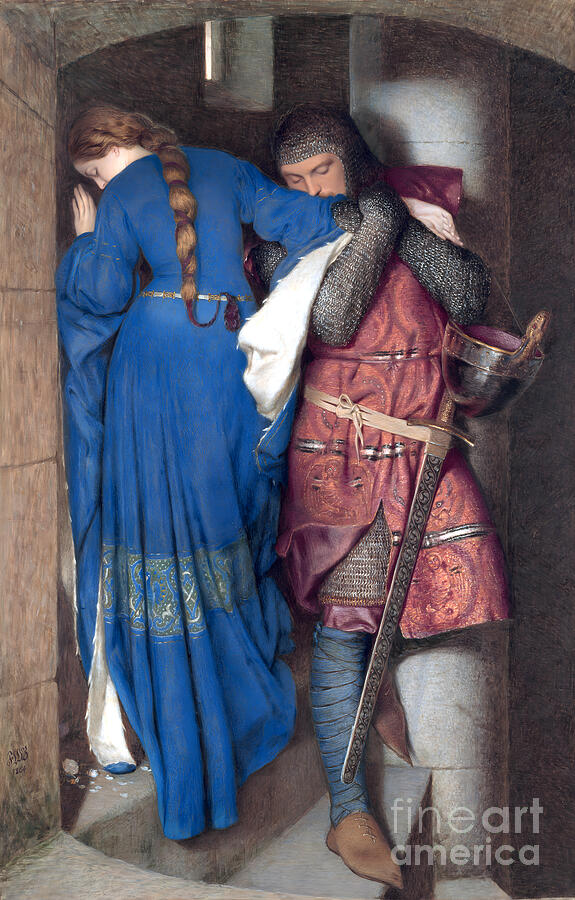
A knight's helmet dangles loose in one hand. His armor presses against a woman's vivid blue dress as they meet -- for the last time, though neither says so -- on a narrow stone stairwell. She holds him with both arms; his sword stays sheathed at his side, and he is already half-turned toward whatever is waiting below. Frederic William Burton's The Meeting on the Turret Stairs (1864) is only a watercolour, barely larger than a cafe tabletop, and yet the National Gallery of Ireland has had to build a queuing system around it.
Artist: Frederic William Burton (1816-1900)
Date: 1864
Medium: Watercolour and gouache on paper, 95.5 x 60.8 cm
Collection: National Gallery of Ireland, Dublin
Notable fact: Voted Ireland's favourite painting in a 2012 public poll; now shown only two hours a week to protect its pigments from light damage
Who Was Frederic William Burton?
Burton was born in County Clare, Ireland, in 1816 and began training at the Dublin Society Schools at the age of ten. He built his early reputation on watercolour portraits and scenes of Irish historical and folk life, exhibiting from the age of sixteen -- and watercolour, rather than oil, stayed his medium for the rest of his working life. In 1858 he moved to London, where contact with the Pre-Raphaelites sharpened the jewel-like intensity already visible in his technique: a miniaturist's patience for layering pigment until it reads, from a few steps back, with the depth of an oil painting. The Meeting on the Turret Stairs, painted in London in 1864, comes near the end of his career as a working artist. A decade later, in 1874, Burton was appointed Director of the National Gallery in London, a post he held for two decades -- and by his own account, he stopped painting entirely once he took the job. He had also been part of the circle that helped establish Ireland's own National Gallery, which opened its doors in Dublin in January 1864: the same year he painted the watercolour that would, decades later, become its most-loved possession.
A Farewell Frozen on the Stairs
Burton compresses the entire drama into a single, wordless gesture. The knight's armor is dulled and matte against the woman's saturated blue gown -- a jewel-bright colour set against something cooler, so the eye lands on her first. Her fingers press into the studs of his breastplate; his hand curls loosely around a folded scrap of cloth, easy to miss on a first look. Neither face is fully visible -- this is an embrace seen from the side, almost overheard rather than watched, as if we have stumbled onto something we were not meant to see. The stone stairwell narrows the whole scene to a single vertical slice, steps rising out of the frame in both directions, so the couple seems suspended between wherever they came from and wherever one of them is about to go.
The Ballad Behind the Painting
The subject is not Burton's invention. It comes from a medieval Danish ballad, translated into English by the Celtic scholar Whitley Stokes and published in Fraser's Magazine in 1855 (William Morris later made his own, more widely read version, Hildebrand and Hellelil). In the story, Hildebrand is a bodyguard who has secretly become the lover of Hellelil, a king's daughter; when her father finds out, he sends her seven brothers to kill him. Burton paints the single moment before that: the farewell on the stairs, Hildebrand asking Hellelil never to speak his name aloud, whatever happens, if she loves him. She cannot keep the promise. Watching him fall to her brothers' swords, she cries out -- and for breaking her word, the youngest brother has her tortured, imprisoned, and sold into slavery. None of that violence is in the painting; Burton chose the one instant before it, which is largely why the image still holds. There's a quiet second layer to the story's afterlife: the antiquarian Margaret Stokes, who eventually gave this watercolour to the National Gallery of Ireland in 1900, was the sister of Whitley Stokes, the same scholar whose translation had put the ballad into English in the first place. Burton, for his part, had travelled Ireland's west with their father and his circle of antiquarians years before. The painting's Danish source, its English translator, and its eventual home all run through one small, tightly connected circle of nineteenth-century Irish scholars.
Two Hours a Week
In 2012, Irish broadcaster RTE asked the public to choose a favourite from ten paintings shortlisted by critics; The Meeting on the Turret Stairs won. It had already won admirers in its own century -- the novelist George Eliot, seeing it in London, said Burton had "raised it to the highest pitch of refined emotion." What the painting has never had on its side is durability: watercolour and gouache fade quickly under light, and Burton's pigments are now considered too fragile for permanent display. The National Gallery of Ireland keeps it in storage and brings it out for exactly two hours a week -- Thursdays from 11:30 to 12:30 and Sundays from 2 to 3 -- with a queue that forms outside Room 20 before the doors open. A painting built around a single fleeting moment is, by conservation necessity, itself only ever fleetingly on view.
Why the Painting Keeps Coming Back
Part of the pull is scarcity engineered by chemistry rather than choice -- you cannot see this one whenever you like, so when you can, you go. But the appeal long predates the gallery's light restrictions. Burton gives almost nothing away and asks the viewer to supply the rest: the armor, the blue dress, the loose helmet, the sheathed sword, the stairs vanishing in both directions are all we get, and from that Victorian audiences and Instagram audiences alike have kept reconstructing the same doomed embrace. It helps that Burton himself walked away from painting only a decade later, which turns this watercolour into something close to a farewell of his own -- one last small, exact thing before the frames and the directorship took over. Neither the ballad's ending nor the painter's own future appears in the image. Both are only implied, which may be the most Victorian trick of all.
Get The Meeting on the Turret Stairs as a museum-quality print, canvas, or poster from the Sapiens Verbum print shop.
Shop This Print →
Watch the full video essay on @SapiensVerbum on YouTube.


Comments
Post a Comment