
Reply of the Zaporozhian Cossacks by Repin: The Letter That Laughs at a Sultan (1891)
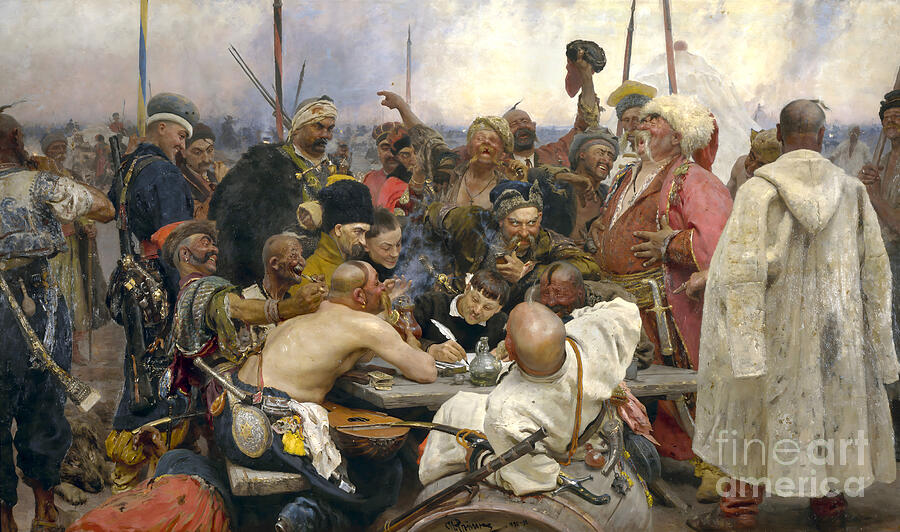
Around a rough wooden table in a camp on the steppe, a crowd of Cossacks is roaring with laughter. A young scribe in the middle bends over a sheet of paper, pen in hand, grinning as he writes. The old leader beside him, pipe in mouth, dictates the next line. A giant in a red coat and white fur hat clutches his belly, a bald man with a scarred head throws back his head, and behind them others shake their fists and wave their hats. Ilya Repin's Reply of the Zaporozhian Cossacks, painted between 1880 and 1891 and now in the State Russian Museum in Saint Petersburg, shows the writing of the most famous insult in East European folklore.
🖼️ Get this painting as a print →
Artist: Ilya Repin (1844–1930)
Date: 1880–1891
Medium: Oil on canvas, 203 × 358 cm
Collection: State Russian Museum, Saint Petersburg (bought by Tsar Alexander III for 35,000 rubles)
Second version: Kharkiv Art Museum (unfinished)
What is the story?
The Zaporozhian Cossacks were free warrior communities who lived beyond the rapids of the Dnieper river, in what is now Ukraine, from the sixteenth to the eighteenth century. According to a famous legend, in 1676, after the Cossacks had defeated his army, the Ottoman sultan Mehmed IV sent them a letter demanding that they submit to him. The Cossacks, led by their chief Ivan Sirko, answered with a reply full of mockery and obscene insults, ridiculing every one of the sultan's grand titles.
Copies of this letter circulated widely in the nineteenth century. Historians doubt that it was ever really sent: the text seems to have been transformed over time from a different exchange of letters, and there is no firm evidence that the episode happened. But as a story of free men laughing at an emperor, it was irresistible.
What does the painting show?
Repin turns the whole canvas into a study of laughter. There are more than twenty figures crowded around the table, and almost every one of them laughs in a different way: some shake with mirth, some grin slyly, some roar with open mouths, one covers his face. The scribe at the centre, the only one in dark, almost town clothes, is the calm point of the picture. Beside him the old chief smokes his pipe with obvious satisfaction.
The details make the scene feel real: the shaved heads with a single lock of hair, the traditional Cossack hairstyle; the muskets, sabres and powder horns; the bandura, a stringed instrument, lying in the foreground; the banners and spears rising against a hazy sky; and, on the right, a tall figure in a long white coat who turns his back to us, a device that pulls the viewer into the circle as if we were standing behind him.
Eleven years of work
Repin started the painting in 1880 and worked on it, on and off, for more than a decade. He made study trips to the south, to the region of Yekaterinoslav (today Dnipro) and to Kachanivka, collecting costumes, weapons and faces. Many of his Cossacks were portraits of real people: the historian Dmytro Yavornytsky, a specialist on the Zaporozhian Cossacks, posed for the scribe, and the general Mikhail Dragomirov for the chief, Ivan Sirko. Repin also began a second version in 1889, which he never finished; it is now in the Kharkiv Art Museum.
When the painting was finally shown in 1891, Tsar Alexander III bought it for 35,000 rubles. It has remained one of the best-known images of Cossack life ever since, endlessly copied, parodied and quoted.
Who was Ilya Repin?
Ilya Repin was born in 1844 in Chuhuiv, near Kharkiv, and trained at the Imperial Academy of Arts in Saint Petersburg. He became the leading realist painter of his age, famous for Barge Haulers on the Volga and for his psychologically intense portraits and history scenes. He spent his last decades at his house in Kuokkala, which became part of Finland after 1917, and died there in 1930.
Few painters have filled a canvas with so many convincing individuals. For other great crowd scenes, compare Rembrandt's The Night Watch, Bruegel's The Harvesters or Carl Bloch's In a Roman Osteria, where the diners turn to stare at the viewer.
Where can you see it?
The painting hangs in the State Russian Museum in the Mikhailovsky Palace in Saint Petersburg, among the museum's great nineteenth-century Russian canvases.
See Repin’s Reply of the Zaporozhian Cossacks framed on your wall: a museum-quality print, canvas or poster from the Sapiens Verbum print shop.
 Choose your size and frame →
Printed and shipped by Fine Art America · 30-day money-back guarantee
Watch the video essay on @SapiensVerbum on YouTube.
Sources
Wikipedia, "Reply of the Zaporozhian Cossacks" and "Ilya Repin".
Comments
Post a Comment