


Eugene de Blaas: Master of Venetian Genre Painting
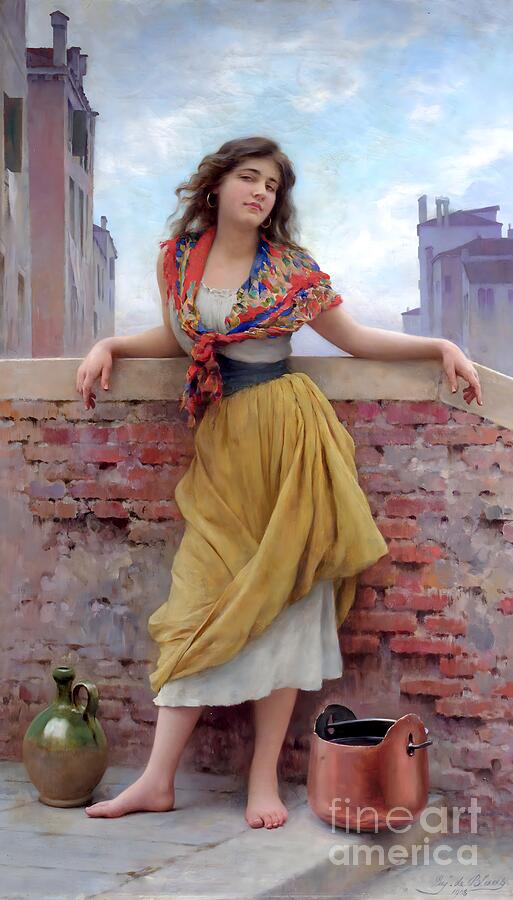
A barefoot girl leans back against a sun-warmed brick parapet, her elbows resting on the stone, a bright flowered shawl knotted over her shoulders. Beside her stand a copper bucket and a green glazed jug; behind her rise the tall, faded houses of Venice. She looks straight at us with a half-smile, as if we had interrupted her on the way to the well. This is the world of Eugene de Blaas (1843–1931), the painter who turned the everyday life of Venice into an elegant, irresistible dream for collectors across Europe.
🖼️ Get this painting as a print →
Artist: Eugene de Blaas (Eugen von Blaas, 1843–1931)
Born: 24 July 1843, Albano, near Rome
Teacher: his father, the Tyrolean painter Karl von Blaas
Based in: Venice
Known for: Venetian genre scenes, portraits of young Venetian women, society portraits
Exhibited: Royal Academy, Fine Art Society, New Gallery and Arthur Tooth & Sons in London; Walker Art Gallery, Liverpool
A family of painters
Eugene de Blaas was born in 1843 in Albano, in the hills south of Rome, to a Tyrolean father and a Roman mother. His father, Karl von Blaas, was a respected academic painter of history and religious subjects, and he was also his son’s first and most important teacher. Eugene’s younger brother, Julius von Blaas, also became a painter, best known for horses and military scenes. The family later moved to Venice when Karl was appointed professor at the city’s Academy of Fine Arts, and Eugene stayed there for the rest of his long life.
His name appears in several forms: Eugen von Blaas in German, Eugenio de Blaas in Italian, and Eugene de Blaas in the English-speaking market where most of his pictures were sold. It is a fitting confusion for an artist who stood between cultures, trained in the Central European academic tradition and devoted to an Italian city.
Venice as a stage
Blaas painted portraits and religious works, but he found his real subject in the streets, canals and courtyards of Venice. He painted young women carrying water, gossiping on bridges, talking with fishermen and gondoliers, or resting on balconies above the water. Titles such as On the Balcony (1877), The Sisters (1878) and A Young Beauty (1882) give an idea of his repertoire.
These are not documentary scenes. The young working women of Blaas’s Venice are always healthy and beautifully dressed, their skin glowing, their clothes freshly washed. The city around them is picturesque but never squalid. In The Water Carrier, the worn bricks, the copper pail and the bare feet tell us that this is working life, but the pose, the confident gaze and the carefully arranged colours, yellow, red and blue against the faded red brick, belong to the theatre. Blaas was selling a mood: the Venice that travellers hoped to find.
A painter for the international market
Venice in the late nineteenth century was full of foreign visitors, and many of them wanted to take a piece of the city home. Blaas understood this market perfectly. He exhibited regularly in London, at the Royal Academy, the Fine Art Society, the New Gallery and the gallery of the dealers Arthur Tooth & Sons, as well as at the Walker Art Gallery in Liverpool, and his paintings found buyers abroad as well as among Venetian aristocrats. He also made more intimate pastels and etchings of modern Venice.
His smooth, highly finished technique places him in the tradition of academic realism, alongside painters such as Pierre-Auguste Cot in Paris or Raimundo de Madrazo, whose After the Bath hangs in the Prado. Like them, he painted fabric and skin with an almost photographic polish, and like them he was dismissed by the modernists of the twentieth century as a painter of sweet, commercial pictures.
Why his women still fascinate
And yet Blaas’s paintings have never lost their public. Today they are highly sought after at auction, and his young Venetians are reproduced everywhere. Part of the appeal is technical: the light on a cheek, the transparency of a sleeve, the play of colour in a shawl. Part of it is the directness of his models. They rarely look down or away. They meet our eyes with amusement, curiosity or a touch of defiance, and that frank gaze gives his pictures a life that goes beyond the postcard view of Venice.
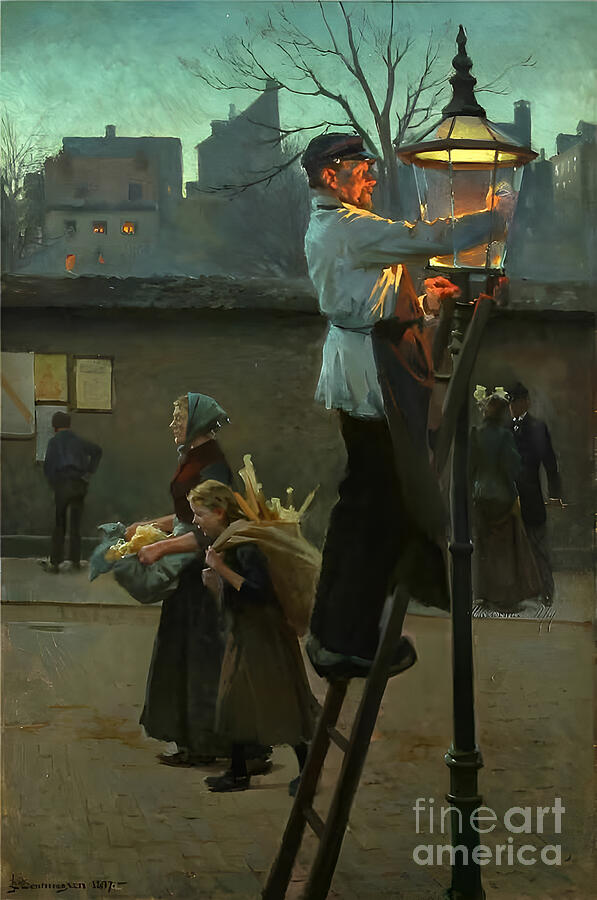
Compare the very different street life painted by the Danish artist Erik Henningsen in The Lamplighter, or the Roman tavern scene of Carl Bloch’s In a Roman Osteria, where a young woman again looks out of the picture straight at the viewer.
See Eugene de Blaas’s The Water Carrier framed on your wall: a museum-quality print, canvas or poster from the Sapiens Verbum print shop.
 Choose your size and frame →
Printed and shipped by Fine Art America · 30-day money-back guarantee
Where can you see his work?
Most of Blaas’s paintings were sold to private collectors and remain in private hands, which is why they appear far more often at auction than in museums. One of his works belongs to the Wien Museum in Vienna. For more nineteenth-century genre painting, browse by period in Explore Art, or see the twelve best-selling art prints chosen by our readers.
Watch the video essay on @SapiensVerbum on YouTube.
Sources
Wikipedia, “Eugen von Blaas” and “Karl von Blaas”.
Comments
Post a Comment