
William-Adolphe Bouguereau: Every Painting We've Explained
Artist guide · William-Adolphe Bouguereau
William-Adolphe Bouguereau: Every Painting We’ve Explained
The most celebrated Salon painter of nineteenth-century France, adored by collectors on both sides of the Atlantic and despised by the Impressionists. Here is who Bouguereau was, how to recognise his hand, every painting of his we have written about, and where you can stand in front of the originals, from the Musée d’Orsay to the hills of Massachusetts.

Who was Bouguereau?
William-Adolphe Bouguereau was born in La Rochelle, on the Atlantic coast of France, on 30 November 1825, into a family of wine and olive-oil merchants. As a boy he was sent to stay with his uncle, a priest, in Mortagne-sur-Gironde, where he discovered literature, religion and the countryside. He showed his talent early: to pay for his move to Paris he painted thirty-three portraits in three months, and in March 1846, aged twenty, he arrived in the capital.
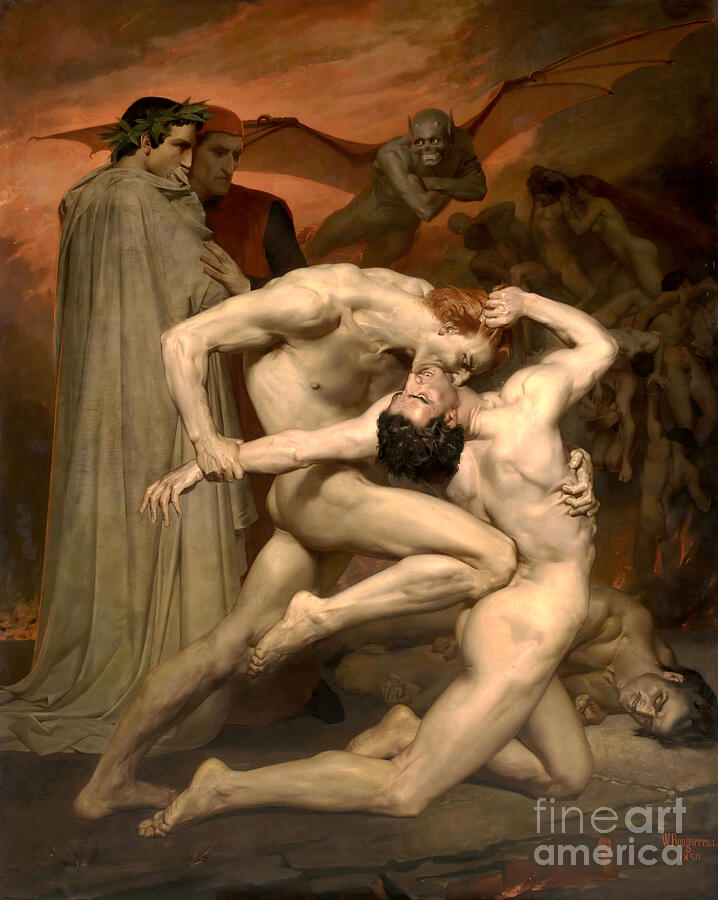
At the École des Beaux-Arts he trained in the studio of François-Édouard Picot, attended anatomical dissections and studied ancient costume and archaeology. His early ambition was history painting, the most prestigious genre of the academic system; Dante and Virgil (1850), a scene of savage violence from Dante’s Inferno, belongs to these years. In 1850, at his third attempt, he won a joint first place in the Prix de Rome, which took him to the Villa Medici in Rome from 1851 to 1854. There he studied Greek sculpture, Raphael and the Renaissance masters, and read the classical authors who would supply his subjects for the rest of his life.
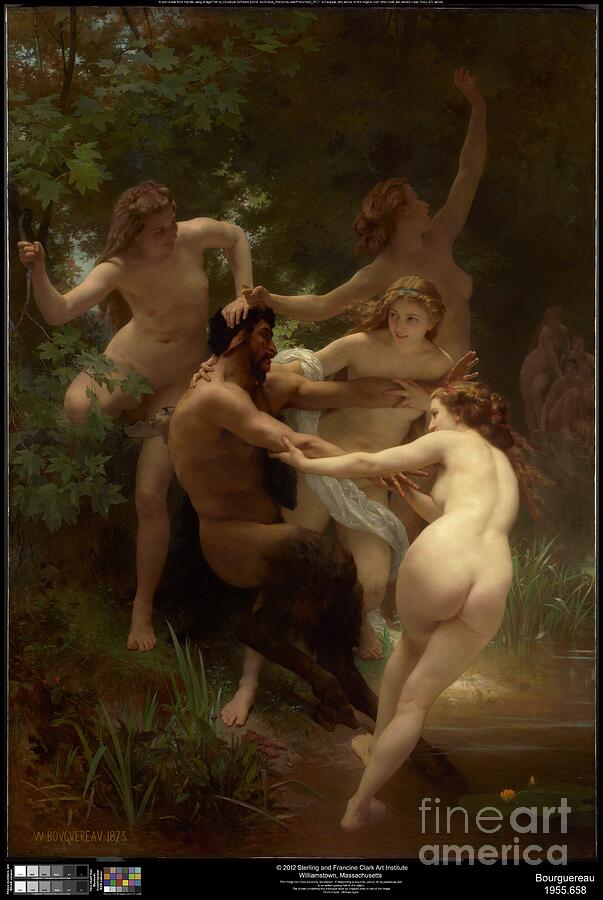
Back in France he exhibited at the Paris Salon every year of his working life. He received the Legion of Honour in 1859, and gradually turned from vast official commissions to mythological and religious scenes, nudes and idealised peasant girls, which sold for high prices to collectors in Paris and, increasingly, in the United States. Nymphs and Satyr was the sensation of the Salon of 1873 and went straight to a New York collector. He taught for decades at the Académie Julian, which welcomed foreign students and, unusually for the time, women, and he received the Salon’s Grand Medal of Honour in 1885.
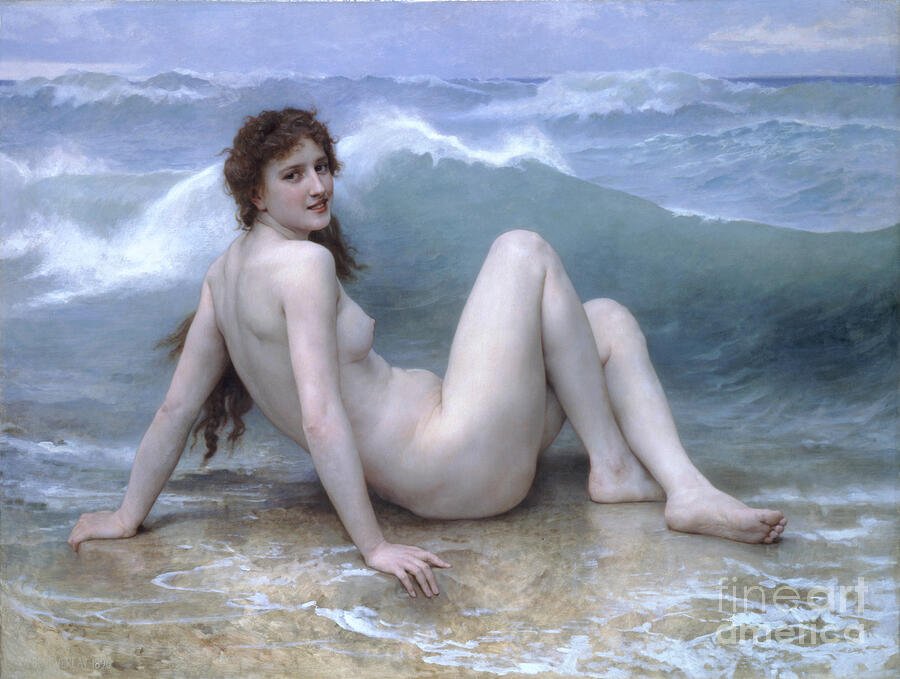
He married Nelly Monchablon in 1866; she died in 1877. In 1896 he married his former pupil, the American painter Elizabeth Jane Gardner, the year he painted The Wave. He died in La Rochelle on 19 August 1905. Some 822 paintings by him are known, but the whereabouts of many are unknown.
His reputation fell as quickly as it had risen. To the Impressionists and the critics who championed modern art, Bouguereau stood for everything stale and commercial about the Salon, and for much of the twentieth century his pictures were hidden in museum storerooms. A revival of interest in figure painting in the 1980s brought him back into view, and today his best works are once again among the most visited pictures in their museums.
How to recognise a Bouguereau
- Porcelain skin. The surface is so smooth that no brushstroke is visible; flesh glows with soft pinks and creamy whites, modelled with total control of anatomy.
- Classical subjects, living bodies. Nymphs, Venus, the Furies, Dante’s damned: ancient and literary stories told through idealised figures that seem to breathe.
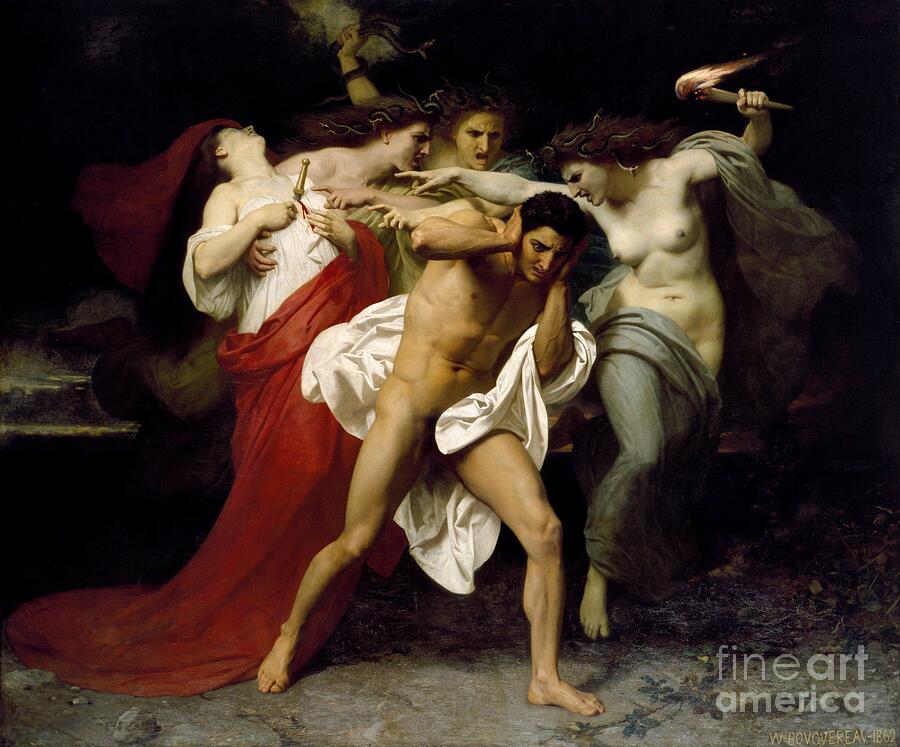
- Compositions in a circle or a spiral. Groups of figures turn around a centre, as in the ring of nymphs around the satyr or the Furies around Orestes.
- A direct gaze. Many of his figures look straight out at the viewer, which makes even his mythological scenes feel strangely present.
Bouguereau painted in the same decades as Manet and Monet, but in the opposite spirit: where they made the brushstroke visible, he hid it completely. To see the contrast for yourself, compare his work with the Impressionist rooms upstairs in the Musée d’Orsay, or with Cabanel’s Birth of Venus, the other great Salon nude of the period.
Every Bouguereau painting we’ve explained
All Bouguereau essays →-
 1
1Dante and Virgil (1850)
Musée d’Orsay, Paris
Two damned souls tear at each other in the eighth circle of Hell while Dante and Virgil look on. The twenty-four-year-old Bouguereau showed he could paint violence as well as grace.
-
 2
2Orestes Pursued by the Furies (1862)
Chrysler Museum of Art, Norfolk, Virginia
Orestes covers his ears as the Furies close in, holding up the body of the mother he has killed. A Greek tragedy compressed into a single instant of panic.
-
 3
3Nymphs and Satyr (1873)
Clark Art Institute, Williamstown, Massachusetts
Four laughing nymphs drag a reluctant satyr towards a forest pool. The hit of the 1873 Salon spent years over a hotel bar in Manhattan, then decades in storage.
-
 4
4The Wave (1896)
Private collection
A young woman sits at the edge of the sea and looks back at us, smiling, as a green wave rises behind her: the most polished figure set against the one thing that cannot be polished.
Where to see Bouguereau
Musée d’Orsay (Paris)
Esplanade Valéry Giscard d’Estaing, 75007 Paris · Dante and Virgil, The Birth of Venus and other Salon paintings. Read our Paris museum guide.
Clark Art Institute (Williamstown, Massachusetts)
225 South Street, Williamstown · Nymphs and Satyr. Open Tuesday to Sunday, 10 a.m. to 5 p.m. (daily in July and August).
Chrysler Museum of Art (Norfolk, Virginia)
One Memorial Place, Norfolk · Orestes Pursued by the Furies.
Watch: Bouguereau on our YouTube channel
The newsletter behind the paintings
New essays and the stories behind them, straight to your inbox. Or browse every painting by artist, period, theme and museum.
Some links are affiliate links; we may earn a commission at no extra cost to you.
Sources: Wikipedia, “William-Adolphe Bouguereau”; Montreal Museum of Fine Arts (self-portrait, 1984.16, via Wikimedia Commons); Clark Art Institute and Chrysler Museum of Art official websites.
Comments
Post a Comment