
Francisco Goya: Every Painting We've Explained
Artist guide · Francisco Goya
Francisco Goya: Every Painting We’ve Explained
Painter to the Spanish court, witness to a war and, in the end, a deaf old man painting nightmares on the walls of his own house. Here is who Goya was, how to recognise his hand, every painting of his we have written about, and where you can stand in front of the originals in Madrid.

Who was Goya?
Francisco José de Goya y Lucientes was born on 30 March 1746 in Fuendetodos, a village in Aragon. At fourteen he began training in Zaragoza under José Luzán, copying prints. He failed twice to win a place at the Royal Academy of San Fernando in Madrid, in 1763 and 1766, studied with Francisco Bayeu and in 1773 married Bayeu’s sister, Josefa.
His career in Madrid began with designs for the Royal Tapestry Factory: some forty-two cartoons of picnics, games and fairs from around 1777. Royal favour followed. He became a salaried painter to Charles III in 1786 and court painter to Charles IV in 1789, and in 1799 received the title of First Court Painter. Between late 1792 and early 1793 an undiagnosed illness left him permanently deaf. In 1799 he published Los Caprichos, eighty satirical prints, and around 1800 he painted Charles IV and His Family.
The French invasion of 1808 and the war that followed changed his art. In 1814 he painted The Second of May and The Third of May 1808, and in the same years made the etchings later known as The Disasters of War, published only in 1863. From the late 1810s he lived in a house outside Madrid, the Quinta del Sordo, and between 1819 and 1823 covered its walls with the Black Paintings. In 1824 he left for Bordeaux, where he died on 16 April 1828, aged eighty-two. In 1919 his remains were brought back to Madrid and buried in San Antonio de la Florida.
How to recognise a Goya
- Faces that tell the truth. Even in royal portraits Goya refuses to flatter. Kings, queens and courtiers look exactly as heavy, bored or anxious as they probably were.
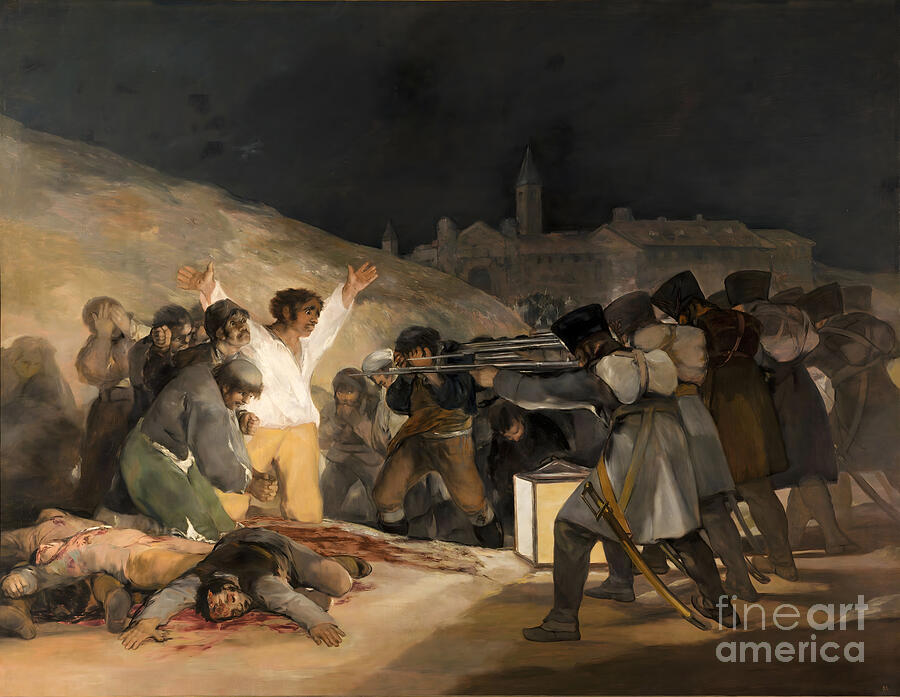
- Light as an accusation. In The Third of May a single lantern lights the victim and leaves the soldiers as a dark row of backs. Goya uses light to choose sides.
- Fast, rough brushwork. Especially in the late work, paint is dragged, scraped and smeared. The Black Paintings were laid straight onto plaster walls, and you can feel the speed.
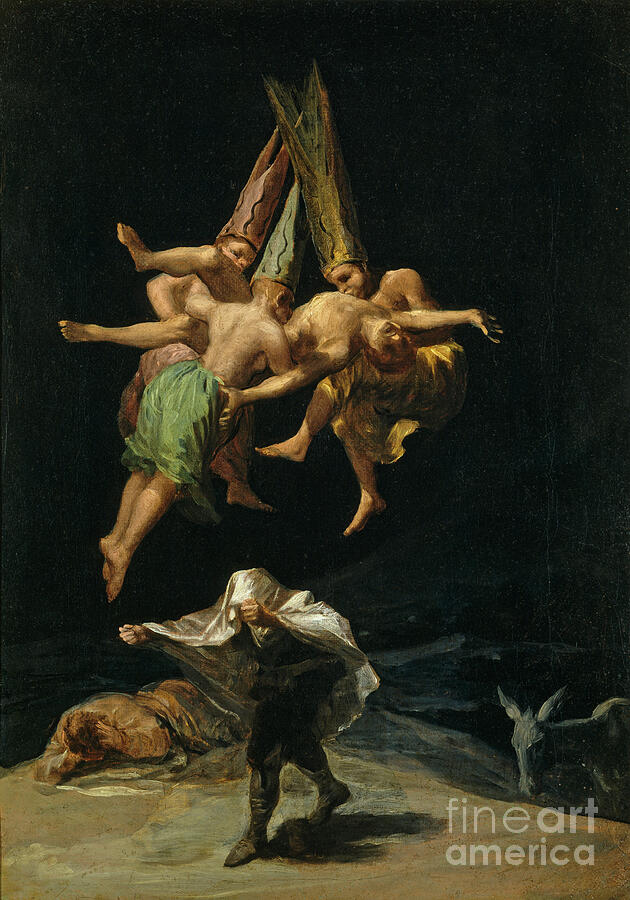
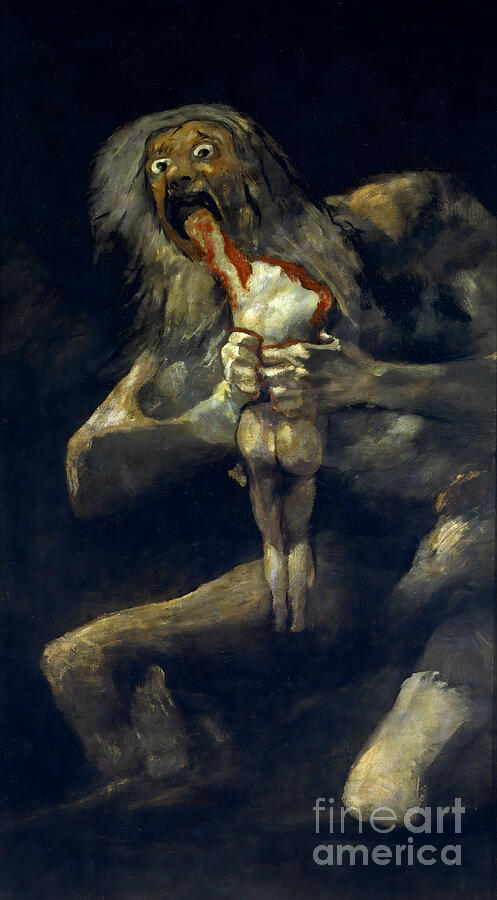
- Monsters, witches and crowds. From the Caprichos to Witches’ Flight and Saturn, Goya keeps returning to superstition, violence and the dark side of the mind.
Later painters took a great deal from him, from Manet’s execution pictures to the Expressionists. For another painter of shipwreck, horror and human suffering, read our essay on Géricault’s Raft of the Medusa.
Every Goya painting we’ve explained
All Goya essays →-
 1
1The Third of May 1808 (1814)
Museo del Prado, Madrid
A firing squad with no faces, a man in a white shirt with his arms flung wide, and a war painting that the king it was made for chose not to show.
-
 2
2Witches’ Flight (c. 1798)
Museo del Prado, Madrid
Painted for the Duke and Duchess of Osuna: witches in Inquisition-style hats carry a man into the night sky, while superstition and the Enlightenment fight below.
-
 3
3Saturn Devouring His Son (c. 1820–1823)
Museo del Prado, Madrid
The Titan who ate his children, painted on the wall of Goya’s own house and never meant for the public: the myth, and what the image may mean.
-
 4
4The Quinta del Sordo: the Black Paintings (1819–1823)
Museo del Prado, Madrid
Fourteen dark scenes painted straight onto the plaster of the house outside Madrid where an old, deaf Goya lived, later taken off the walls and moved to the Prado.
Where to see Goya
Museo del Prado (Madrid)
Paseo del Prado, Madrid · the largest collection of Goya in the world: The Third of May 1808 and The Second of May, Witches’ Flight, Charles IV and His Family, the two Majas and the whole room of Black Paintings, Saturn among them. Read our Madrid guide for the other masterpieces nearby.
Real Ermita de San Antonio de la Florida (Madrid)
Glorieta de San Antonio de la Florida, 5, Madrid · the small chapel whose dome and vaults Goya covered with frescoes of the miracles of Saint Anthony of Padua in 1798, on a royal commission. His remains were moved here from Bordeaux and reburied in front of the altar in 1919. Free entry.
Watch: Goya on our YouTube channel
The newsletter behind the paintings
New essays and the stories behind them, straight to your inbox. Or browse every painting by artist, period, theme and museum.
Some links are affiliate links; we may earn a commission at no extra cost to you.
Sources: Wikipedia, “Francisco Goya”; Fundación Goya en Aragón (San Antonio de la Florida); esMadrid; the museum records cited in each essay; official website of the Museo del Prado.
Comments
Post a Comment