
The Virgin of the Rocks by Leonardo da Vinci: One Grotto, Two Paintings, as a Vintage Poster (1483–86)
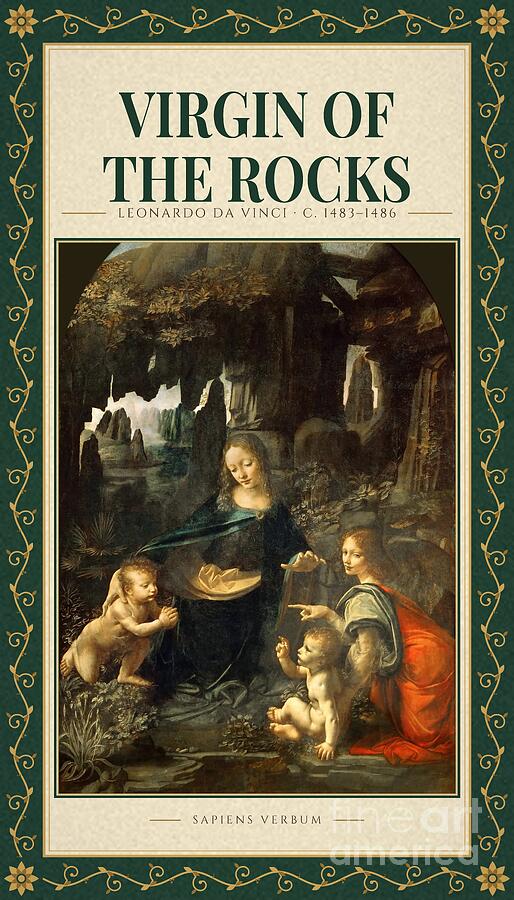
In a dark grotto of jagged rock, a young woman kneels with one hand on the shoulder of a small boy and the other held open above a second child. An angel in a red cloak points across the scene, water glints in the distance, and wild flowers grow out of the stone. The Virgin of the Rocks is one of Leonardo da Vinci’s most mysterious paintings, and he painted it twice: the first version hangs in the Louvre in Paris, the second in the National Gallery in London. The picture below is our vintage poster of the Paris painting; a detail of the London version is shown further down.
🖼️ Get the vintage poster →License this image →
Artist: Leonardo da Vinci (1452–1519)
Title: The Virgin of the Rocks (La Vergine delle rocce)
Paris version: 1483–86, oil on panel transferred to canvas, 199 × 122 cm, Musée du Louvre
London version: about 1491/2–99 and 1506–08, oil on poplar, 189.5 × 120 cm, National Gallery, London (NG1093)
Commission: 1483, for the chapel of the Confraternity of the Immaculate Conception in San Francesco Grande, Milan
Figures: The Virgin, the infant Christ, the infant Saint John the Baptist and an angel
A commission in Milan
In 1483, soon after he moved from Florence to Milan, Leonardo and his associates were commissioned to paint the pictures for a large, partly sculpted altarpiece in the church of San Francesco Grande. The chapel belonged to a confraternity devoted to the Immaculate Conception of the Virgin Mary, and Leonardo’s painting was to be placed directly beneath a sculpture of the Virgin, with two panels of angels playing music on either side. The subject he chose is not in the Gospels: the meeting of the infant Christ and his cousin, the infant Saint John the Baptist, on the Holy Family’s journey, watched over by Mary and an angel.
A grotto of shadow
Leonardo sets the scene in a cave of fantastic rocks, open to a distant landscape of water and peaks. The figures form a pyramid, with the Virgin’s head at the top. On the left, Saint John kneels with his hands joined in prayer; on the right, the Christ Child raises two fingers to bless him. Mary reaches out a protective hand, and the angel looks out at us while pointing at John. The faces and bodies seem to emerge from the darkness, their edges softly blurred, an early masterpiece of the shading the Italians call sfumato. The plants at their feet are painted with a botanist’s precision.
Why are there two?
The complete history of the two paintings is not known, which has kept historians arguing for a long time. The explanation the National Gallery gives is that Leonardo sold the first picture, now in the Louvre, because the confraternity refused to pay him enough for it, and later painted the London version to replace it. The two are almost identical, but the differences are telling. In London the angel no longer points, the colours are cooler, the figures have haloes and Saint John holds a slender reed cross. The London painting was restored between 2008 and 2010, and its conservators concluded that most of it is by Leonardo’s own hand, although debate continues about how much his assistants contributed.
Why it works as a vintage poster
The Sapiens Verbum poster keeps the Paris painting intact and frames it in cream and dark green with gold scrolls, under a bold title. The dark grotto and the pale faces read clearly from across a room, and the poster suits a study, a library or a quiet corner for prayer. For another Madonna with a hidden meaning, read The Madonna of the Pinks by Raphael, painted by a young artist who studied Leonardo closely; for Leonardo’s later Holy Family, see The Virgin and Child with Saint Anne; and for more sacred art, browse our Sacred Art: Paintings and Vintage Posters page.
Hang Leonardo’s Virgin of the Rocks — the grotto, the pointing angel and the light emerging from the dark — as a vintage art poster from the Sapiens Verbum print shop.
 Choose your size and frame →
See the religious vintage poster collection →License this image →
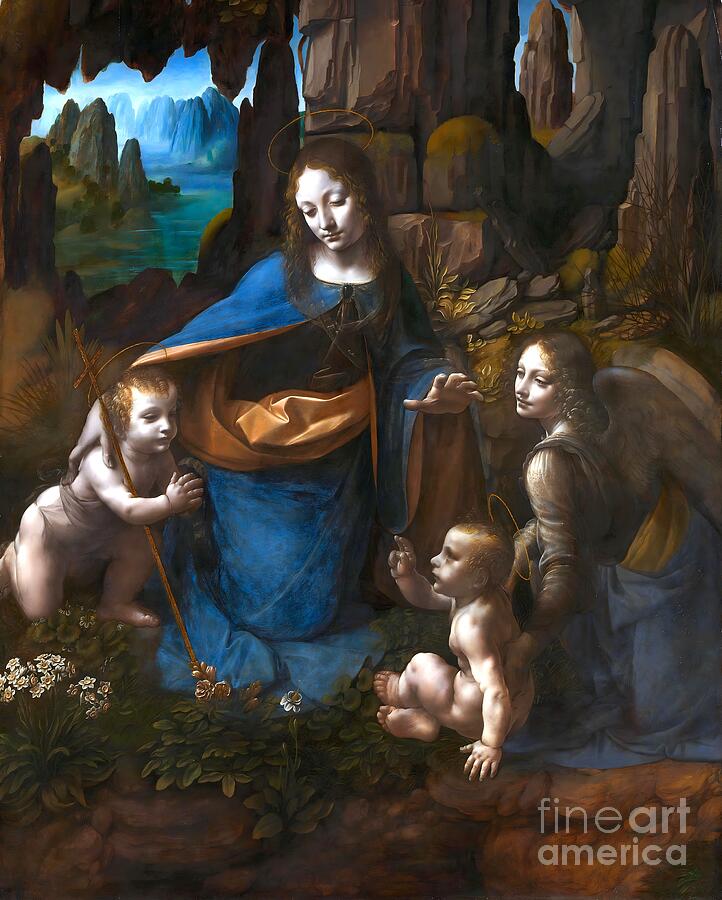
Hang the London Virgin of the Rocks as Leonardo painted it, as a print, canvas or framed print from the Sapiens Verbum print shop.
 Choose your size and frame →Raphael’s Madonna of the Pinks as a poster →
Printed and shipped by Fine Art America · 30-day money-back guarantee
💬 Over to you: Paris or London: which Virgin of the Rocks moves you more, the one with the pointing angel or the one with the haloes? And where in the world are you reading from? Tell us in the comments.
Comments
Post a Comment