

Praying Hands by Albrecht Dürer: The World's Most Famous Image of Prayer, as a Vintage Poster (1508)
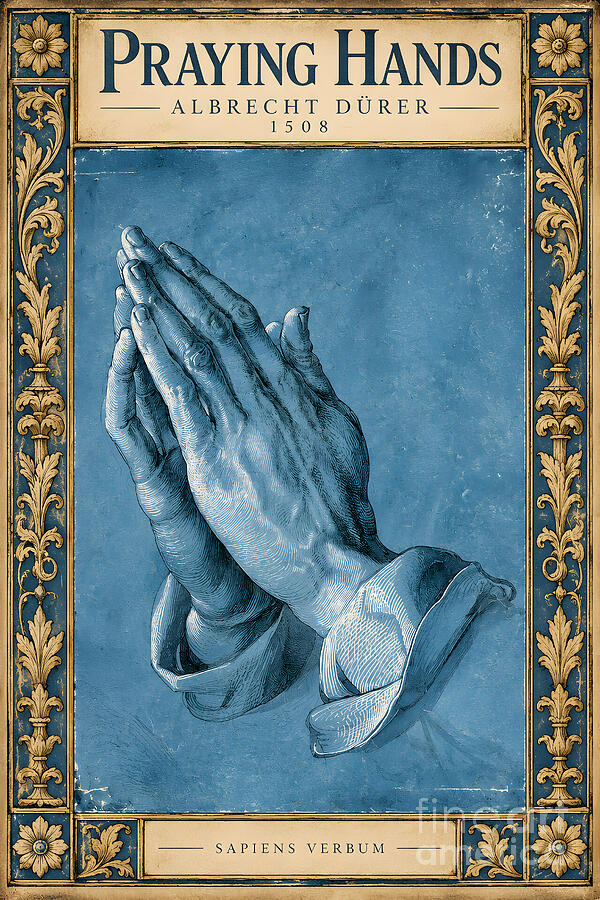
Two hands, pressed together, fingertips pointing upwards, sleeves rolled back. No face, no saint, no setting: just the gesture of prayer. Albrecht Dürer drew Praying Hands in 1508 as a working study for an altarpiece, and it has become the most widely reproduced image of prayer in the Western world, found on cards, posters, mugs and even on Andy Warhol’s tombstone. The picture below is our vintage poster of the drawing; the original is shown further down.
🖼️ Get the vintage poster →License this image →
Artist: Albrecht Dürer (1471–1528), German painter and printmaker
Title: Betende Hände (Praying Hands), also called Study of the Hands of an Apostle
Date: 1508
Medium: Brush and ink with white heightening on blue-prepared paper, 29.1 × 19.7 cm
Location: Albertina, Vienna (inv. 3113)
Purpose: Study for an apostle in the central panel of the Heller Altarpiece, destroyed by fire in 1729
A study for a lost altarpiece
In 1507 the Frankfurt cloth merchant Jakob Heller commissioned an altarpiece for the Dominican church in Frankfurt, and Dürer painted its central panel. Its subject was the Assumption and Coronation of the Virgin, with the apostles gathered around her empty tomb. To prepare it, Dürer made a series of drawings of heads, drapery and hands. Praying Hands is one of them: the hands of an apostle who kneels at the right-hand edge of the scene. In 1615 that panel was sold to Maximilian I of Bavaria, and it was destroyed in a fire in Munich in 1729. Today it is known through a copy painted by Jobst Harrich in 1615, now in Frankfurt, and through Dürer’s preparatory drawings, which have outlived the painting they were made for.
Light drawn on blue paper
Dürer worked on paper he had coated with a blue ground, drawing the forms in grey and black with the tip of a brush and then building the light with white. The result looks almost like sculpture. You can follow every crease of the knuckles, the tendons on the back of the hand, the slight gap between the palms and the folds of the rolled-up sleeves. The hands are not idealised: they are thin, bony and real. Originally the sheet also included a study of the apostle’s head; the two parts were later separated.
Whose hands are they?
A popular modern story claims that the hands belonged to Dürer’s brother, who supposedly worked in the mines to pay for Albrecht’s training. It is a moving tale, but it is a legend rather than history. One reconstruction suggests that Dürer studied his own left hand with the help of mirrors to obtain the pair of hands and the angle he needed. What is certain is that the drawing was first shown to the public in Vienna in 1871, and from then on it began its second life as a universal symbol of prayer, faith and gratitude.
Why it works as a vintage poster
The Sapiens Verbum poster keeps Dürer’s blue paper and white light and sets them inside a frame of gold scrolls and flowers, with the title above. It suits a bedroom, a study or a quiet corner for prayer, and makes a meaningful gift for a first communion, a confirmation, an ordination or a loved one going through a difficult time. For another Dürer masterpiece, read Dürer’s Self-Portrait of 1500; for more sacred art, browse our Sacred Art: Paintings and Vintage Posters page; and for the oldest icon of Christ, see Christ Pantocrator of Sinai.
Hang Dürer’s Praying Hands — the blue paper, the white light and a frame of gold — as a vintage art poster from the Sapiens Verbum print shop.
 Choose your size and frame →
See the religious vintage poster collection →License this image →
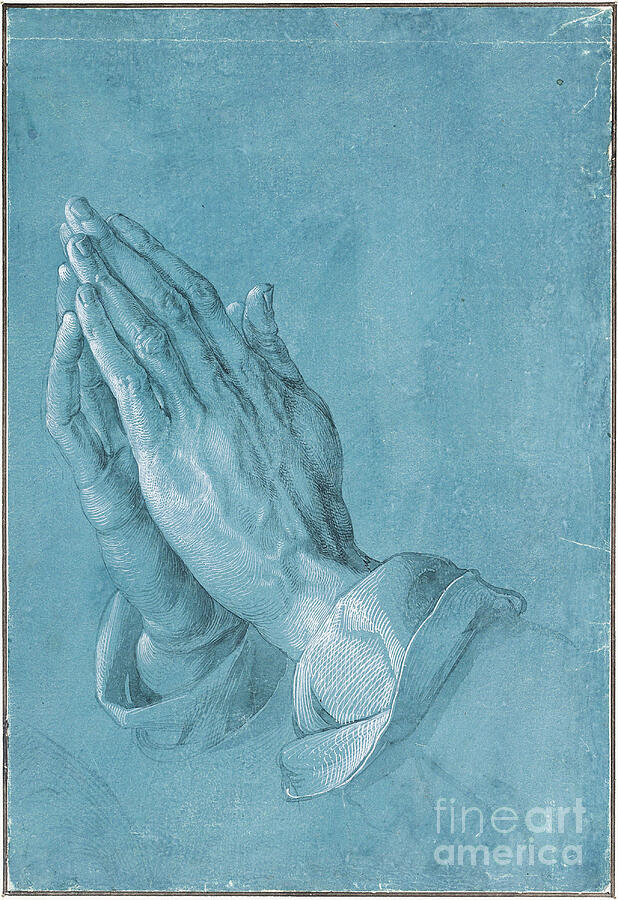
Hang Dürer’s study as he drew it, every crease and highlight in place, as a print, canvas or framed print from the Sapiens Verbum print shop.
 Choose your size and frame →Dürer’s Christ among the Doctors as a poster →
Printed and shipped by Fine Art America · 30-day money-back guarantee
💬 Over to you: Does this drawing hang in your home or did it hang in your grandparents’ house? And where in the world are you reading from? Tell us in the comments.
Comments
Post a Comment