
Christ Pantocrator of Sinai: The Oldest Icon of Christ, as a Vintage Poster (6th Century)
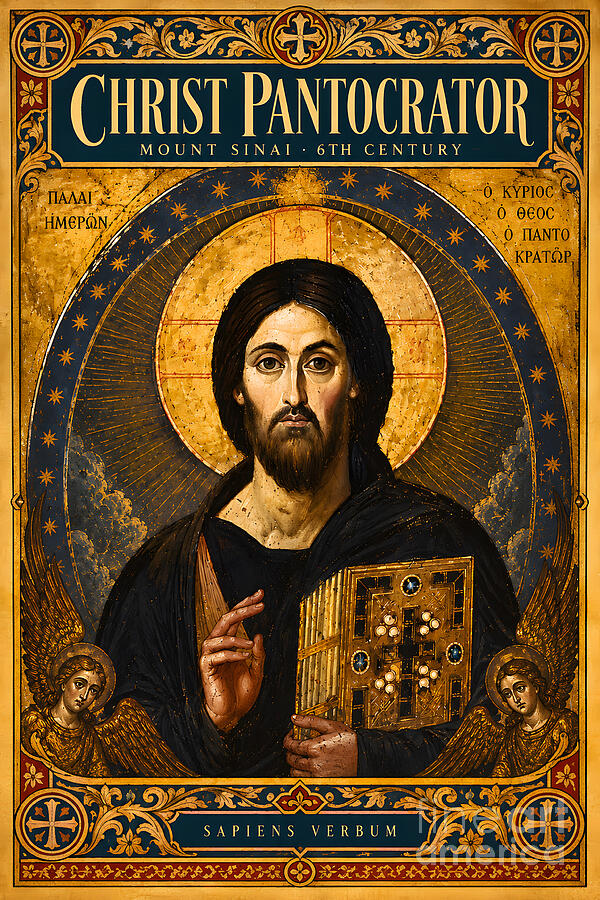
A calm face, two slightly different eyes, a hand raised in blessing and a heavy Gospel book held against the chest. The Christ Pantocrator of Saint Catherine’s Monastery on Mount Sinai, painted in the sixth century, is one of the oldest surviving icons in the world and the earliest known image of Christ as Pantocrator, “ruler of all”. For almost fifteen hundred years it has been kept in a desert monastery at the foot of the mountain where, according to tradition, Moses received the Law. The picture below is our vintage poster inspired by the icon; a wide version is shown further down.
🖼️ Get the vintage poster →License this image →
Artist: Unknown Byzantine painter, probably working in Constantinople
Title: Christ Pantocrator (“Christ, Ruler of All”)
Date: About the mid-6th century
Medium: Encaustic (hot coloured wax) on wood, 84 × 45.5 cm
Location: Saint Catherine’s Monastery, Mount Sinai, Egypt
Subject: Christ blessing with his right hand and holding the Gospel book in his left
The oldest Pantocrator we know
Saint Catherine’s Monastery was founded by the Byzantine emperor Justinian I late in his reign, between 548 and 565, and it received rich gifts from the imperial court. The Christ Pantocrator is thought to have been one of them, and for that reason scholars generally believe it was painted in Constantinople. For centuries nobody knew how old it was: the icon had been almost entirely painted over, and it was taken for a thirteenth-century work. Only in 1962, when the later overpainting was removed, did the sixth-century original reappear. Apart from a damaged area on the left side of Christ’s head and a few small repairs, its surface is in remarkably good condition.
Painted in hot wax
The icon was made in encaustic, a technique in which pigments are mixed with melted wax and applied while warm. It gives the face its soft, glowing modelling, with fine white highlights and deep shadows. Encaustic became rare in the Byzantine world after the period of Iconoclasm in the eighth and ninth centuries, and Sinai is the only place where a substantial number of early encaustic icons survive. The panel has been cut down at the top and along the sides, which is why Christ sits slightly off-centre, close to us, almost life-size.
Two sides of one face
Look closely at the face. At first it seems perfectly frontal and still, but the symmetry is carefully avoided. The eyebrows are drawn differently, the eyes look slightly different, and the hair and beard do not mirror each other. The art historian Kurt Weitzmann read the frontal pose as an image of Christ’s divinity and the small asymmetries as signs of his living, human nature, the two natures defined by the Church councils of the fifth century. Whatever one’s reading, the effect is unforgettable: a face that is serene and alive at the same time.
Saved by the desert
From 726 onwards, waves of Byzantine Iconoclasm led to the destruction of countless religious images in Constantinople. By then Sinai had been under Muslim rule for nearly a century, cut off from the imperial capital, and the monastery’s icons escaped. That isolation is why one of the very first images of Christ as ruler of the universe is still in its original home today.
Why it works as a vintage poster
The Sapiens Verbum poster reimagines the icon with a gold halo, a starry blue mandorla, two small angels and a richly decorated frame, while keeping the face, the blessing hand and the jewelled Gospel book at its heart. It is a natural choice for a prayer corner, a study or a church hall, and a meaningful gift for a baptism, an ordination or anyone who loves Byzantine art. For another early image of Christ’s face, see Head of Christ by Correggio; for more sacred art, browse our Sacred Art: Paintings and Vintage Posters page; and for Christ in triumph, read Resurrection of Christ by Carl Bloch.
Hang the Christ Pantocrator of Sinai — the blessing hand, the Gospel book and the gold of Byzantium — as a vintage art poster from the Sapiens Verbum print shop.
 Choose your size and frame →
See the religious vintage poster collection →License this image →
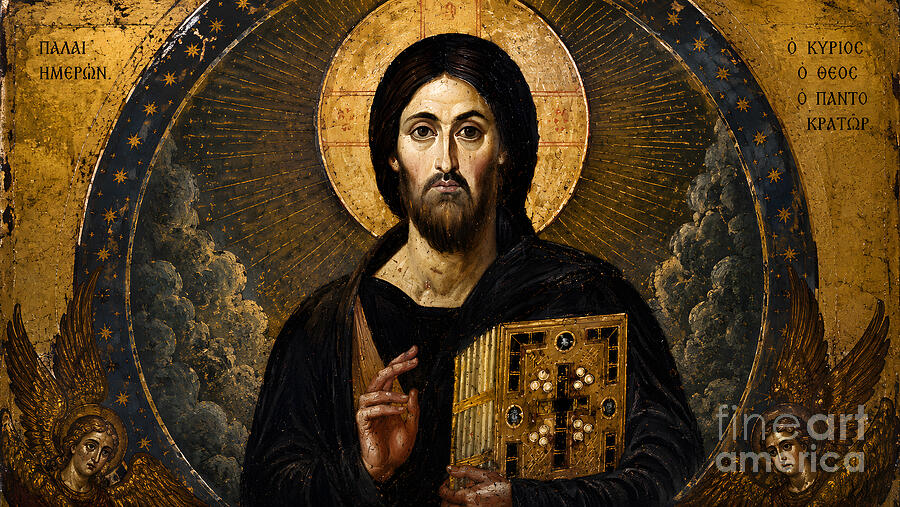
Hang the Pantocrator in a panoramic format, ideal above a sofa, a desk or a bed, as a print, canvas or framed print from the Sapiens Verbum print shop.
Choose your size and frame →Bloch’s Resurrection of Christ as a poster →
Printed and shipped by Fine Art America · 30-day money-back guarantee
💬 Over to you: Can you see the difference between the two eyes? And where in the world are you reading from? Tell us in the comments.
Comments
Post a Comment