The Swing by Jean-Honore Fragonard: The Garden That Kept a Secret (1767)
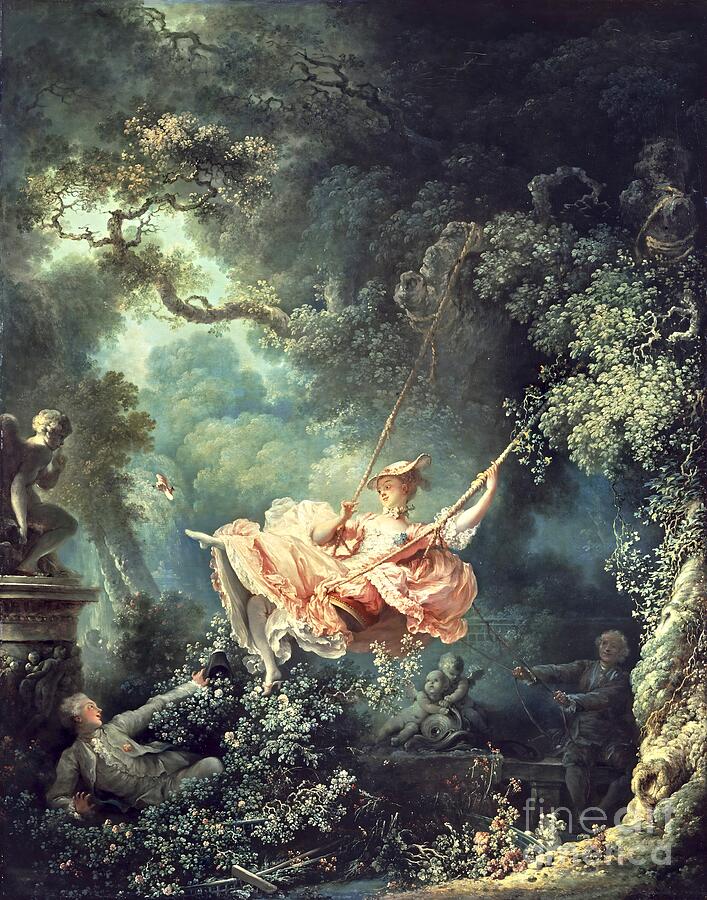
A pink shoe leaves her foot and does not come back. In Jean-Honoré Fragonard’s The Swing — painted about 1767–68 and catalogued at the Wallace Collection as Les hasards heureux de l’escarpolette — a young woman in rose silk flies through a dark garden while one man pulls the ropes and another waits in the bushes. The picture is small, 81 × 64.2 cm, and it has done more work for the idea of the French eighteenth century than canvases ten times its size.
Artist: Jean-Honoré Fragonard (1732–1806), born in Grasse
Date: c. 1767–1768
Medium: Oil on canvas, 81 × 64.2 cm
Collection: Wallace Collection, London (P430); displayed in The Study at Hertford House
Notable fact: The first painter asked to make it refused; Fragonard took the job and left the bishop out
The commission Doyen refused
In October 1767 the playwright Charles Collé wrote down what the history painter Gabriel-François Doyen had just told him. A “gentleman of the Court” had received Doyen in a petite maison with his mistress present. He wanted Madame painted on a swing, pushed by a bishop, and himself placed so that he could see her legs — “and better still, if you want to enliven your picture a little more.” Doyen, fresh from a religious success at the Salon of 1767, refused and sent the patron to Fragonard. Collé notes that Fragonard was already at work.
Collé never names the gentleman. Later writers have often identified him as the tax farmer François-David Bollioud de Saint-Julien; the Wallace Collection and later catalogues treat that identification as a long-standing assumption with thin proof. What the diary does fix is the brief: a private erotic joke, first offered to a painter of saints.
What the garden is doing
Fragonard does not give you a park you could walk. He gives you a thicket. The trees close over the swing like a theatre curtain; the light hits the dress and almost nothing else. A stone Cupid, of the type of Étienne-Maurice Falconet’s L’Amour menaçant, holds a finger to his lips above the young man in the bushes. Two more putti sit to the right of the older figure who works the ropes. A small dog has been added to the finished picture — a detail Collé’s brief did not mention.
The garden is not scenery. It is the condition that makes the joke possible: enough shadow for one spectator, enough leaf for the other, and a single shaft of light for the woman who is, for a second, out of both their hands.
Two men and a flying shoe
The Wallace Collection reads the pair as an elderly husband or official lover on the right and a younger lover on the left. The older man is not a bishop. Fragonard kept the ropes and dropped the cassock. The younger man, half-hidden, looks straight up as the pink slipper leaves her foot. The museum notes that his raised hat does some of the talking the brief had assigned to a more explicit “enlivening.”
That flying shoe is the painting’s punchline and its clock. Rococo pictures are often accused of having no time in them. This one has a fraction of a second. She is neither going up nor coming down; she is at the top of the arc, and the shoe has already decided to leave.
From a petite maison to Manchester Square
Firm ownership starts late. The canvas is recorded with the financier Marie-François Ménage de Pressigny, guillotined in 1794; the revolutionary government seized it. It later passed, by a route that includes the Duc de Morny, to Richard Seymour-Conway, 4th Marquess of Hertford, who bought it at auction in Paris in 1865. Lady Wallace bequeathed it to the nation in 1897. It hangs in The Study at Hertford House, Manchester Square.
An engraving of 1782 published the composition under its French title, Les hasards heureux de l’escarpolette — the happy accidents of the swing. In 2021 the Wallace Collection cleaned yellowed varnish and old retouches. The lace went sharp again; the depth of the trees came back. Fragonard, the conservators noted, seems to have worked on the canvas with little underdrawing: the garden was invented in paint.
Why the pink still works
Enlightenment critics wanted art that improved the viewer. The Swing does not improve anyone. It records a private arrangement with more honesty than a history painting of the same year would have managed, and it does so without naming the people. That is why it survived the joke that paid for it. The bishop was never painted. The gentleman of the Court was never securely identified. The woman still occupies the only fully lit square on the canvas.
Look first at the shoe. Then at the finger on the stone Cupid’s mouth. Then at the man in the dark who has been given the view he asked for, and who still cannot touch her. The picture is a commission that got away from its brief and became, instead, a study of timing.
Get Fragonard’s The Swing as a museum-quality print, canvas, or poster from the Sapiens Verbum print shop.
Shop This Print →
Comments
Post a Comment