Tiepolo’s Madonna of the Goldfinch: A Bird on a Thread (c. 1767–1770)
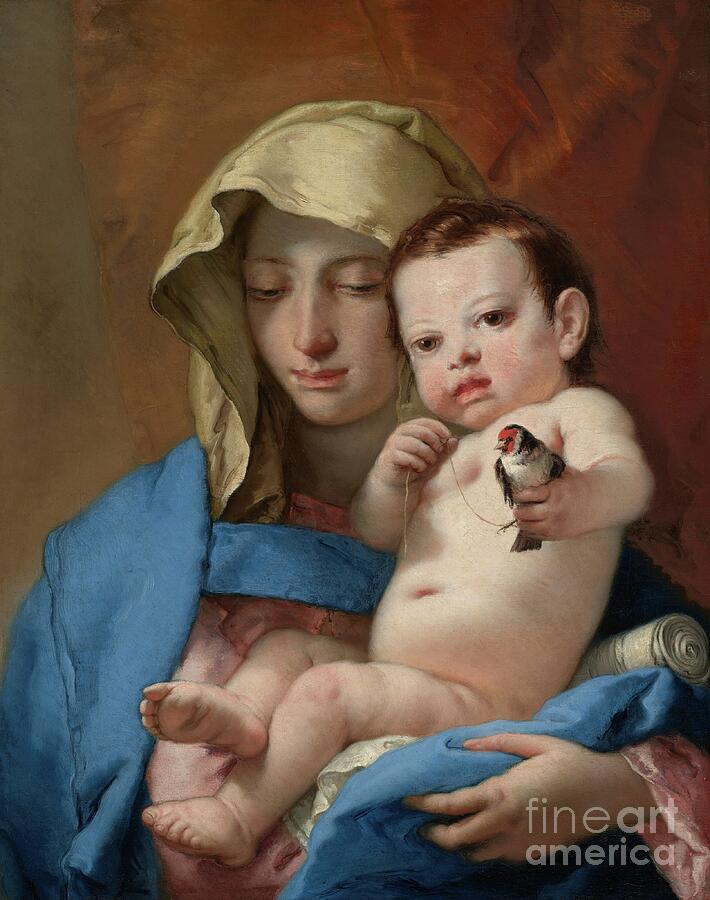
The Child holds a string. At the end of it, a goldfinch waits with a red mask and charcoal wings, as if the next second of the painting might be a tug or a flight. Giovanni Battista Tiepolo’s Madonna of the Goldfinch (about 1767–1770) is a late, quiet canvas from a painter famous for ceilings the size of weather. Here the drama shrinks to a veil, a blue mantle, and a bird that Christian viewers already knew as a sign of the Passion: the goldfinch that feeds among thorns.
Artist: Giovanni Battista Tiepolo (1696–1770)
Date: c. 1767–1770
Medium: Oil on canvas (62 × 49.5 cm)
Collection: National Gallery of Art, Washington, D.C. (1997.60.1; West Building, Gallery M32)
Notable fact: A late half-length Madonna from Tiepolo’s last years; the goldfinch on a thread is a traditional emblem of Christ’s coming Passion
A Ceiling Painter Who Suddenly Whispers
Tiepolo made his name in Venice, then Würzburg and Madrid, with airborne saints, allegories, and skies that refuse to stay indoors. This Madonna is the opposite scale: half-length, close, almost private. Mary’s head tilts under a cream veil; an azure mantle closes across a rose robe; she supports the Child with the economy of a mother who has done this a thousand times. The Child looks out. The bird does not. The string between them is the whole plot — a leash so thin it reads as play until you remember what the goldfinch meant in European devotion.
Why a Goldfinch, and Why a Thread
Renaissance and Baroque Madonnas had already taught viewers the code. The European goldfinch, which feeds on thistles, became a compact emblem of the Crown of Thorns and of the Passion waiting inside the Nativity. Raphael’s earlier Madonna of the Goldfinch in the Uffizi is the famous cousin of the type. Tiepolo keeps the symbol and adds a Venetian lightness: the bird is small, the thread is almost a toy, the Child’s other hand is still open as if the game has just started. Tenderness first; theology second. That order is the point. You are allowed to enjoy the plump infant and the red face of the bird before the thorn-story arrives.
Late Work, Last Years
The dating — about 1767 to 1770 — places the canvas at the end of Tiepolo’s life. He died in Madrid in 1770, after years of huge royal and ecclesiastical commissions. A small Madonna is not a retreat from that career so much as a change of instrument: the same fluency of flesh and drapery, used for an image you could hang in a room rather than a palace vault. The National Gallery of Art holds this version as a gift of The Brown Foundation, Houston (accession 1997.60.1). It hangs, when on view, in the West Building on the main floor — Gallery M32 — among other European pictures that reward standing close.
What the Eyes Do First
Start with the Child’s stare. Then drop to the goldfinch, then follow the thread back to the tiny fist. Only after that circuit do you notice Mary’s lowered gaze, which refuses the viewer and stays with the boy. The background is a warm, almost featureless dusk of brown and grey, so nothing competes with skin, veil, and the blue that names her. Tiepolo does not fill the canvas with apostles or architecture. He leaves air around the three living things that matter: mother, child, bird.
Why the Thread Still Holds
Most late-eighteenth-century religious pictures either go sugary or go grand. This one does neither. It treats a doctrinal emblem as something a child might actually hold. That is why it still works on a wall and why it rose to the top of the Masterworks of Art History Premium Prints traffic in the last thirty days: the image is instantly readable, then slowly sharper. Look at the bird. Then notice the string. The painting is already telling you that play and fate can occupy the same hand.
Get Tiepolo’s Madonna of the Goldfinch as a museum-quality print, canvas, or poster from the Sapiens Verbum print shop.
Shop This Print →
Related Baroque reading on @SapiensVerbum: Rubens Hands Peter the Keys — another canvas where a small object (a pair of keys, a bird on a thread) carries the whole charge of the story.

Comments
Post a Comment