The Destruction of Sodom and Gomorrah by John Martin: Why Lot's Wife Turned to Salt (1852)
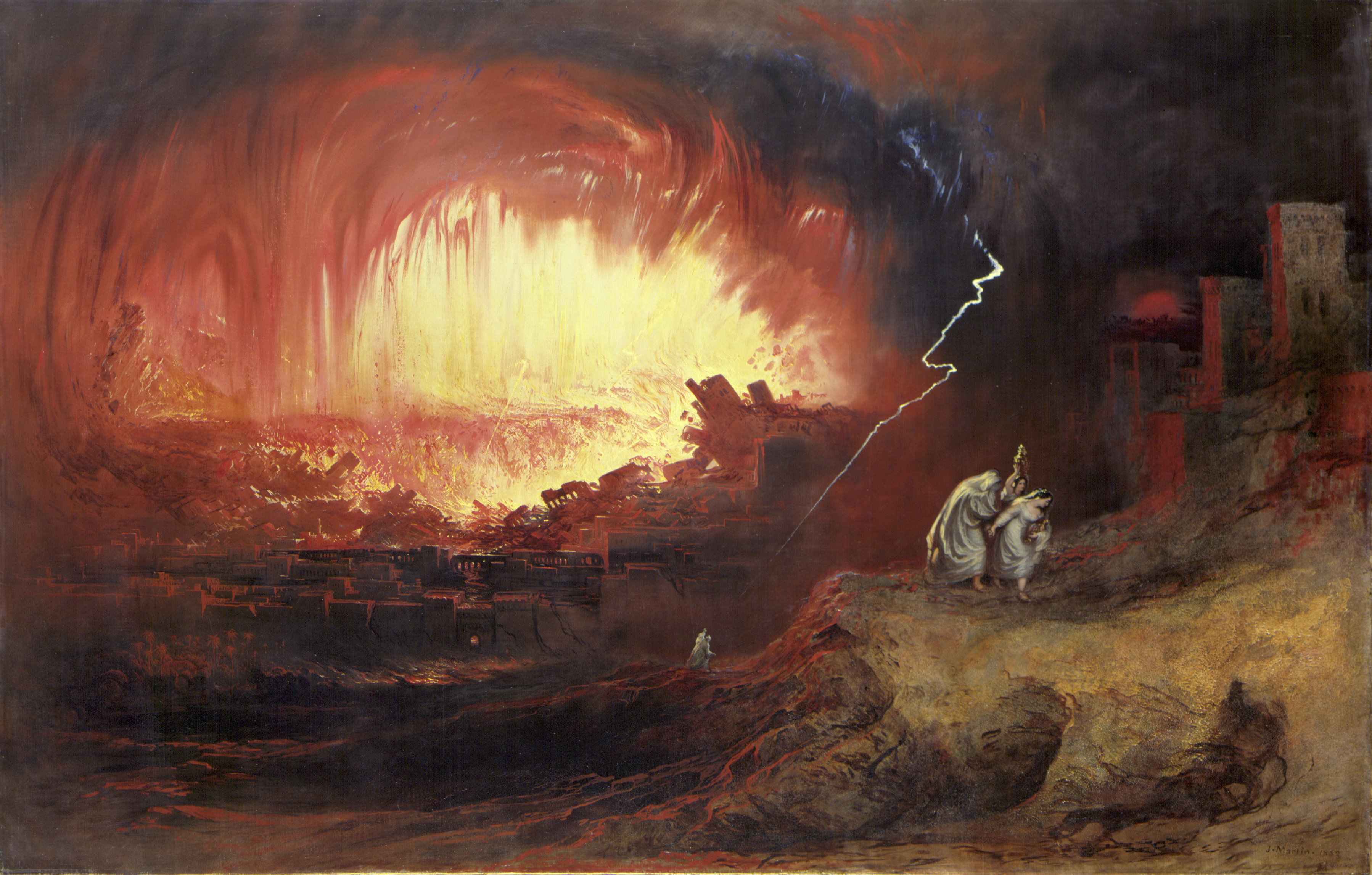
There is only one rule that will save your life: do not look back. In Genesis, angels pull Lot and his family out of Sodom before fire falls from the sky; the cities of the plain are erased in a single divine storm. Lot's wife turns anyway. The text gives her no name and almost no psychology - only the consequence. She becomes a pillar of salt. In 1852, the English painter John Martin made that instant into an apocalypse so large that the woman herself nearly disappears inside it: a ribbon of scarlet cloud, a city already melting, and, if you know where to look, one small human mistake at the edge of the world.
Artist: John Martin (1789-1854)
Date: 1852
Medium: Oil on canvas, 136.3 x 212.3 cm
Collection: Laing Art Gallery, Newcastle upon Tyne (TWCMS: C6975)
Notable fact: Martin showed the picture at the Royal Academy in 1852; Victorian viewers already knew him as the painter who made private drawing rooms feel too small for the end of the world
A Single Rule, and the Instinct That Breaks It
The biblical episode is brutally short. God warns Lot; the angels hurry the family out; the instruction is absolute - keep moving, do not look back at the doomed cities. Lot's wife looks. Later tradition and midrash have filled the blank with motives: curiosity, pity, greed for the life she is leaving, nostalgia sharp enough to kill. The painting does not settle the argument. Martin places the human drama so small against the catastrophe that the moral becomes almost physical: looking back is not a thoughtful choice so much as a reflex - the last pull of home when the sky has already decided against you.
John Martin, Painter of the Apocalypse
By mid-century Martin had built a reputation on spectacles of collapse: Babylon, Nineveh, the Deluge, Pandemonium. Critics paired him with Turner as a master of atmospheric violence, then often dismissed him as theatrical. That judgment missed the point of his best work. Martin used scale the way a composer uses volume. Fire, storm, and architecture lock together until the canvas feels less like a Bible illustration than a weather system with a story trapped inside it. The Destruction of Sodom and Gomorrah belongs to that late phase - painted the year before his death in 1854 - when the reds grow hotter and the sky itself seems to tear.
Reading the 1852 Canvas
The center of the picture is not a face but a vortex: flame, wind, and collapsing matter fused into one roaring vertical. To one side, the cities of the plain dissolve into a furnace of orange and black. Above, a cyclone of cloud and lightning seals the judgment. Tiny figures - Lot, his daughters, the doomed wife - occupy the foreground margins the way insects occupy a landscape after a blast. Martin's famous scarlet is not decoration; it is temperature. The sublime here is exactly what Romantic theorists meant by the word: terror mixed with fascination, beauty that refuses to comfort you.
Mount Sodom's salt formations later gave travelers a geological joke that doubles as pilgrimage - a "pillar" you can still point at. Martin's version works the other way round. He does not need a literal statue. The woman's transformation is already complete in the gesture of turning, swallowed by a disaster so absolute that salt feels almost merciful by comparison.
Why Looking Back Still Hurts
The painting endures because the story is not really about ancient cities. It is about the cost of leaving - the split-second when the past is more vivid than survival. Martin understood that private emotion could be staged as public catastrophe without losing either. Stand in front of the Laing canvas (or the print) long enough and the biblical warning becomes oddly modern: progress, exile, migration, grief. The rule is still the same. The instinct that breaks it has not changed either.
Own This Painting
Hang Martin's apocalypse - fire, storm, and the smallest figure who looked back.
Watch the full video essay on @SapiensVerbum on YouTube.


Comments
Post a Comment