Mortlake Terrace by J.M.W. Turner (1827)
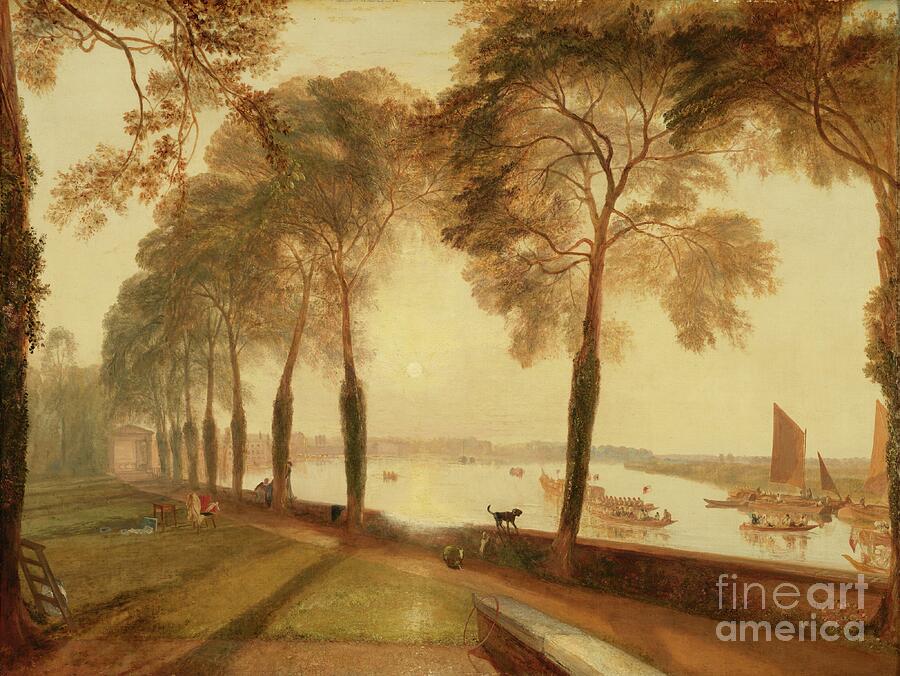
Look once for the black dog on the wall. Look again for the sun that is trying to erase the river. If you only know J.M.W. Turner from storms and wrecks, Mortlake Terrace (1827) is where you meet the other Turner: the one who treats light as the main character and everything else as its supporting cast.
Artist: Joseph Mallord William Turner (1775–1851)
Date: 1827
Medium: Oil on canvas (92.1 × 122.2 cm)
Collection: National Gallery of Art, Washington, D.C. (Andrew W. Mellon Collection)
Notable fact: Painted for William Moffatt at The Limes, Mortlake; evening companion to the Frick Collection’s Mortlake Terrace: Early Summer Morning (1826)
What Is at Stake
Most people scroll past a “pretty Thames sunset” in three seconds. That is the trap. If you leave this painting as decoration, you miss the argument Turner is making: a view can be owned as a souvenir, but light cannot. William Moffatt paid for a picture of his house. Turner delivered a picture of an hour that refuses to sit still.
Act I — Moffatt Wants the Evening
The Limes sits at Mortlake, west of London, looking onto the Thames near Kew. Moffatt already owned the morning version (now at the Frick): trees, terrace, river in early light. A year later Turner paints the reverse direction — from the grounds, staring west into the setting sun. Same estate, opposite hour. This is not two postcards. It is a commission turned into a two-episode show: dawn and dusk as rival characters fighting over the same stage.
Act II — The Sun Tries to Win
Two ivy-covered elms rise like soft columns. Between them the river becomes a pale road. Sailboats catch warm flashes; the far bank softens until map-reading fails. The terrace wall cuts a cool horizontal against the blaze. People sit and stand without turning the scene into costume drama. A navy coat hangs on the parapet. A black dog walks the stone near the centre; a smaller white dog is barely there beside it. Every object has a job. The dog’s job is silhouette. The sun’s job is erasure. The wall’s job is to keep you human-scale while the sky goes nuclear.
Act III — The Twist
Shown at the Royal Academy in 1827, later entering the Mellon Collection and the National Gallery of Art, the canvas looks polite next to Turner’s disasters. That politeness is the plot twist. The takeaway is not “rich man, nice garden.” The takeaway is optical: Turner lets light eat the subject until looking itself becomes the subject. Critics who wanted clearer ships and sharper roofs were asking for a different century. This quiet terrace is already halfway to the modern habit of painting weather as meaning.
The Opinion You Can Finish
Here is the line this channel will keep returning to: Turner is not interesting because he paints storms. He is interesting because even when nothing sinks, he still makes light the protagonist. Mortlake is the proof. Look once for the black dog on the wall. Look again for the river turning into a road of glare. The house is Moffatt’s. The hour is Turner’s.
Own This Painting
Hang Turner’s Mortlake Terrace — evening light on the Thames, the elms, and the walk along the wall.
Watch on @SapiensVerbum: the full Commented Paintings reading of Turner’s Mortlake Terrace — look once for the dog, look again for the light.


Comments
Post a Comment