The Titan's Goblet by Thomas Cole: A World Inside a Cup (1833)
A stone cup the size of a mountain holds a lake on its rim. Tiny classical ruins cling to the brim; a whole weather system seems to drink from the bowl. Thomas Cole's The Titan's Goblet (1833) is Hudson River imagination pushed into fantasy - landscape as mythic architecture.
Artist: Thomas Cole (1801-1848)
Date: 1833
Medium: Oil on canvas
Collection: The Metropolitan Museum of Art, New York
Notable fact: Hudson River School landmark; a colossal goblet set in wilderness, often read as allegory of nature's abundance and human scale
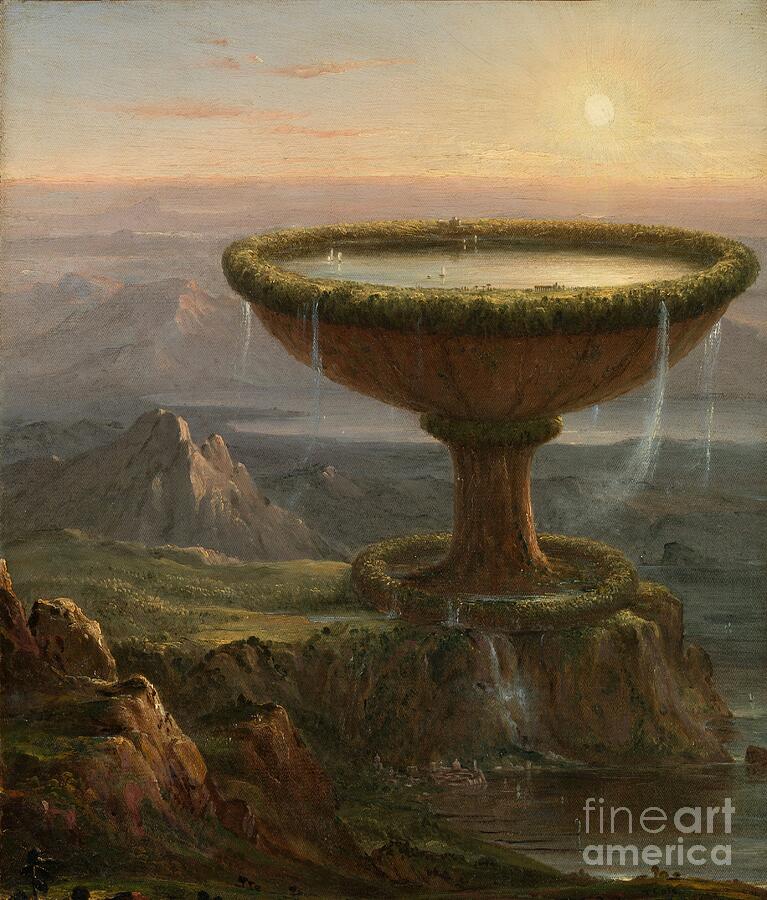
Impossible Vessel
The goblet rises from the terrain as if geology learned to be a cup. Vegetation and water on the rim make the fantasy feel organic. Around it, mountains and sky perform Cole's usual grandeur - then the eye returns to the vessel that should not exist and somehow does.
Readings of the Cup
Abundance, fertility, the cycle of life and death, a divine reservoir feeding the world - interpreters keep circling. The tiny human traces on the rim sharpen the question: do we master nature, or only decorate its lip?
Hudson River Dream Logic
Cole founded a school of American landscape that celebrated wilderness with moral weather. The Titan's Goblet keeps that ambition and adds fairy-tale scale. It is less a travel view than a thought about sublimity you can almost measure in acre-feet.
Why the Goblet Still Amazes
Wonder needs a hinge between real and unreal. Cole's hinge is craft: believable light on an unbelievable object. Stand with the Met canvas and your sense of size recalibrates. That is the Titan's joke on the viewer.
Own This Painting
Hang Cole's Titan's Goblet - the stone cup, the rim of ruins, and landscape dreaming bigger than maps.
Watch the video essay on @SapiensVerbum on YouTube.


Comments
Post a Comment