Adieu! by Alfred Guillou: A Farewell That Still Breaks the Heart
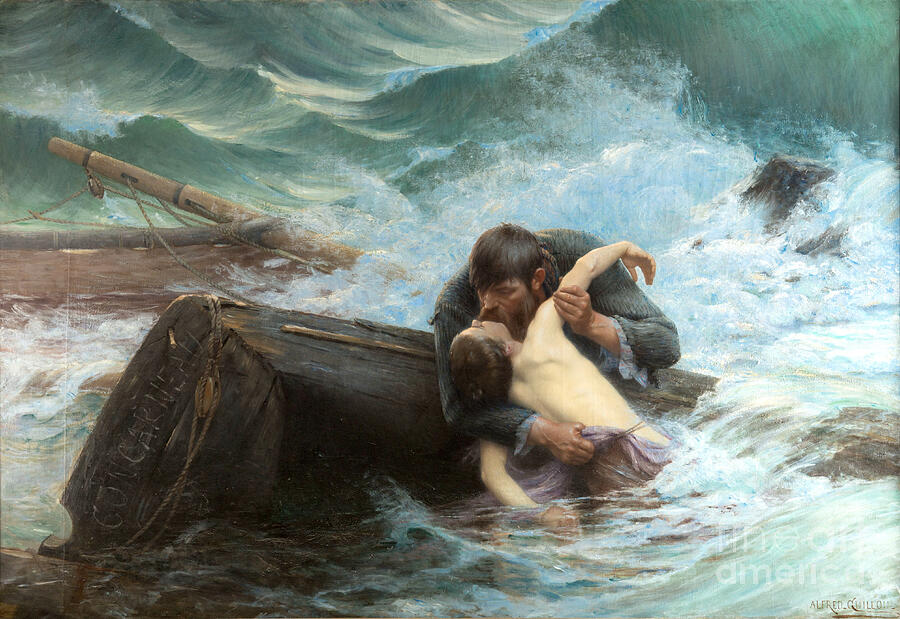
A fishing boat pulls away from shore; arms reach across water that will not wait. Alfred Guillou's Adieu! (c. 1892) turns a Breton goodbye into theatre you can feel in your throat - salt air, working clothes, and a farewell that knows the sea does not schedule reunions.
Artist: Alfred Guillou (1844-1926)
Date: c. 1892
Medium: Oil on canvas
Notable fact: Shown at the Paris Salon of 1892 and again at the Exposition Universelle of 1900; Guillou was celebrated for Breton maritime scenes
Brittany as Emotion, Not Postcard
Paris audiences loved Guillou's provincial "exoticism" - fishermen, coasts, and rituals of a region that still felt far from boulevard life. Adieu! earns that attention by refusing tourism's cheer. The drama is ordinary and therefore sharper: people who live by the water saying goodbye as work demands.
Gesture Across the Gap
Composition hinges on distance. One group remains on land or in the shallows; another is already claimed by the boat. Hands and bodies lean into the space between - a temporary bridge of longing. Faces do the rest. This is not allegory with labels; it is a human hour painted large enough for a Salon wall.
Salon Success, Universal Stage
After the 1892 Salon, the painting returned to public view at the 1900 Exposition Universelle, confirming Guillou's reputation as a painter who could make regional life feel monumental. The title needs no footnote. Everyone knows what "Adieu!" costs when the horizon is the job.
Why the Farewell Still Stings
Modern travel has shrunk maps; it has not cancelled departure. Look once for Breton costume and rigging. Look again for the second when love and livelihood pull in opposite directions.
Own This Painting
Hang Guillou's Breton farewell - reaching hands, a departing boat, and a goodbye the tide will not postpone.
Watch the video essay on @SapiensVerbum on YouTube.


Comments
Post a Comment