

Flaming June by Leighton: The Orange Dress That Outlived Victorian Taste (1895)
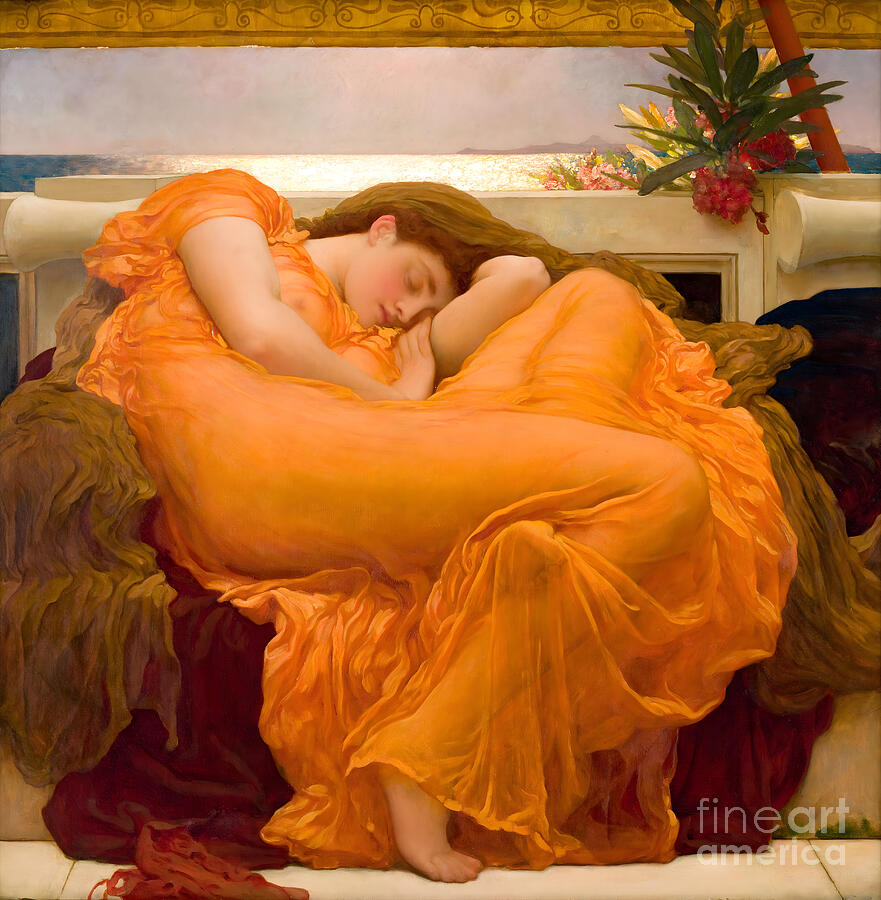
A young woman lies curled up asleep on a marble bench, her head resting on her arm, her body folded into an almost perfect circle. Her dress of sheer orange silk glows like fire and clings to her limbs. Behind her, beyond a balustrade, the sea shimmers in the afternoon heat, and in the top right corner hangs a branch of oleander in flower. Frederic Leighton's Flaming June, shown at the Royal Academy in 1895, is the most famous image of sleep in Victorian art, and one of the most reproduced paintings of the nineteenth century. The picture below is our vintage poster version of the painting; the original is shown further down.
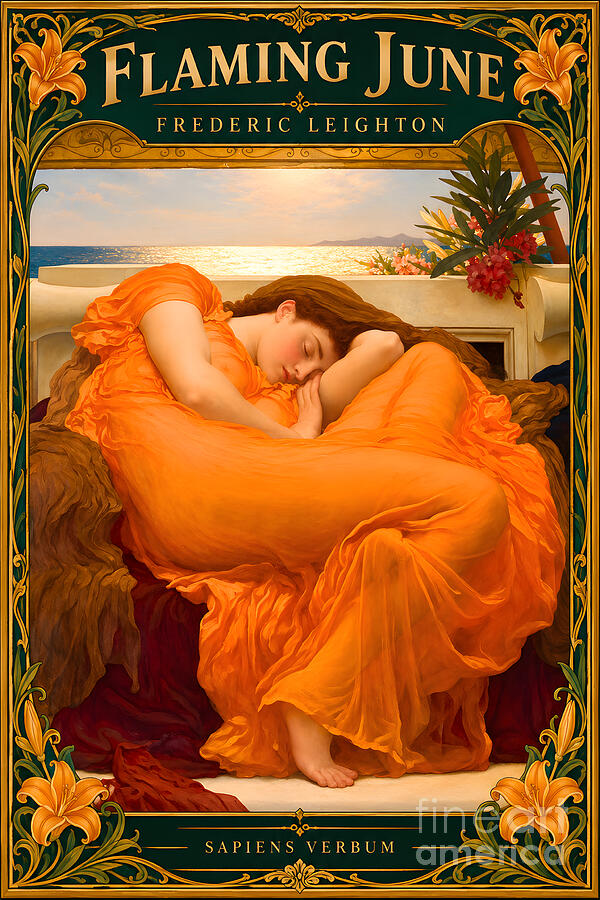
🖼️ Get the vintage poster →License this image →
Artist: Frederic Leighton (1830–1896)
Date: 1895
Medium: Oil on canvas, 120 × 120 cm
Collection: Museo de Arte de Ponce, Puerto Rico (bought in 1963)
Notable fact: In the 1960s it failed to sell at auction
What does the painting show?
The canvas is perfectly square, and Leighton fills it with a single figure arranged like a coiled spring. Her head rests on her right arm, her left arm curls over it, and her knees are drawn up so that her body forms a great spiral that turns from her face down to her bare foot at the bottom. There is no story, no action, no other person: just sleep, heat and colour.
The orange dress is the heart of the picture. It is so fine that the body shows through it, and Leighton paints every fold in shades from deep amber to pale gold, so that the whole figure seems to burn against the cooler tones around it: the white marble, the bronze-coloured drapery under her, the silver line of the sea. Behind her, the horizon shines in the glare of a summer afternoon, and a distant coastline floats in the haze.
In the upper right corner hangs a branch of oleander, a beautiful but poisonous plant. It may hint at the thin line between sleep and death, a theme that fascinated Victorian painters and poets.
Michelangelo in Kensington
The pose was not invented from nothing. The art historian Andrew Graham-Dixon has pointed out that it is loosely modelled on Michelangelo's marble figure of Night on the Medici tombs in Florence, which Leighton deeply admired. Leighton, who was also a sculptor, made careful studies of the figure nude before adding the drapery, and the solid, sculptural body under the silk shows that training. The face may be that of Dorothy Dene or Mary Lloyd, two of his favourite models in the 1890s.
Leighton was the leading classical painter of Victorian Britain and president of the Royal Academy from 1878. He died in January 1896, a few months after Flaming June was exhibited, having been made Baron Leighton just the day before, the first painter ever raised to the peerage. For a darker side of his work, see Perseus and Andromeda.
From forgotten to famous
After Leighton's death, taste turned against the polished classical style of his generation. By the 1960s Flaming June was so unfashionable that it failed to sell at auction even with a reserve of only 140 dollars. In 1963 the Puerto Rican industrialist and collector Luis A. Ferré bought it in Amsterdam for less than a thousand dollars for his new Museo de Arte de Ponce. Today it is that museum's most famous work, and it has been lent to the Frick Collection in New York and to Leighton House in London, where it returned to its painter's studio in 2016.
Its sleeping figure belongs to a family of Victorian dreamers and enchantresses, from Waterhouse's The Lady of Shalott to Poynter's The Cave of the Storm Nymphs.
Where can you see it?
The painting belongs to the Museo de Arte de Ponce in Puerto Rico. While the museum building undergoes structural repairs, the painting has been shown on loan in the United States, so check where it is before planning a visit.
Hang Frederic Leighton’s Flaming June as a vintage art poster from the Sapiens Verbum print shop.
 Choose your size and frame →See the vintage poster collection →License this image →
See Leighton’s Flaming June framed on your wall: a museum-quality print, canvas or poster from the Sapiens Verbum print shop.
 Choose your size and frame →
Printed and shipped by Fine Art America · 30-day money-back guarantee
Watch the video essay (in Spanish) on @SapiensVerbum on YouTube.
Sources
Wikipedia, "Flaming June" and "Frederic Leighton"; Andrew Graham-Dixon on Leighton's Flaming June.
Comments
Post a Comment