
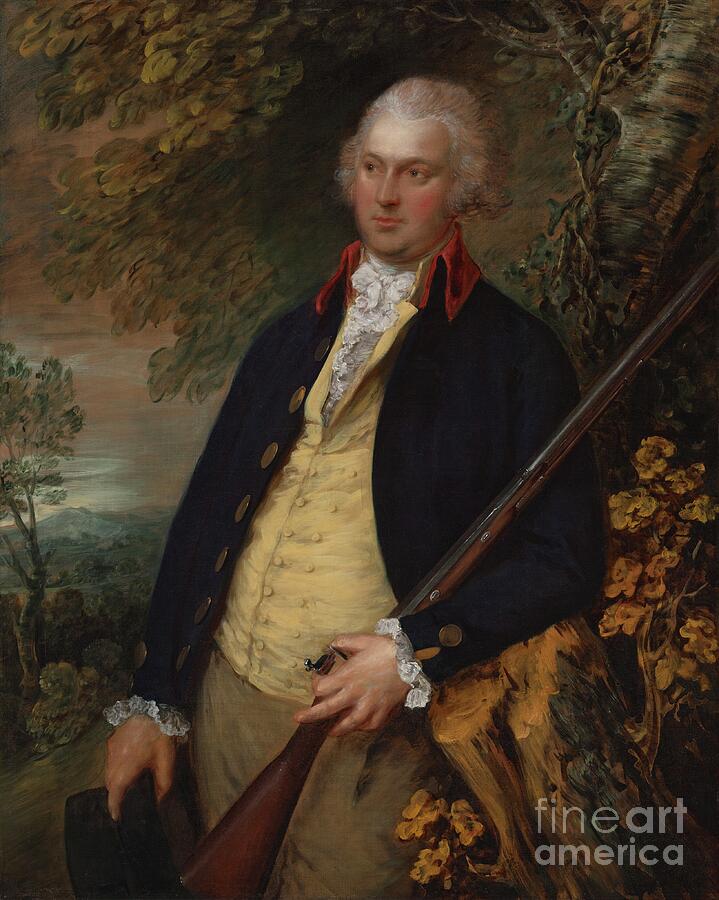
William Yelverton Davenport by Gainsborough: The Country Squire with a Gun (c. 1785)
He has just come in from the woods, or is about to go out. William Yelverton Davenport stands under a great tree with a sporting gun in the crook of his arm and his black hat in his other hand, a Shropshire landowner painted by one of the most fashionable portraitists in London. Thomas Gainsborough made this picture in the last years of his life, around 1785 to 1788. Since then it has travelled from a country house in Shropshire to Pittsburgh, New York and Washington, and spent years on loan to the American embassy in London.
🖼️ Get this painting as a print →
Artist: Thomas Gainsborough (1727–1788)
Title: William Yelverton Davenport
Date: c. 1785/1788
Medium: Oil on canvas, 127.3 × 101.9 cm
Sitter: William Yelverton Davenport (1750–1832), of Davenport House, Worfield, Shropshire
Collection: National Gallery of Art, Washington (1961.5.3, gift of the Coe Foundation); not currently on view
Status: Public domain.
A squire in his own landscape
Gainsborough places his sitter almost against the trunk of a tree, the foliage closing over his head like a canopy. Davenport wears a dark navy coat with gilt buttons and a scarlet collar, a pale yellow waistcoat buttoned high, buff breeches and a froth of white lace at the throat and wrists. The gun rests across his body, its long barrel running up past his shoulder; his right hand hangs at his side holding a black hat. He looks away to our right, not at us, as if something in the woods has caught his attention.
To the left the view opens: a small tree, a distant blue hill and an evening sky warming to pink. It is the kind of landscape Gainsborough painted for pleasure, and here it tells us who the man is. He is not a courtier or a merchant but a country gentleman, at home on his land, dressed for a day’s shooting. The gun and the hat are the props of that identity, the way a book or a column would be for a scholar or a statesman.
The late Gainsborough touch
Look at the leaves above the sitter’s head. They are not drawn leaf by leaf but laid on in quick, curling strokes of olive, gold and brown, and the same loose handling runs through the ivy on the trunk and the bushes at the lower right. The face is the most finished part of the picture, pink-cheeked and solid; around it the paint grows freer and freer until it dissolves into the background.
That contrast is typical of Gainsborough’s last decade. He painted quickly, relied on looking at nature more than on academic rules, and in his later works used a restrained palette and loose, economical brushwork. Seen close up, the foliage here is almost abstract. From a few steps away it becomes a living tree, moving slightly in the wind.
Gainsborough at the top
By the time he painted Davenport, Gainsborough had come a long way from Sudbury in Suffolk, where he was baptised in 1727. He had trained in London, worked in Ipswich, built a fashionable practice in the spa town of Bath from 1759, and in 1774 moved to Schomberg House in Pall Mall, London. He was a founding member of the Royal Academy, painted King George III and Queen Charlotte in 1780 and remained a favourite of the royal family. From 1784, after a quarrel with the Academy over how his pictures were hung, he showed his work in his own studio instead.
He also complained, famously, that he was “sick of Portraits” and wanted to take his viol da gamba to a village where he could paint “Landskips”. Portraits paid the bills; landscape was his love. In this canvas, painted not long before his death in London on 2 August 1788, he found a way to have both.
From Shropshire to Washington
The sitter, William Yelverton Davenport, lived from 1750 to 1832. His family seat, Davenport House at Worfield near Bridgnorth, had been built in 1726 by Francis Smith of Warwick for Henry Davenport, and is today a Grade I listed building. According to the National Gallery of Art, the portrait was painted for the sitter and passed down the family, reaching Mrs. Cuthbert Leicester-Warren, a daughter of Edmund Henry Davenport, in 1890. It was shown at the Royal Academy’s Winter Exhibition in London in 1887.
Then it crossed the Atlantic. It passed through the art historian A. J. Finberg and the New York dealers Knoedler and John Levy Galleries, and by 1925 belonged to Benjamin Franklin Jones Jr. of Sewickley Heights, near Pittsburgh. After a sale at Parke-Bernet in New York in 1941 it was bought by the collector William Robertson Coe, and in 1961 the Coe Foundation gave it to the National Gallery of Art in Washington. The gallery then sent it back to London on long loan, first to the residence of Ambassador David K. E. Bruce from 1961 to 1969, and from 1978 to the United States Embassy. A Shropshire squire ended up representing America in London.
The painting is not currently on view in Washington, but the gallery holds an exceptional group of British and European pictures. Among them are Turner’s Mortlake Terrace, Monet’s Houses of Parliament, Sunset and Leonardo’s Ginevra de’ Benci. For more forgotten portraits and stories, see our page of hidden masterpieces.
Hang Gainsborough’s William Yelverton Davenport — the navy coat, the scarlet collar, the feathery trees — as a print, canvas or poster from the Sapiens Verbum print shop.
 Choose your size and frame →
Printed and shipped by Fine Art America · 30-day money-back guarantee
💬 Over to you: Hunter, landowner or gentleman dressed up for his portrait? What does the gun say to you? Tell us in the comments.
Sources
National Gallery of Art — William Yelverton Davenport, c. 1785/1788 (provenance and exhibition history)
National Gallery of Art — William Yelverton Davenport (1750–1832)
National Gallery of Art — Thomas Gainsborough, biography
Wikipedia — Thomas Gainsborough
Wikipedia — Davenport House, Worfield
Sapiens Verbum — William Yelverton Davenport, Thomas Gainsborough
Comments
Post a Comment