
The Abduction of Europa by Rembrandt: The Glance That Misses the Shore (1632)
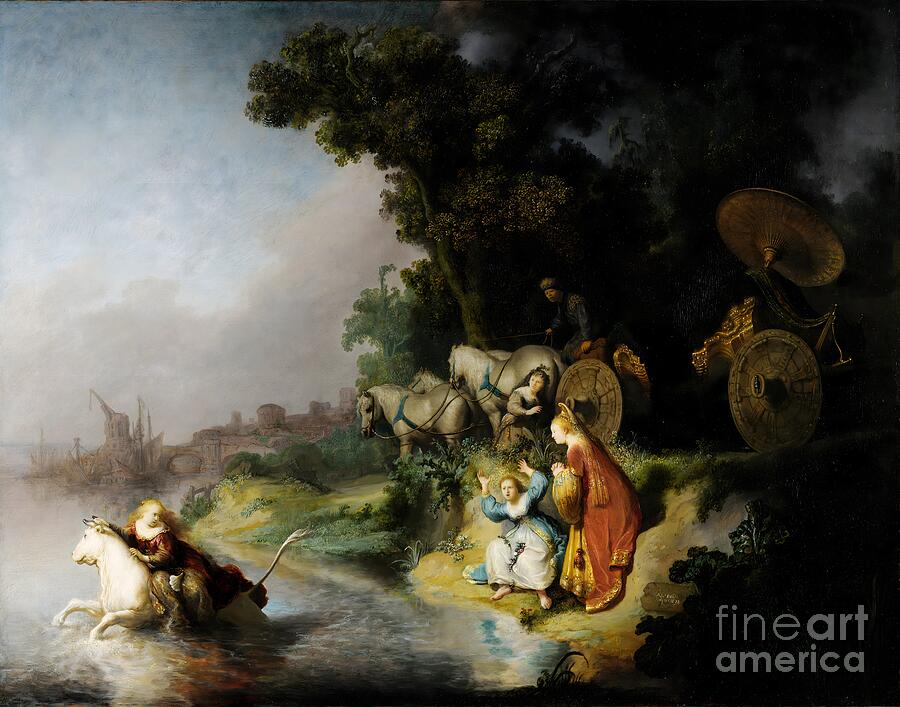
What happens when a god does not announce himself? In Rembrandt’s The Abduction of Europa (1632), Jupiter has already chosen the disguise: a white bull, knee-deep in the sea, with a princess on his back. Europa grips a horn and twists to look at the shore she is leaving. Her companions are still on the beach. The carriage is still there. The painting stops on the second when the joke becomes a crossing, and a myth becomes a picture about looking back.
Artist: Rembrandt van Rijn (1606–1669)
Title: The Abduction of Europa
Date: 1632 (signed on a stone at center right, RHL van Rijn 1632)
Medium: Oil on oak panel
Dimensions: 64.6 × 78.7 cm (25 7/16 × 31 in.)
Collection: J. Paul Getty Museum, Los Angeles (95.PB.7)
Subject: Jupiter, disguised as a bull, carrying Europa across the sea, from Ovid’s Metamorphoses
Status: Public-domain artwork
🖼️ Get this painting as a print →
The Shore Is Still in the Picture
Look at the water before you look at the bull. Rembrandt gives the abduction a coast. Europa is already off the sand, but the beach has not been left behind. Women crowd the edge. One lifts an arm. A carriage waits under the trees. The distance between the bull and that group is the whole story: short enough to hear a shout, wide enough that she will not step back.
The bull is white, heavy, and oddly calm. He does not rear. He wades. Europa’s body does the drama the animal refuses. One hand is on the horn. The other digs into the neck. Her face is turned inland. Rembrandt paints the kidnapping as a glance backward, not as a struggle in the open sea.
Ovid, Without the Announcement
The episode is in Ovid’s Metamorphoses. Jupiter wants Europa, princess of Tyre. He comes to the meadow as a white bull, mild enough that the girls hang garlands on him. Europa climbs onto his back. He walks into the water and does not stop. The shore becomes a continent. The land she reaches will take her name.
Rembrandt keeps the disguise and drops the pastoral. There is no leisurely garlanding. The bull is already in the sea, and the faces on the beach have understood. Mythological pictures are rare in his work. When he takes one, he treats it as a human emergency: a hand, a horn, a look that arrives too late. Two centuries later, Cabanel would put another goddess on the water and polish the emergency away. Rembrandt leaves it in the fingers.
A Small Panel, Signed on the Stone
The picture is oil on a single oak panel, 64.6 by 78.7 centimetres, signed and dated 1632 on a stone at center right. Rembrandt was twenty-six. He had just moved from Leiden into the Amsterdam market for history painting, and this panel is one of the works with which he claimed that ground. Not every picture that carries his name survived the check: the Berlin helmet lost it in 1986. This one is signed, dated, and still his.
By 1652 it was with Jacques Specx, the Dutch East India Company merchant who had opened the Japan trade and governed Batavia. Later it passed through French and German collections, was shown at the New York World’s Fair in 1939, and was bought by the J. Paul Getty Museum in 1995. The number is 95.PB.7.
How to Look at the Painting
Start with the women on the shore. Then the carriage. Then the gap of water. Only then take Europa’s turned face, and follow her arm down to the horn. The bull’s head is the hinge. Everything on land points at it. Everything at sea has already accepted it.
The light sits on the white hide and on the pale dress. The coast is darker, busier, and about to become memory. Rembrandt does not paint the landing. He paints the moment the name of a continent is still a girl looking back.
Sources
J. Paul Getty Museum — Rembrandt, The Abduction of Europa, 1632, 95.PB.7
Wikipedia — The Abduction of Europa (Rembrandt)
Rembrandt in Southern California — Getty, The Abduction of Europa
Bring Rembrandt’s The Abduction of Europa to your wall as a museum-quality print, canvas or poster from the Sapiens Verbum print shop.
 Choose your size and frame →
Original artwork by Rembrandt van Rijn, 1632 · Public Domain · Printed and shipped by Fine Art America
Part of the Mythology and Art History collections at Sapiens Verbum. More pictures readers hang: twelve best-selling prints.
Comments
Post a Comment