

The Man with the Golden Helmet: The Rembrandt That Never Was (c. 1650)
For most of the twentieth century, this painting fooled everyone twice over. First, experts believed it showed Rembrandt's own brother. Then they believed Rembrandt himself had painted it. Neither claim survived the century intact.
Artist: Circle of Rembrandt (formerly attributed to Rembrandt van Rijn)
Date: c. 1650
Medium: Oil on canvas (67.5 x 50.7 cm)
Collection: Gemaldegalerie, Berlin
Notable fact: Bought in 1897 as a newly discovered Rembrandt; the attribution was formally withdrawn in 1986 after a multi-year technical investigation
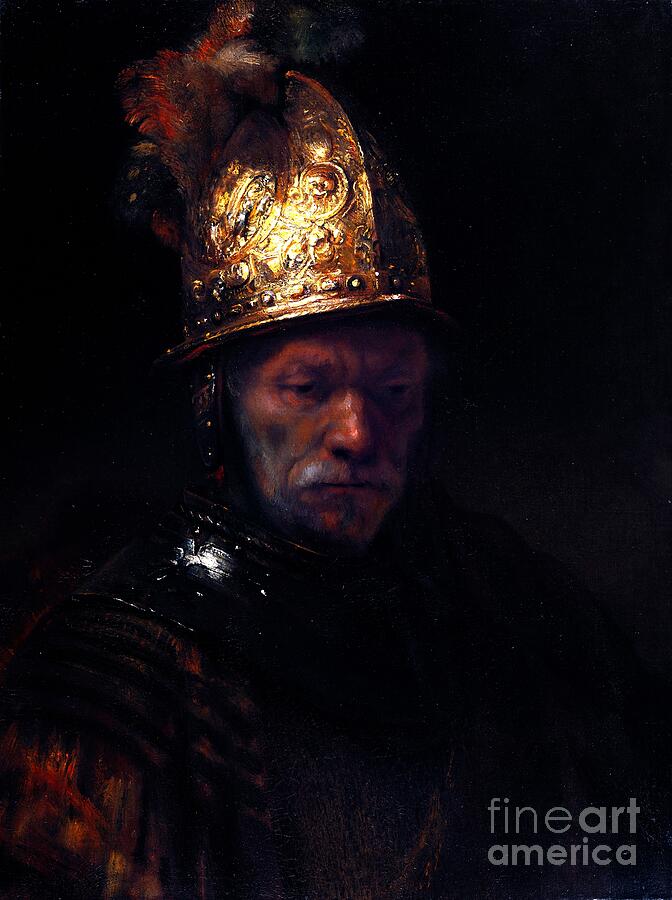
A Face Swallowed by Shadow
An old soldier sits half-turned from us, his features almost lost in darkness. What the light picks out instead is the helmet: an extravagant, fantastical thing bristling with earpieces, a feathered plume, and medallions hammered into the gold, each catching a different angle of the same low light. The brushwork on the metal is thick, almost sculpted, laid on with a loaded brush and in places worked with the handle end of it -- a technique that later became one of the arguments against Rembrandt's own hand, since he rarely built paint quite this way. The face, by contrast, is thin, dim, and unfinished-looking. The painting isn't really about the man at all. It's about what happens to a face when all the light in the room goes somewhere else.
Not Even the Right Brother
When the painting surfaced in the late nineteenth century, the pioneering Rembrandt cataloguer Cornelis Hofstede de Groot went a step further than just naming an artist -- he named a sitter, proposing the old man was Rembrandt's own brother, Adriaen. It was a tidy story: a family member, sat for in the studio, dressed up in invented armor for the fun of it. It also turned out to be guesswork dressed as fact. No evidence ties this face to Adriaen van Rijn or to anyone else. The "sitter" was very likely never a sitter in the ordinary sense at all, but an invented old-soldier type, the kind of imaginary character head that Rembrandt's studio produced by the dozen -- worn to sell a mood and a texture, not to record a particular person's face for posterity.
The Masterpiece That Lost Its Name
In 1897, the Berlin museum director Wilhelm von Bode acquired the painting after identifying it as a genuine Rembrandt -- a striking find, since it had surfaced from a Swiss private collection without ever having passed through expert hands. It was an instant sensation. Reproduced on postcards, calendars, and in art-history textbooks for the better part of a century, it became one of the most famous images anywhere attached to Rembrandt's name, rivaled by only a handful of his other works.
Doubt started creeping in during the 1970s and hardened through the early 1980s, as the Rembrandt Research Project re-examined the master's catalogue painting by painting. In November 1985, the Berlin curator Jan Kelch concluded that the work was probably painted around 1650 by one of Rembrandt's students, not by Rembrandt himself -- the handling of paint, he found, simply didn't match the documented habits of Rembrandt's own brush. In 1986, after further technical and art-historical study, the museum formally withdrew the attribution. Kelch was careful about what that did and didn't mean: "It is not a fake," he said. "It remains a great masterful work." The painting hadn't changed. Only the name on the wall had.
A Masterpiece Either Way
Strip away both misattributions -- the wrong painter, the wrong brother -- and what's left is a picture that still does exactly what it always did: it makes gold look like it's lit from within, and it makes a stranger's half-hidden face feel like the most private thing in the room. That it came out of Rembrandt's workshop rather than his own hand doesn't diminish the achievement so much as widen it -- proof that whatever "the Rembrandt effect" actually was, it wasn't only ever one man's alone.
Get The Man with the Golden Helmet as a museum-quality print, canvas, or poster from the Sapiens Verbum print shop.
Shop This Print →
Watch the full video essay on @SapiensVerbum on YouTube.


Comments
Post a Comment