
Saint Sebastian by Andrea Mantegna: The Martyr Among the Ruins, as a Vintage Poster (c. 1480)
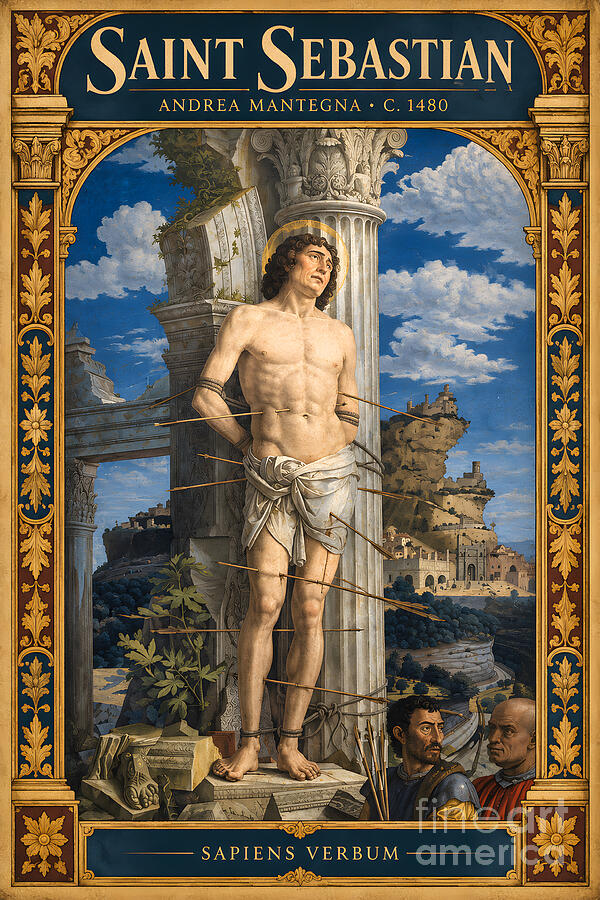
A young man stands tied to a broken classical arch, his body pierced by arrows, his eyes turned calmly to the sky. Around him lie fragments of ancient sculpture, a fig tree grows from the ruins, and at the bottom edge two archers turn away as if their work were done. Andrea Mantegna painted this monumental Saint Sebastian in about 1480, and it now hangs in the Musée du Louvre in Paris. The picture below is our vintage poster of the painting; the original is shown further down.
🖼️ Get the vintage poster →License this image →
Artist: Andrea Mantegna (about 1431–1506), Italian painter
Title: Saint Sebastian
Date: about 1480
Medium: Tempera on canvas, 255 × 140 cm
Location: Musée du Louvre, Paris (RF 1766), acquired in 1910
Subject: The martyrdom of Saint Sebastian, tied to a classical arch and pierced by arrows
The saint who survived the arrows
According to Christian tradition, Sebastian was an officer in the Roman imperial guard who was sentenced to death for his faith, tied up and shot with arrows. Because arrows were linked with sudden disease, he became one of the great protectors against the plague, and Mantegna lived in an age of frequent epidemics. He painted the saint three times: a small panel now in Vienna, this large canvas in the Louvre, and a late, darker version in the Ca’ d’Oro in Venice.
A hero seen from below
In the Louvre picture Mantegna sets the viewer’s eye very low, almost at the saint’s feet. Sebastian rises above us like a statue, solid and calm, with his head and eyes turned towards heaven even as the arrows pierce his body. At the bottom edge the heads and shoulders of two archers appear, cut off by the frame, so that they seem to stand in our own space. The contrast is deliberate: the steady martyr above, the ordinary men below who have done their work and turned away.
A painter in love with antiquity
Mantegna was obsessed with ancient Rome, and this canvas shows it everywhere. The saint is tied to a Corinthian column and a broken arch, and fragments of classical sculpture lie at his feet. A fig tree grows out of the ruins, and in the distance a winding road climbs towards a fortified city on a rocky hill, often read as the heavenly city that awaits the faithful. Every stone and every leaf is painted with the precision of an archaeologist.
From Mantua to the Auvergne
Nothing is known for certain about who commissioned the painting. The Louvre’s own account is that it probably reached Aigueperse, in the Auvergne region of France, in the early 1480s, in connection with the marriage in 1481 of Chiara Gonzaga, daughter of the Marquis of Mantua, to Gilbert de Bourbon, Count of Montpensier. In the seventeenth century it was admired in the Sainte-Chapelle of Aigueperse, although the name of the painter had already been forgotten. The Louvre bought it in 1910.
Why it works as a vintage poster
The Sapiens Verbum poster sets Mantegna’s tall, statuesque saint under a classic title panel, keeping the sharp light, the ruins and the sky that make the original so striking. Its strong vertical format suits a hallway, a study or a narrow wall, and it is a meaningful gift for anyone named Sebastian or devoted to the saint, whose feast falls on 20 January. For another face of the Passion, see Head of Christ by Correggio; for more sacred art, browse our Sacred Art: Paintings and Vintage Posters page; and for gift ideas see our Art Gift Guide.
Hang Mantegna’s Saint Sebastian — the arrows, the ruins and the calm upturned face — as a vintage art poster from the Sapiens Verbum print shop.
 Choose your size and frame →
See the religious vintage poster collection →License this image →
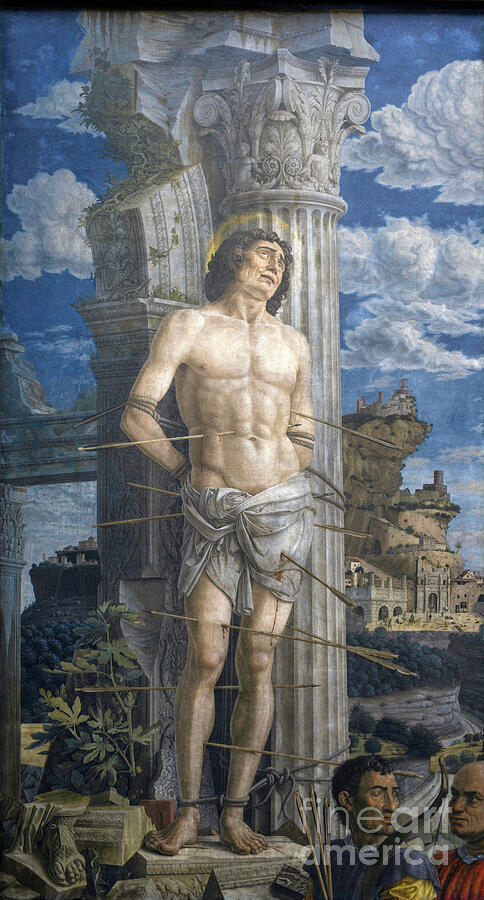
Hang the canvas as Mantegna painted it, with every arrow and every carved stone in place, as a print, canvas or framed print from the Sapiens Verbum print shop.
 Choose your size and frame →Mantegna’s Adoration of the Magi as a poster →
Printed and shipped by Fine Art America · 30-day money-back guarantee
💬 Over to you: Does Mantegna’s Sebastian look like he is suffering, or already somewhere beyond pain? And where in the world are you reading from? Tell us in the comments.
Comments
Post a Comment