
Saint Francis in the Desert by Giovanni Bellini: The Saint, the Light and the Wounds You Almost Miss
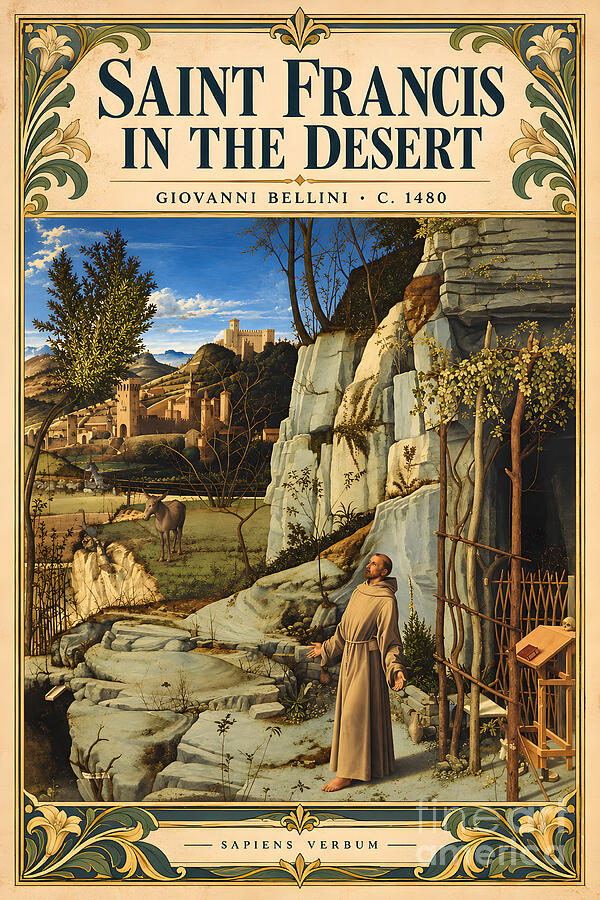
A man in a brown habit steps out of his cave and stops. He opens his arms, lifts his face to a light that pours in from the upper left of the picture, and stands still. Around him nothing else seems to notice: a donkey waits in a field, a heron stands by the water, a rabbit peers out of the rocks, a shepherd watches his flock. Giovanni Bellini painted Saint Francis in the Desert in Venice in the late 1470s, and it is one of the great mysteries of the Renaissance: we see the saint, we see the light, but we do not see what he is looking at. The picture below is our vintage poster version of the painting; the original panel is shown further down.
🖼️ Get the vintage poster →License this image →
Artist: Giovanni Bellini (c. 1435–1516)
Title: Saint Francis in the Desert
Date: late 1470s
Medium: Oil on panel, about 125 × 142 cm
Location: The Frick Collection, New York
Subject: Saint Francis of Assisi in the wilderness, often read as the moment he received the stigmata
A saint outside his cave
Francis of Assisi (c. 1181–1226) gave up a merchant's fortune to live in poverty, and he often withdrew to pray in remote places. Bellini shows him at the mouth of a rocky shelter that he has made his home. A vine grows over the entrance. Inside we can see his reading desk with a book, a skull and a simple cross. He has left his wooden sandals behind on the ground and stands barefoot on the rock. Nothing in his pose is theatrical: he is not falling to his knees or crying out. He simply leans back a little, with his arms open and his mouth slightly parted, as if he has just been surprised by something wonderful.
The wounds you almost miss
The most common reading is that Bellini painted the stigmatisation: according to the early lives of the saint, in 1224 on the mountain of La Verna, Francis received the wounds of the crucified Christ in his hands, feet and side. In most pictures of this scene a winged seraph or a crucifix appears in the sky and rays of light strike the saint. Bellini leaves all of that out. There is no angel and no visible rays, only a strong, warm light that falls from the upper left across the rocks. As The Frick Collection points out, the wounds are only faintly visible on his palms. You have to look for them, and many visitors walk past without seeing them at all.
A hymn to creation
Other scholars think Francis is not receiving wounds but singing. Towards the end of his life he composed the Canticle of the Creatures, a hymn that praises God through “Brother Sun”, “Sister Moon”, wind, water, fire and earth. Bellini's landscape reads like an illustration of that song. The donkey, the heron, the rabbit and a tiny kingfisher share the valley with the saint; a shepherd tends his sheep; a walled town climbs a hill in the distance under a wide blue sky. Every leaf and stone is painted with the same care as the saint's face. Whether the moment is the stigmata, the Canticle or both at once, the painting makes the whole world take part in it.
A Venetian treasure that travelled to New York
The earliest record of the painting dates from 1525, when it hung in the palace of the Venetian collector Taddeo Contarini. In the nineteenth century it left Venice and was sold in England, and in 1915 the American industrialist Henry Clay Frick bought it for his house on Fifth Avenue in New York, where it remains today as one of the most admired pictures in the museum. Technical study has shown that the panel was cut down slightly at the top. Bellini signed it on a small, creased piece of paper painted in the lower left corner, a little trompe-l'œil note that reads IOANNES BELLINVS. His brother Gentile was also a painter, and you can read about his great Procession in St Mark's Square in our Daily story on its six-year restoration.
Why it works as a vintage poster
The Sapiens Verbum poster keeps what makes the picture unforgettable: the small figure with open arms, the golden light, the cave, the donkey and the far-off town, framed under a vintage title panel. It is a calm, luminous image for a study, a reading corner or a bedroom, and a meaningful gift for anyone who loves Saint Francis, nature or Italian art. For another picture of light breaking into a quiet scene, see our essay on The Light of the World by William Holman Hunt.
Hang Bellini's Saint Francis in the Desert — the open arms, the golden light and the whole of creation looking on — as a vintage art poster from the Sapiens Verbum print shop.
 Choose your size and frame →
See the vintage poster collection →License this image →
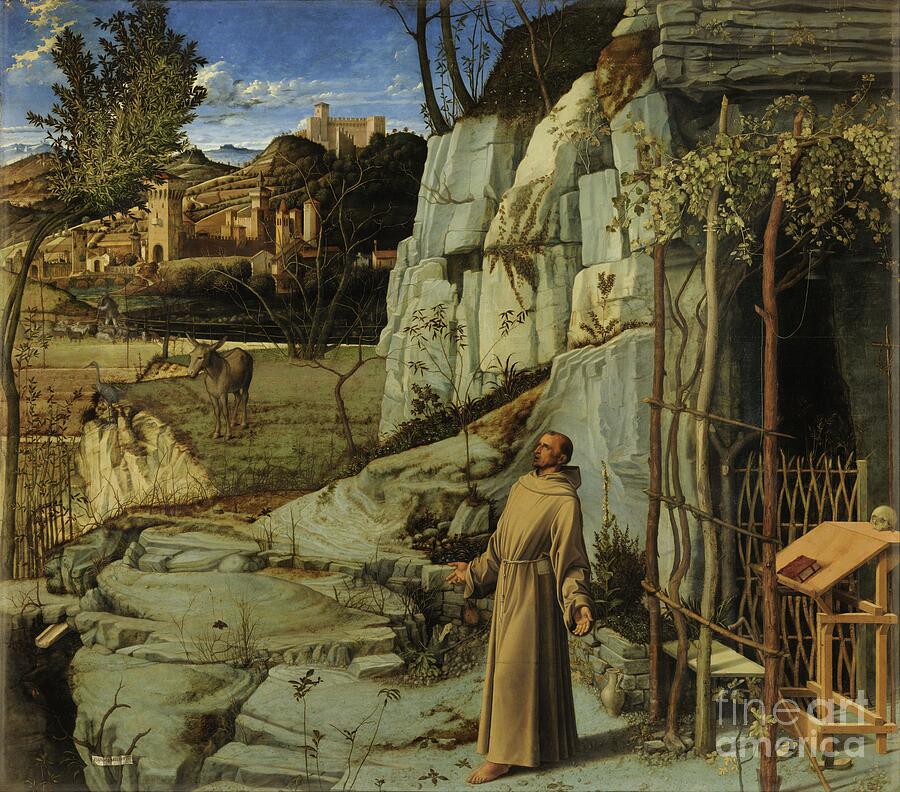
Hang the painting as Bellini made it, with every leaf, stone and animal in its place, as a print, canvas or framed print from the Sapiens Verbum print shop.
 Choose your size and frame →
Printed and shipped by Fine Art America · 30-day money-back guarantee
💬 Over to you: What do you think Francis is looking at: the wounds of Christ, the sun of his Canticle, or something Bellini chose never to show? And where in the world are you reading from? Tell us in the comments.
Comments
Post a Comment