


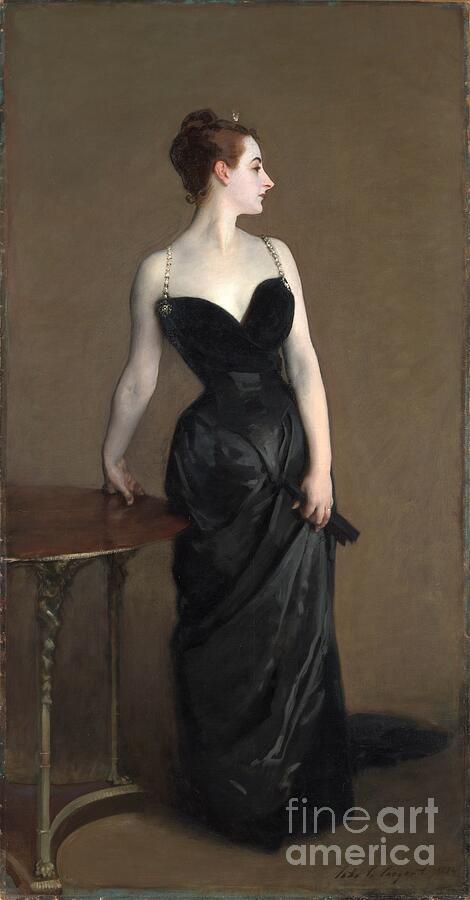
Madame X by Sargent: The Portrait That Scandalized Paris (1884)
A young woman stands in profile against a warm brown background, one hand resting on a small table, the other gathering the folds of a black satin gown. Her skin is so pale it looks almost lavender, her ear is touched with rouge, and her head turns away from us with a kind of proud indifference. Today she is one of the most admired portraits in New York. In the spring of 1884, at the Paris Salon, she was a disaster. John Singer Sargent called the picture “the best thing I have done” — and it very nearly ended his career in Paris.
🖼️ Get this painting as a print →
Artist: John Singer Sargent (1856–1925), American painter, born in Florence
Title: Madame X (Madame Pierre Gautreau), shown at the Salon as Portrait de Mme ***
Date: 1883–84
Medium: Oil on canvas, 208.6 × 109.9 cm
Collection: The Metropolitan Museum of Art, New York, Arthur Hoppock Hearn Fund, 1916 (16.53), The American Wing, Gallery 771
Notable fact: At the 1884 Salon the right strap of the gown hung off her shoulder; after the scandal Sargent repainted it in place.
A portrait nobody ordered
The sitter was Virginie Amélie Avegno Gautreau (1859–1915), born in Louisiana and married to a French banker, Pierre Gautreau. In Paris she was famous less for anything she said than for how she looked: a striking profile, pale powdered skin and a talent for turning every entrance into a performance. She was what the French called a professional beauty.
Sargent, still in his twenties and one of the most gifted young portraitists in Paris, wanted to paint her precisely because she was so talked about. There was no commission. He persuaded her to pose, with her full agreement, and planned the picture as a showpiece for the Salon — the painting that would make his name and bring in a stream of wealthy clients. The Met’s technical studies show how hard he worked at it: X-rays reveal changes to her profile, a shift in the position of the ear and adjustments to both arms.
Looking at the pose
Everything in the picture is built on contrast. The black dress is almost a flat silhouette, cut very low and held up by two thin jewelled straps. Against it, the skin of the shoulders, arms and chest is painted in cool, almost unnatural tones of pink and grey. The body faces us, the head turns sharply away, and the right arm twists back to rest on the table. It is a pose of elegance and tension at the same time, as if she were showing herself off and refusing to look at us in the same moment.
The background is plain and warm, with nothing to distract from the outline of the figure. Sargent tried other colours first: visitors to his studio described a palette of blue, green, white and black, and he later wrote that he had “dashed a tone of light rose over the former gloomy background” before settling on the neutral brown we see now. A thin glimpse of the earlier colour still shows along the edge of the canvas.
The 1884 Salon scandal
Sargent sent the portrait to the Salon of 1884 under the discreet title Portrait de Mme ***, but everyone in Paris recognised the sitter at once. As he had painted it, the right strap of her gown had slipped down off her shoulder. To many visitors that single detail turned a society portrait into something close to a picture of undress, and the reaction was hostile. Critics mocked the strange colour of her skin and the exaggerated pose; visitors laughed and joked in front of the canvas.
Madame Gautreau and her mother were mortified and begged Sargent to withdraw the painting. He refused, insisting he had painted her exactly as she appeared. But when the Salon closed he took up his brush again and repainted the fallen strap, firmly back on the shoulder. A photograph of his studio taken in 1885 is the first record of the change. Sargent himself later referred to the episode as “the Gautreau disaster”.
From Paris to London
The commissions Sargent had hoped for did not come. In 1886 he moved to London, where he would live for the rest of his life, and according to the Met the uproar over the portrait may well have influenced that decision. It did not ruin him for long. Within a decade he was the most sought-after portrait painter in Britain and America — the painter of society beauties, industrialists and aristocrats, and of luminous outdoor pictures such as Carnation, Lily, Lily, Rose, painted in the English countryside a year after he arrived.
The portrait itself stayed in his studio. For more than twenty years he declined to exhibit it publicly, and by the time he did, the scandal had begun to work in its favour.
How Madame X came to the Met
In 1915 Sargent sent the painting to the Panama-Pacific International Exposition in San Francisco. On 8 January 1916, writing from London to his friend Edward Robinson, director of the Metropolitan Museum, he offered it to the museum: “now that it is in America I rather feel inclined to let it stay there if a Museum should want it. I suppose it is the best thing I have done. I would let the Metropolitan Museum have it for £1,000.” The Met bought it that year through the Arthur Hoppock Hearn Fund. Sargent asked only that the sitter’s name be kept discreet, and so the picture entered the collection as Portrait of Madame X. Virginie Gautreau had died the year before.
How to read it today
Seen now, the fallen strap seems a small thing, and the real power of the painting lies elsewhere: in the daring simplicity of the silhouette, in the way Sargent turns a real woman into an almost abstract image of style and self-display. Madame X is a portrait of a person, but also a portrait of celebrity itself — of a woman who made her appearance into her art, and of a young painter who gambled his reputation on painting it exactly as it was.
Hang Sargent’s Madame X — the black gown, the pale profile, the most famous scandal of the Paris Salon — as a print, canvas or poster from the Sapiens Verbum print shop. The museum image and the commercial print are separate.
 Choose your size and frame →
Printed and shipped by Fine Art America · 30-day money-back guarantee
💬 Over to you: Was Sargent right to repaint the strap, or should he have left Madame X exactly as Paris first saw her? Tell us in the comments.
Sources
The Metropolitan Museum of Art — John Singer Sargent, Madame X (Madame Pierre Gautreau) (16.53)
The Met — From the Archives: How Madame X Came to The Met
The Met — Revealing Madame X
Wikipedia — Portrait of Madame X
Sapiens Verbum — Madame X, John Singer Sargent
Watch: Madame X explained
Comments
Post a Comment