The Literary Quintet by Wilhelm Menzler: A Reading Party on the Terrace (1910)
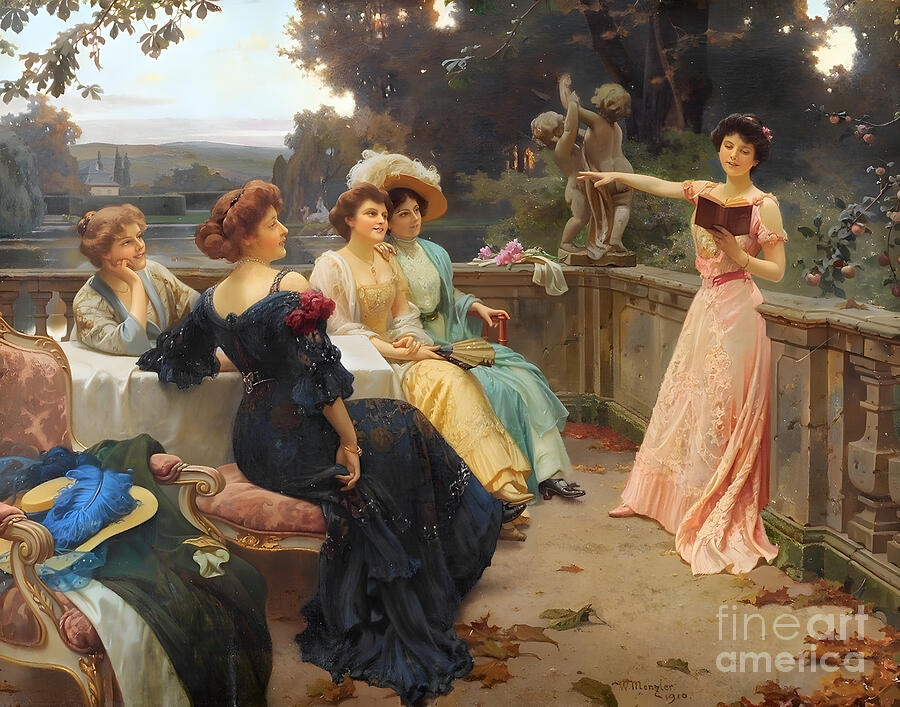
On a stone terrace above a park, a young woman in a pale pink gown stands with an open book, reading aloud and pointing with her free hand as if the words demanded it. Four friends listen from the balustrade and the garden sofa: one leans her chin on her hand, one turns her whole body toward the reader, two sit close together, one of them under a wide feathered hat. Behind them a cupid statue plays among the trees and a lake opens toward distant hills. The Literary Quintet, painted by the German artist Wilhelm Menzler and signed and dated 1910, is a picture about one of the quiet pleasures of its age: listening to someone read.
Artist: Wilhelm Menzler (1846–1926), born in Kassel
Date: 1910 (signed and dated lower right, “W. Menzler 1910”)
Medium: Oil on canvas
Subject: Five women on a garden terrace; one reads aloud to the others
Notable fact: Part of the Best Sellers collection of the Sapiens Verbum print shop
What does The Literary Quintet show?
The composition is built like a small stage. On the right, the reader stands alone against the stone balustrade, the only upright figure in the picture. Her pink dress, trimmed with lace and a ribbon at the waist, catches the light. She holds the book close in her left hand and extends her right arm toward the garden, a gesture that belongs as much to the theatre as to the drawing room.
Her audience fills the left half of the canvas. The woman nearest to us sits with her back half turned, in a dark blue evening dress with a red flower at the shoulder; we see only her profile. Beside her sit a woman in yellow, holding a folded fan, and a woman in pale green under a wide straw hat trimmed with white feathers. Further back, a fifth figure rests her chin on her hand, the classic pose of a listener lost in thought. On the upholstered sofa in the foreground lie a straw hat with a blue feather and a folded shawl, as if the group had arrived on a walk and settled down for the afternoon.
Why is the setting so important?
Menzler sets the scene on a terrace that belongs to a large house or park. Fallen autumn leaves lie on the flagstones and fruit hangs from a tree on the right, so the season seems to be late summer turning to autumn. Behind the reader, a statue of cupids stands among the trees. Beyond them, the view opens onto a lake and a distant landscape with a church tower in soft evening light.
The details are chosen to frame the reading. The cupids hint that the book might be a love story or a volume of poetry, although the painting never tells us which. The open landscape suggests the imaginative distance that a good story creates. The women are gathered in a protected, private space, and the book is what takes them somewhere else.
Who was Wilhelm Menzler?
Wilhelm Menzler was born in Kassel, in central Germany, in 1846, and died in 1926. He worked for much of his career in Munich, then one of the great art centres of Europe, and painted portraits, genre scenes and flowers. His work was shown in the official annual exhibition at the Munich Glaspalast; the catalogue of the 1897 exhibition reproduces one of his portraits. He also exhibited in Vienna.
Menzler is not a name found in most art history books, and the documentation on many of his paintings is thin. We have not found a museum record for The Literary Quintet, and we do not know where the original hangs today, so we will not guess. What we can do is look closely, and the painting rewards that: the handling of silk, lace and feathers, the reflected light on the faces and the careful balance of the five figures show a painter fully trained in the polished style of the Munich school.
Why was reading aloud such a popular subject?
Around 1900, reading aloud was a normal part of social life for middle- and upper-class families. Before radio, a novel, a newspaper serial or a book of poems read by one person to a small group was a shared entertainment, and in many homes it was one of the most common ways women spent time together. Painters across Europe returned to the theme again and again, from intimate interiors to garden parties like this one.
What makes Menzler’s version appealing is its mood of attention. No one looks at the viewer. Every face turns toward the reader, and the painting invites us to join the circle and listen. It is easy to see why the image works so well on a wall at home, above a reading chair or in a library corner. If the painting makes you want to pick up a book yourself, browse our reading recommendations. For another quiet garden scene of the same years, read our essay on Waterhouse’s The Soul of the Rose (1908), and for the art of books today, our news story on the NY Art Book Fair.
Get Menzler’s The Literary Quintet as a museum-quality print, canvas, or poster from the Sapiens Verbum print shop.
Shop This Print →
Watch on @SapiensVerbum: The Literary Quintet: Five Women, One Book and a Perfect Afternoon.
Comments
Post a Comment