
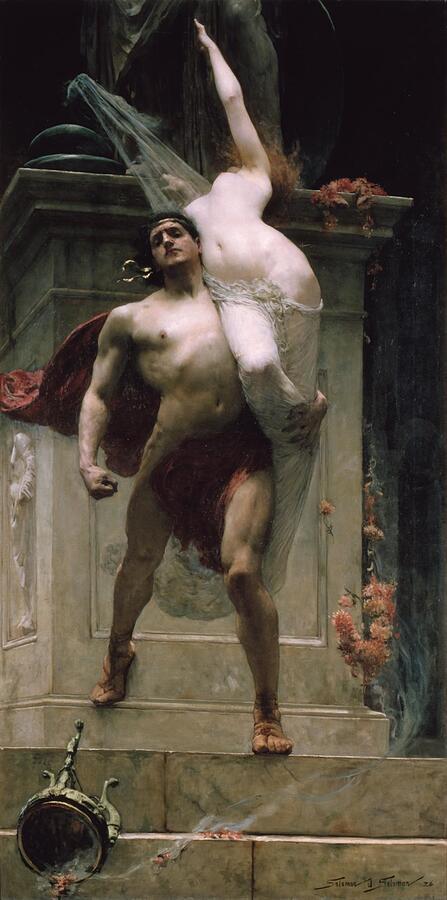
Ajax and Cassandra by Solomon J. Solomon: Sacrilege at the Fall of Troy (1886)
Troy is burning, and in the temple of Athena a Greek warrior strides down from the goddess's pedestal with a woman thrown over his shoulder. She twists upward, one arm stretched towards the statue above her, her fingers still tangled in a veil that clings to the stone. This is Ajax and Cassandra, painted in 1886 by the young British artist Solomon Joseph Solomon: a canvas three metres tall that shows the most sacrilegious moment of the fall of Troy at life size.
🖼️ Get this painting as a print →
Artist: Solomon Joseph Solomon (1860–1927)
Date: 1886
Medium: Oil on canvas, 304.5 × 152.5 cm
Collection: Art Gallery of Ballarat, Victoria, Australia (purchased 1887)
First shown: Royal Academy, London, 1886
What is the story?
Cassandra was a princess of Troy, daughter of King Priam. Apollo gave her the gift of prophecy, and when she refused him he added a curse: she would always tell the truth, and no one would ever believe her. She warned the Trojans against the wooden horse, and they laughed. On the night the city fell, she ran to the temple of Athena and clung to the goddess's statue, the one place where a suppliant was supposed to be safe.
Ajax the Lesser, leader of the Locrians, dragged her away. In the oldest versions of the story the statue itself was pulled down in the struggle. The crime was so great that even the other Greeks wanted to punish him, and Athena did: on the voyage home she wrecked his fleet, and when Ajax boasted that he had escaped the sea in spite of the gods, Poseidon split the rock he was clinging to and drowned him.
What does the painting show?
Solomon builds the whole picture on one powerful diagonal. Ajax, naked except for a red cloak, a headband and sandals, steps down the marble stairs with his fist clenched, looking out at us with something close to defiance. Cassandra is thrown over his shoulder, her pale body turned away from him and stretched upward towards Athena, whose dark bronze statue stands above them in the shadows. The thin veil running from her hand to the statue is the last link between the victim and the goddess who should protect her.
The details tell us this is a sacred place being violated. Garlands of red and pink flowers, offerings to the goddess, hang from the altar and fall across the steps. A bronze lamp or vessel has been knocked over and rolls on the step at the lower left. On the side of the pedestal a carved relief of a robed figure watches, untouched. The painting is signed and dated at the bottom right, "Solomon J. Solomon 86".
The format matters too. At more than three metres high and only one and a half wide, the canvas is as tall as a doorway, and the figures are larger than life. It was made to stop visitors in their tracks at the Royal Academy, where it was shown in 1886.
A French training in London
Solomon was born in London in 1860 and was only twenty-six when he painted this. He had studied at Heatherley's, at the Royal Academy Schools and in Munich, and then in Paris at the École des Beaux-Arts under Alexandre Cabanel, the painter of The Birth of Venus. That Paris training shows everywhere here: the anatomy studied from the model, the smooth flesh, the theatrical light. The same taste for violent classical drama appears in Bouguereau's Dante and Virgil and Orestes Pursued by the Furies.
In Britain the closest parallel is Frederic Leighton, whose Perseus and Andromeda shows another woman of myth at the mercy of male power. The difference is in the tone: where Leighton is cool and decorative, Solomon is physical and brutal.
Solomon went on to a distinguished career. He became a full member of the Royal Academy in 1906, one of the few Jewish painters to do so, and later president of the Royal Society of British Artists. During the First World War he became a pioneer of military camouflage, designing fake trees used as observation posts on the Western Front. He died in Kent in 1927.
Why is it in Australia?
In 1887 the painting travelled to Melbourne for exhibition and was bought for the gold-rush city of Ballarat, with help from the colonial government. The reviews called it a masterpiece, but for a time the gallery hung it out of the way so as not to offend delicate sensibilities. Modern critics are divided: the art historian Elizabeth Prettejohn has called it a textbook work of patriarchal misogyny, while the gallery counts it among its most loved paintings. Both readings are possible because Solomon makes the violence so hard to look away from.
The figure of Cassandra, the woman who sees the truth and cannot make anyone listen, has never lost its force. For another enchantress of Greek myth seen through Victorian eyes, read our essay on Waterhouse's Circe Offering the Cup to Odysseus.
See Solomon’s Ajax and Cassandra framed on your wall: a museum-quality print, canvas or poster from the Sapiens Verbum print shop.
 Choose your size and frame →
Printed and shipped by Fine Art America · 30-day money-back guarantee
Watch the video essay (in Spanish) on @SapiensVerbum on YouTube.
Sources
Wikipedia, "Ajax and Cassandra" and "Solomon Joseph Solomon"; Homer, Odyssey, book 4 (the death of Ajax the Lesser).
Comments
Post a Comment