

Anders Zorn's Nudes: Skin, Water and Light in the Swedish Summer
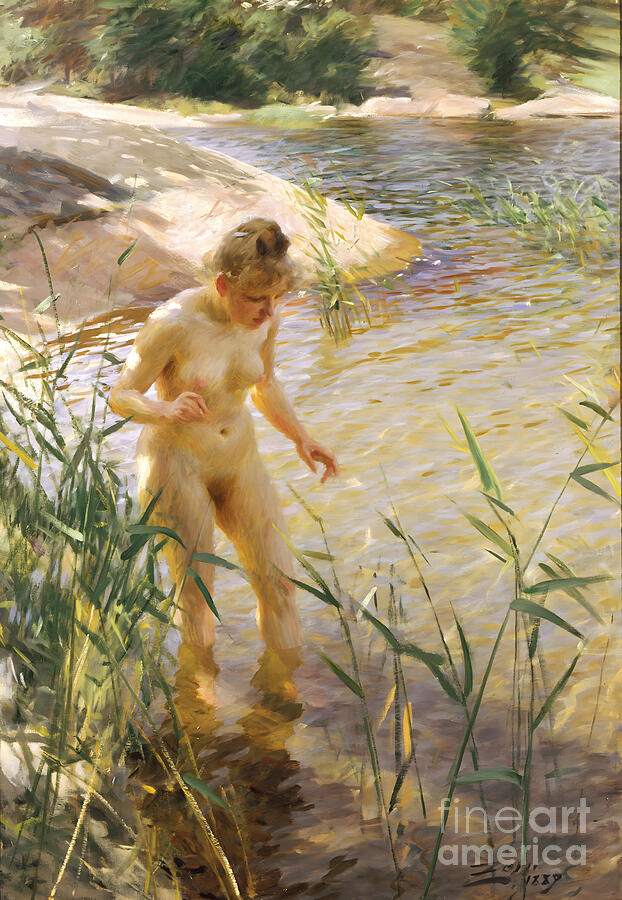
A woman steps into shallow water among the reeds. Sunlight breaks on the surface, and the same broken light runs across her shoulders and hips. There is no goddess here, no myth and no marble: only a real body outdoors on a Swedish summer day. Anders Zorn (1860–1920), the Swedish painter best known in his lifetime for portraits of kings and American presidents, also painted some of the freshest nudes of his era. Painted on the rocky shores of the Stockholm archipelago and by the lakes of Dalarna, they are studies of skin, water and light.
Artist: Anders Zorn (1860–1920), born in Mora, Dalarna, Sweden
Subject: Outdoor nudes, mostly painted from the 1880s to the 1910s
Media: Oil, watercolour and etching
Where to see his work: Zornmuseet (Mora), Nationalmuseum (Stockholm), Musée d'Orsay, the Metropolitan Museum of Art, Museum of Fine Arts, Boston
Notable fact: Zorn often worked with a famously limited palette of just four colours
Who was Anders Zorn?
Zorn was born in 1860 and grew up on his grandparents' farm near Mora, in the province of Dalarna in central Sweden. He trained at the Royal Swedish Academy of Arts in Stockholm from 1875 to 1880 and quickly became known for his talent. After years of travel and work in London, Paris, Spain, Italy and the United States, he became one of the most highly regarded portrait painters of his era. His sitters included King Oscar II of Sweden and three American presidents: Grover Cleveland, William H. Taft and Theodore Roosevelt. At the Paris Exposition Universelle of 1889, aged only 29, he was made a Chevalier of the Legion of Honour.
Portraits made him rich, but Zorn never lost his attachment to Dalarna. In 1886 he and his wife Emma bought land near Mora church, and the house they enlarged there, Zorngården, became their home. The landscape and people of the region, and the summer light of the Swedish lakes and coast, run through his most personal work, including his nudes.
Why did Zorn paint nudes outdoors?
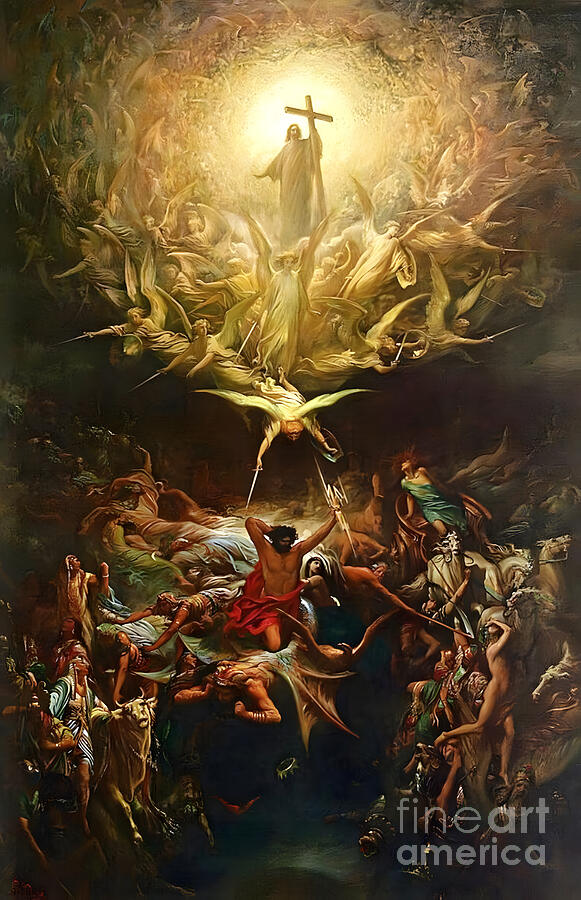
For centuries the nude in European painting had been an indoor subject, set in the studio and justified by mythology: Venus, nymphs, bathers from ancient stories. Nineteenth-century academic painters such as Alexandre Cabanel still followed that model, as you can see in Cabanel's Birth of Venus. Zorn took the naked figure out of the studio and put it in real places: on sun-warmed rocks by the sea, at the edge of a forest lake, in a boat. His models were not goddesses but local women, painted with the same frankness as the landscape around them.
That choice was as much about painting as about the body. Zorn was fascinated by what light does when it passes through water and leaves, and by how it changes the colour of skin. Outdoors, a shoulder can be warm in the sun and cool in reflected light from the water at the same time. The nude became his way of studying that.
Skin, water and light
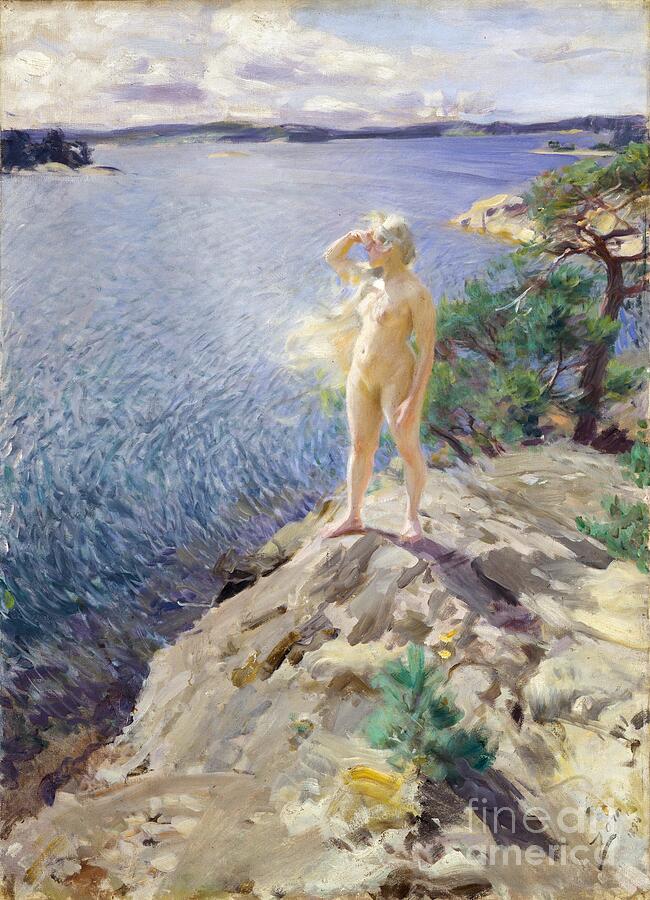
In In the Skerries (1894) a young woman stands on a granite outcrop in the Stockholm archipelago, one hand raised to shade her eyes. Below her, the sea is painted in quick, broken strokes of blue and white, and the same restless brushwork continues across the rocks and her body. Nothing is smoothed or polished. The figure is part of the scene, lit by the same wind and sun.
In Reflexer (Reflections), shown at the top of this article, the effect is even stronger. The woman wades into shallow water among reeds, and the reflections of the sky and the surrounding shore dissolve around her legs. Zorn builds the picture from confident, visible strokes, so that up close it is almost abstract, and from a distance it suddenly becomes water, sunlight and skin.
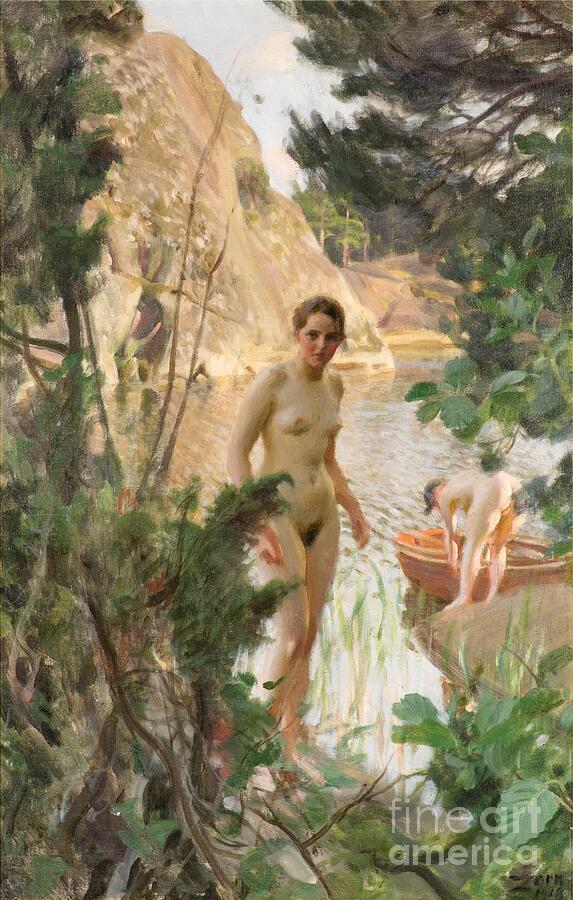
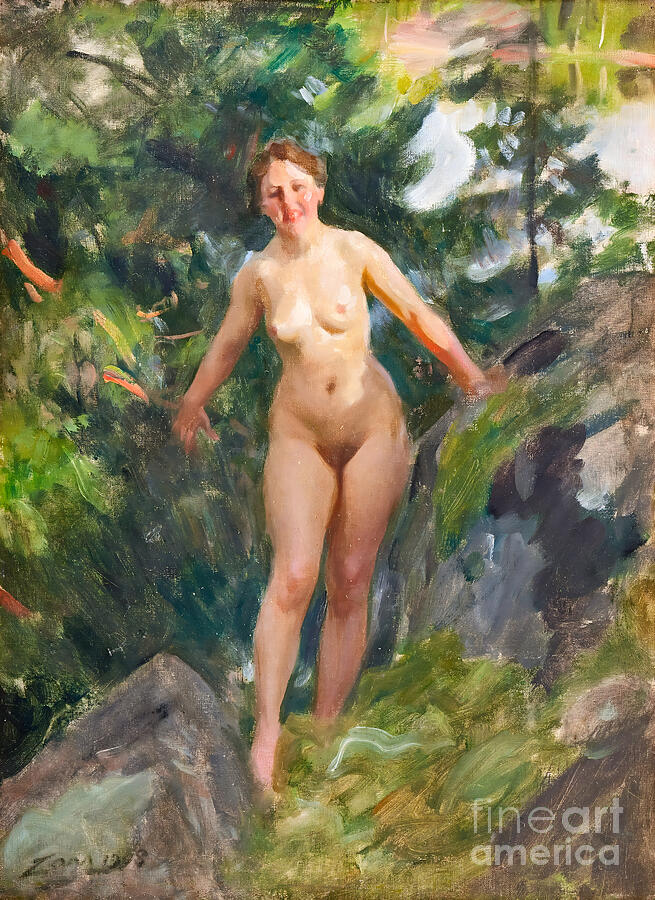
Some pictures tell a small story without needing a myth. In Jollen (The Dinghy) one woman stands among the pines on a steep shore while another sits in a small wooden boat below. It is the kind of scene a summer visitor might glimpse on any Swedish lake: bathers, a boat, trees, bright water. In Naked in a Rocky Forest (1908) a woman steps forward out of the green shadows of the trees, the light catching her body as if she had just walked into a clearing.
What is the "Zorn palette"?
Part of the fascination of Zorn's work for painters today is his palette. He is known for working with a very limited set of colours: lead white, yellow ochre, vermilion and ivory black. It sounds too little to paint a landscape, let alone skin in sunlight, yet the combinations give a remarkable range. Ivory black has a bluish tone, so mixed with white it gives cool greys that read almost as blue, and mixed with yellow ochre it gives olive greens. Vermilion and ochre supply the warm notes of skin. The so-called "Zorn palette" is still taught in painting classes as an exercise in doing more with less.
The principle shows clearly in his nudes: the warmth of the body set against cooler greys and greens, with no colour wasted.
The etched nudes
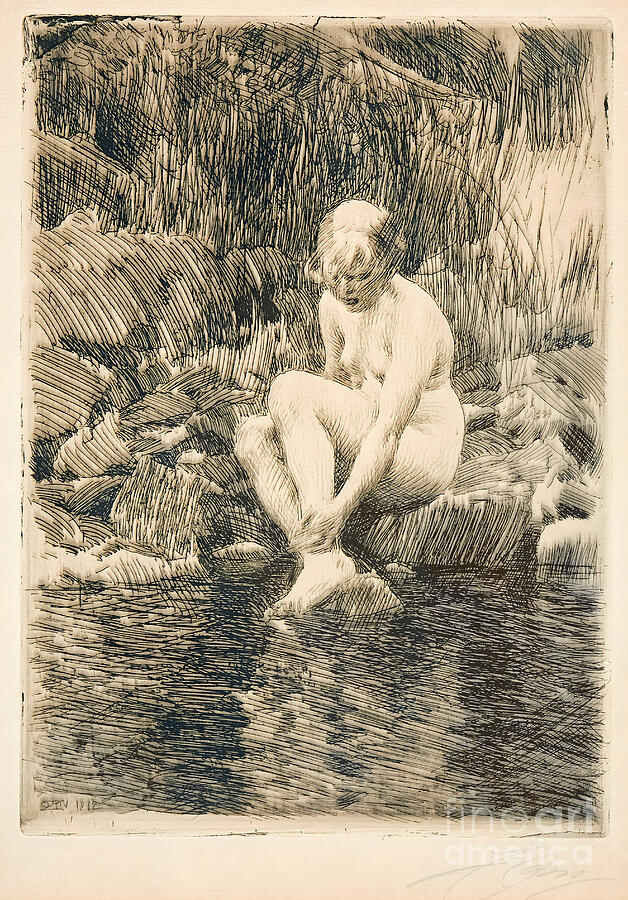
Zorn was also a highly accomplished etcher, and many of his nudes exist as prints. In an etching, he had only black lines on white paper, so he suggested light and water through the direction and density of his lines. In Dagmar (1911), a seated model rests on the rocks at the water's edge, and the reflections below her are built from long, parallel strokes that seem to move like the surface of the lake.
How were the nudes received?
Zorn's international reputation rested on his portraits, but today his nudes are among his best-known works. His preference for strong, full-figured country women even gave rise to a local word: such women came to be called a Zornkulla, after kulla or dalkulla, the local word for an unmarried woman or girl from Dalarna. Unlike the idealised nudes of the Paris Salon, his figures are individual and healthy, closer to the rural world he came from than to the studio.
His nudes belong to the same late nineteenth-century fascination with the human body that produced very different pictures, such as Falero's reclining nudes or John Collier's Lilith. Set beside them, Zorn's bathers look almost like snapshots of summer.
Where to see Zorn's work
The best place to understand Zorn is Mora itself. The Zorn Collections there include Zornmuseet, opened in 1939 and designed by the architect Ragnar Östberg, and Zorngården, the artist's home, preserved much as it was when Emma Zorn died in 1942. In Stockholm, the Nationalmuseum holds major works, including the famous Midsummer Dance (1897). Outside Sweden, his paintings can be seen at the Musée d'Orsay in Paris, the Metropolitan Museum of Art in New York and the Museum of Fine Arts, Boston.
Browse all of Anders Zorn’s paintings and etchings in the Sapiens Verbum print shop, as museum-quality prints, canvas or posters.
See the Zorn Collection →
Watch the video essay on @SapiensVerbum on YouTube.
Comments
Post a Comment