

Woman with a Parasol by Monet: Camille and Jean on a Windy Hill (1875)
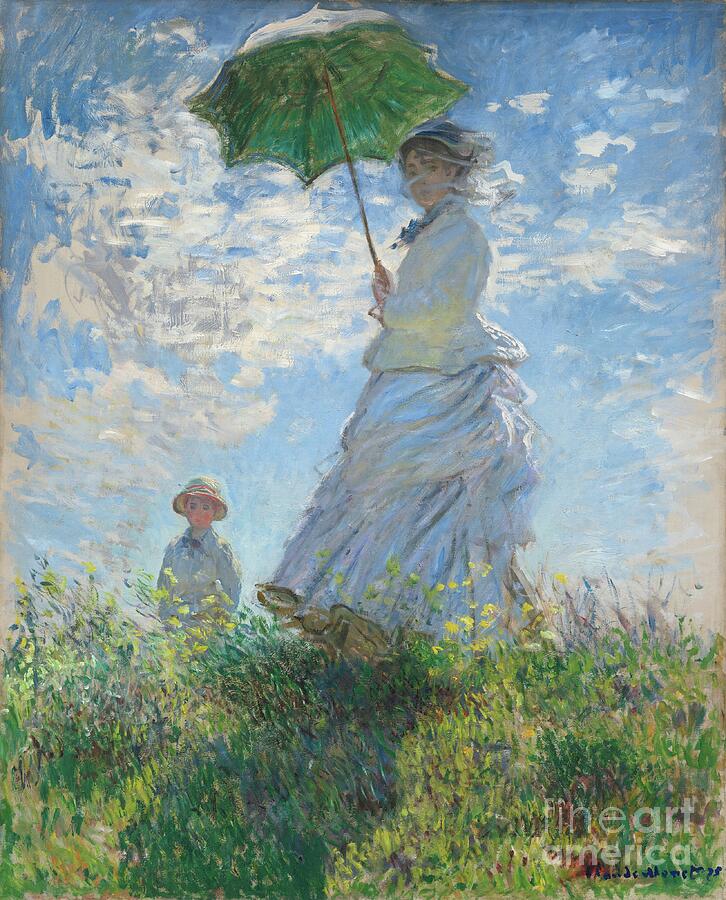
A woman stands on the crest of a grassy hill, seen from below against a bright, windy sky. A green parasol shades her face, a veil flutters across it, and her white dress seems to dissolve into the clouds behind her. A little farther back, half hidden by the slope, a small boy in a straw hat looks on. Claude Monet painted Woman with a Parasol – Madame Monet and Her Son in the summer of 1875, near his home at Argenteuil, and the models were his own wife, Camille, and their son, Jean. It looks like a snapshot of a family walk, and in a sense that is exactly what it is.
🖼️ Get this painting as a print →
Artist: Claude Monet (1840–1926), French painter
Title: Woman with a Parasol – Madame Monet and Her Son (also known as The Promenade)
Date: 1875, signed lower right “Claude Monet 75”
Medium: Oil on canvas, 100 × 81 cm
Collection: National Gallery of Art, Washington, D.C., Collection of Mr. and Mrs. Paul Mellon (1983.1.29), West Building, Gallery M85
Notable fact: Shown at the Second Impressionist Exhibition in Paris in 1876 under the title Promenade.
Looking up at the hill
The first thing Monet does is put us low down, almost lying in the grass. From there Camille rises above the horizon, so that nothing stands behind her except sky. The parasol nearly touches the top edge of the canvas, and her long shadow runs diagonally down the slope towards us. The tall format makes her seem even taller, like a figure on a monument — but a monument made of wind and light rather than stone.
Jean, who was seven that summer, stands on the far side of the rise, cut off at the waist by the grass and flowers. He is small, still and slightly apart, a quiet counterweight to his mother’s swirling skirts. Together they make a simple, unforgettable composition: one large figure in motion, one small figure at rest, and an enormous sky.
Painting the wind
This is a picture about weather as much as about people. The sky is laid in with quick, chaotic strokes of blue, grey and white, and in places Monet left the canvas itself showing through in his hurry. The veil across Camille’s face is just a few long strokes of white. Her skirt billows to the left, the grass bends the same way, and the clouds seem to race behind her. Nothing is outlined; everything is suggested.
The colour is just as alive. Small dabs of yellow in the grass suggest buttercups, and Monet lets that same yellow reflect on Camille’s sleeve. Her white dress is not really white at all: it is built from pale blues, greys and touches of yellow, with dense slashes of brilliant white where the sun strikes the back of her skirt and jacket. According to the National Gallery of Art, the canvas was completed in a single outdoor session — a celebration of colour and light caught before it could change.
Argenteuil, 1875: a family in the open air
In the mid-1870s Monet lived at Argenteuil, a small town on the Seine just outside Paris, and its fields, gardens and riverbanks became his open-air studio. Camille Doncieux, his first wife, appears again and again in the pictures of these years: reading in the garden, sitting in the meadow, walking among the poppies. Here she is not posing for a portrait in the traditional sense. She is caught turning her head towards the painter, as if he had just called out to her during a walk.
That intimacy is part of the picture’s charm, and part of its sadness for anyone who knows what came next. Camille died in 1879, aged only thirty-two. In 1886 Monet returned to the theme with two paintings of a woman with a parasol on a hill, now in the Musée d’Orsay. This time the model was Suzanne Hoschedé, and her face is left almost blank.
From the 1876 exhibition to Washington
Monet showed the painting at the Second Impressionist Exhibition in Paris in 1876, simply as Promenade. That same year it was acquired from the artist by Dr. Georges de Bellio, a Romanian-born physician and one of the earliest and most loyal collectors of the Impressionists. It passed to his daughter, later belonged to Georges Menier of the chocolate-making family, and was bought at the Menier sale in Paris in 1965 for the American collector Paul Mellon. Paul and Bunny Mellon gave it to the National Gallery of Art in 1983, where it has become one of the museum’s most loved pictures.
How to read it today
It is easy to see Woman with a Parasol as a pretty summer image, and it is one. But it is also a small manifesto of Impressionism: a modern woman in everyday clothes, painted outdoors, quickly, with visible brushstrokes and with the light and the wind as true subjects. The figures are real people, yet Monet treats them almost the same way he treats the clouds — as passing effects, there for a moment and then gone. To see how far he would push that idea, compare it with his late, almost dissolved view of London in The Houses of Parliament, Sunset, painted nearly thirty years later.
Hang Monet’s Woman with a Parasol — the windy hill, the green parasol, the blue summer sky — as a print, canvas or poster from the Sapiens Verbum print shop.
 Choose your size and frame →
Printed and shipped by Fine Art America · 30-day money-back guarantee
💬 Over to you: Do you see a happy family moment, or a fleeting one Monet already knew he could not hold? Tell us in the comments.
Sources
National Gallery of Art — Claude Monet, Woman with a Parasol – Madame Monet and Her Son (1983.1.29)
Wikipedia — Woman with a Parasol – Madame Monet and Her Son
Sapiens Verbum — Woman with a Parasol, Claude Monet
Comments
Post a Comment