
The Calling of Saint Matthew by Caravaggio: A Beam of Light and a Question (1600)
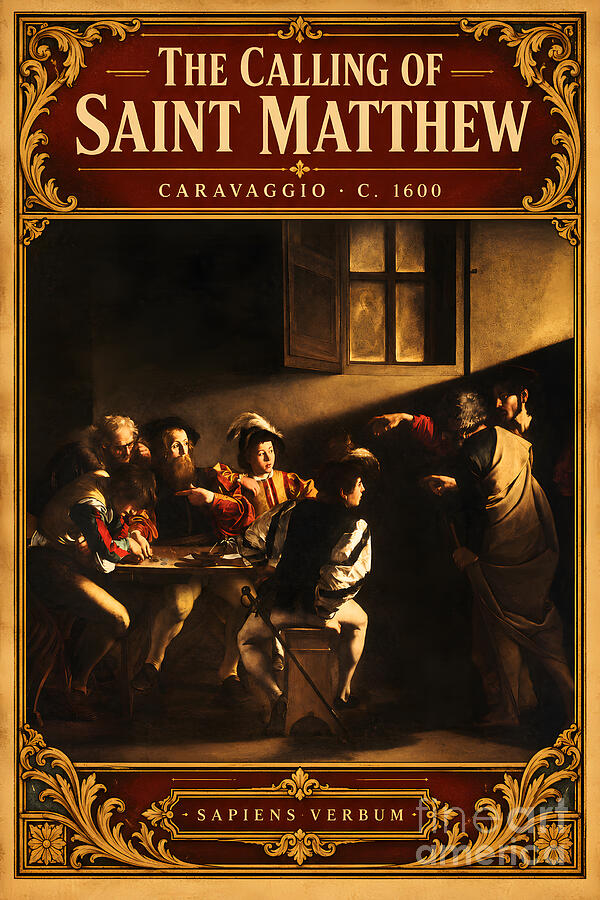
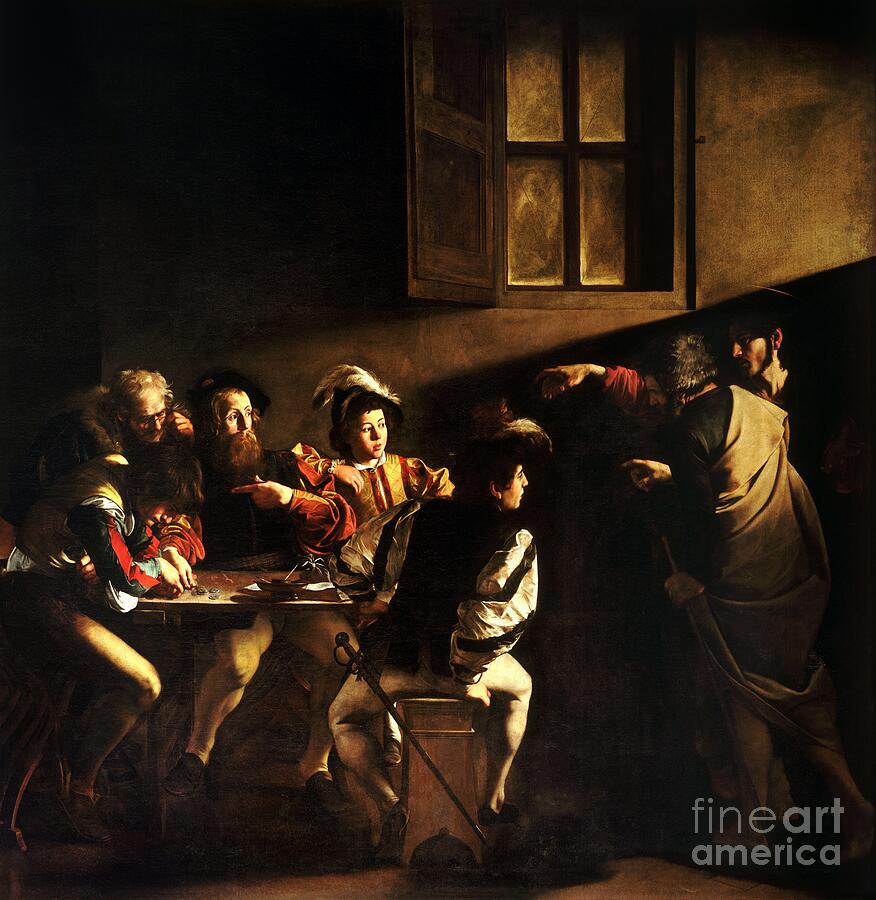
Five men sit around a table in a dark room, counting money. Two more have just come in through a door we cannot see. One of them, half hidden in shadow, raises his hand and points. A shaft of light cuts across the wall above him and falls on the faces at the table. A bearded man looks up and points at himself, as if to say: me? Caravaggio painted The Calling of Saint Matthew for a chapel in Rome in 1599–1600, and four centuries later it is still one of the most famous gestures in art. The picture below is our vintage poster version of the painting; the original canvas is shown further down.
🖼️ Get the vintage poster → License this image →
Artist: Michelangelo Merisi da Caravaggio (1571–1610)
Title: The Calling of Saint Matthew
Date: 1599–1600
Medium: Oil on canvas, 322 × 340 cm
Location: Contarelli Chapel, San Luigi dei Francesi, Rome
Subject: Matthew 9:9, the call of the tax collector Levi
A tax office in Rome
The Gospel tells the story in a single verse. Jesus passes by, sees a man called Matthew sitting at the receipt of custom, and says to him: “Follow me.” And Matthew gets up and follows him (Matthew 9:9). Caravaggio set this moment not in ancient Palestine but in a room that his viewers would have recognised. The men at the table wear the clothes of Rome around 1600: feathered caps, slashed sleeves, a sword at the hip. They look, as Smarthistory puts it, like people Caravaggio might have met in the streets. On the left, an old man in spectacles bends over the coins, and a young man counts them with his head down. They have not even noticed that anyone has come in.
On the right stand Christ and Saint Peter. Peter’s body almost covers Christ’s; we see only his head, with a thin halo, and his arm reaching across the room. Peter repeats the gesture more hesitantly, as if he were the bridge between Christ and the men at the table.
The hand of Adam
Look closely at Christ’s hand. Its relaxed fingers are almost exactly the hand of Adam in Michelangelo’s Creation of Adam on the Sistine Chapel ceiling. Scholars read the quotation as a theological idea: Saint Paul calls Christ the “last Adam”, and here the gesture that once received life now gives it, calling a tax collector into a new life. For a Roman audience who knew the Sistine Chapel, the reference would have been easy to see.
Light as a voice
The real actor in the picture is the light. It does not come from the window on the wall, which is dark and shuttered, but from somewhere above and behind Christ, falling diagonally across the room to the faces at the table. Caravaggio used the stark contrast of light and dark, later called tenebrism, to make the invisible call visible. The beam runs parallel to Christ’s arm, so that the light itself seems to be pointing at Matthew. It was a new way of painting a miracle: no clouds, no angels, only a shaft of light in an ordinary room.
Who is Matthew?
For most of the painting’s history, Matthew has been identified as the bearded man in the centre, pointing at himself. The same model appears as Matthew in the other two paintings in the chapel. But some art historians have argued that the bearded man is pointing at the young man at the end of the table, the one still bent over the money, and that he is the real Matthew, a moment before he looks up. Others think Caravaggio left the question open on purpose. Whichever reading you choose, the painting catches the instant before a decision, when the money is still on the table.
Caravaggio’s first great public commission
The painting hangs where it was made to hang, on the left wall of the Contarelli Chapel in the French national church of San Luigi dei Francesi. The chapel had been paid for by the French cardinal Matthieu Cointerel, who left instructions in his will for scenes from the life of his name saint. The commission for the two side paintings dates from July 1599, and Caravaggio received the final payment in July 1600. Opposite hangs The Martyrdom of Saint Matthew, and above the altar The Inspiration of Saint Matthew (1602). It was Caravaggio’s first major church commission and the work that made his name in Rome. Pope Francis later recalled visiting the chapel as a young man to look at the painting: “This is me, a sinner on whom the Lord has turned his gaze.”
Why it works as a vintage poster
The Sapiens Verbum poster keeps the whole drama: the shuttered window, the diagonal of light, the startled faces and the pointing hand, framed in gold under a deep red title panel. Caravaggio’s dark background becomes the perfect ground for a vintage design. For more of his work, see our essay on The Taking of Christ and the page Caravaggio: Every Painting We’ve Explained.
Hang Caravaggio’s Calling of Saint Matthew — the beam of light, the pointing hand and the question me? — as a vintage art poster from the Sapiens Verbum print shop.
 Choose your size and frame →
See the vintage poster collection →License this image →
Hang the painting as Caravaggio made it, darkness and all, as a print, canvas or framed print from the Sapiens Verbum print shop.
 Choose your size and frame →
Printed and shipped by Fine Art America · 30-day money-back guarantee
💬 Over to you: Who do you think is Matthew: the bearded man pointing at himself, or the young man who has not looked up yet? And where in the world are you reading from? Tell us in the comments.
Sources
Wikipedia — The Calling of Saint Matthew
Smarthistory — Caravaggio, Calling of Saint Matthew
Wikipedia — The Martyrdom of Saint Matthew (Caravaggio)
Comments
Post a Comment