
The Adoration of the Kings by Jan Gossaert: The Christmas Altarpiece He Signed Twice, as a Vintage Poster (1510–15)
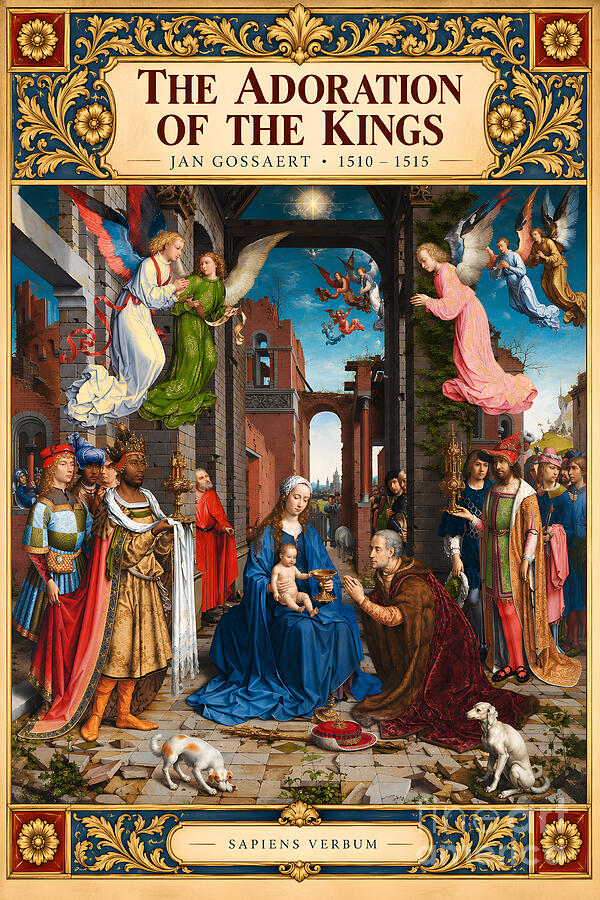
Three kings have travelled from the ends of the earth. In a grand building that is already falling into ruin, Caspar kneels before the Virgin and offers the Christ Child a golden cup full of gold coins, while Melchior and Balthasar wait their turn with their courtiers. Around them crowd shepherds, an ox and a donkey, two dogs, and a choir of angels looking down through the broken roof. Jan Gossaert painted The Adoration of the Kings in about 1510–15, and it is one of the most spectacular Christmas pictures of the Northern Renaissance. The picture below is our vintage poster of the painting; the original is shown further down.
🖼️ Get the vintage poster →License this image →
Artist: Jan Gossaert, also called Jean Gossart or Mabuse (active 1508, died 1532), Netherlandish painter
Title: The Adoration of the Kings
Date: 1510–15
Medium: Oil on oak, 179.8 × 163.2 cm
Location: National Gallery, London (NG2790)
Subject: The Magi bring gold, frankincense and myrrh to the Christ Child, Matthew 2:1–11
Gifts for a newborn king
The Gospel of Matthew tells how wise men from the East followed a star to Bethlehem, “and when they were come into the house, they saw the young child with Mary his mother, and fell down, and worshipped him: and when they had opened their treasures, they presented unto him gifts; gold, and frankincense, and myrrh.” By Gossaert’s time the wise men had long been imagined as three kings of different ages from different parts of the world. Here Caspar kneels at the front and holds out a golden goblet of gold coins; the Christ Child has already taken one in his hand. Melchior stands behind him with frankincense, and Balthasar, shown as an African king, approaches from the left with myrrh.
A crowded, glittering stage
Everything in the picture shines: brocade, fur, jewels, armour and goldsmith’s work, all painted with the precision that Netherlandish painters were famous for. But Gossaert fills the scene with humbler figures too. Saint Joseph, in red, stands behind a column; shepherds peer in from the back with the ox and the donkey; two dogs sniff about in the foreground. Above, the Star of Bethlehem shines through the ruined vault, the dove of the Holy Spirit hovers, and angels look down from the broken architecture, one of them holding a scroll with the words Gloria in excelsis Deo. The ruin itself was a familiar symbol: the old order crumbling as a new one is born. On one of the capitals, a small carving of the sacrifice of Isaac points ahead to the Crucifixion.
A signature hidden twice
Gossaert wanted to be remembered for this picture. He signed it twice, on the headdress of the black king Balthasar and on the silver collar of one of his attendants, while the names of Caspar and Balthasar are worked into the goblet lid and the hat. For the composition he looked back to an earlier masterpiece, Hugo van der Goes’s Monforte Altarpiece, and he borrowed details from prints by Albrecht Dürer and Martin Schongauer; one of the dogs comes from Dürer’s engraving of Saint Eustace. Infrared studies show extensive underdrawing and many changes made as he worked, apparently all by his own hand.
From an abbey chapel to Trafalgar Square
Gossaert seems to have painted the altarpiece for the Benedictine abbey church at Geraardsbergen (Grammont) in Flanders, probably for the funerary chapel of Daniel van Boechout, lord of Boelare; at the time the painter was in the service of Philip of Burgundy, later Bishop of Utrecht. In 1601 the Archdukes Albert and Isabella acquired it for the palace chapel in Brussels. It later passed through the collections of Charles of Lorraine and Emmanuel-Marie de Cock, came to London in 1787 and was bought in 1796 by the 5th Earl of Carlisle for Castle Howard. In 1911 the widow of the 9th Earl offered it to the National Gallery for £40,000, and it was bought with a special grant and help from the Art Fund, Lord Glenconner, Lord Iveagh and Alfred de Rothschild.
Why it works as a vintage poster
The Sapiens Verbum poster puts Gossaert’s whole scene, from the angels in the ruins to the dogs at the kings’ feet, under a classic title panel, so it reads at once as a Christmas image. It is a festive choice for the Christmas season that stays interesting all year round, because there is always another detail to find, and a thoughtful gift for anyone who loves the Renaissance or the Christmas story. For another Nativity full of ordinary life, see Bruegel’s The Census at Bethlehem; to follow the story in five masterpieces, read The Christmas Story in Five Paintings; and for more ideas see our Art Gift Guide.
Hang Gossaert’s Adoration of the Kings — the three kings, the shepherds and the angels in the ruined palace — as a vintage art poster from the Sapiens Verbum print shop.
 Choose your size and frame →
See the religious vintage poster collection →License this image →
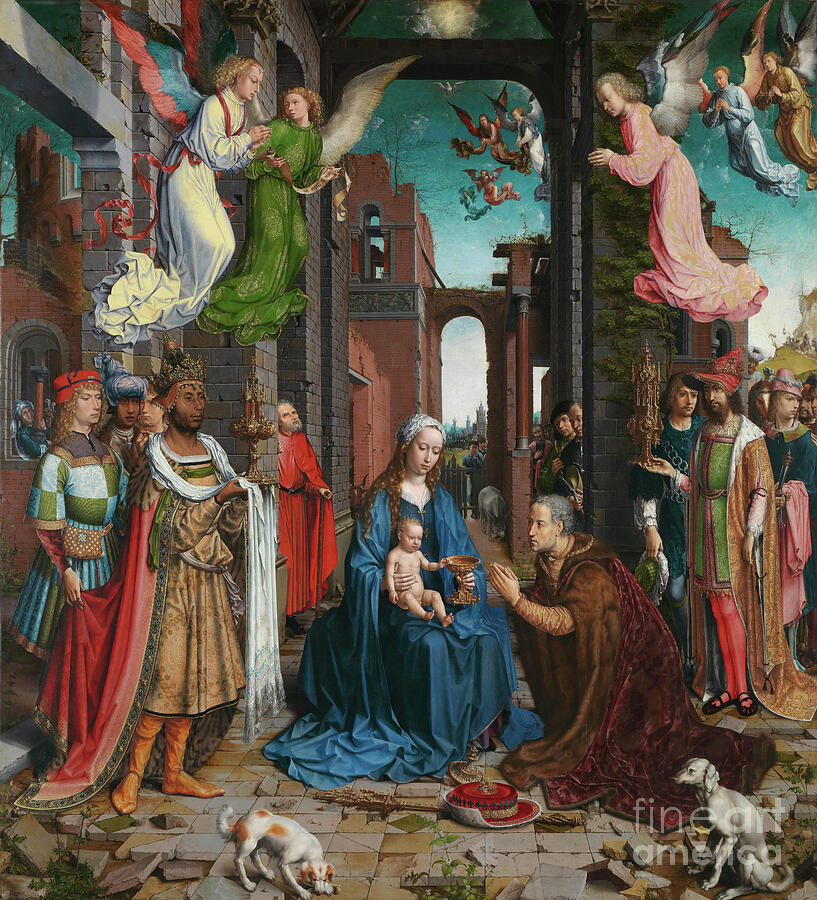
Hang the altarpiece as Gossaert painted it, with every jewel, every angel and both hidden signatures in place, as a print, canvas or framed print from the Sapiens Verbum print shop.
 Choose your size and frame →
Printed and shipped by Fine Art America · 30-day money-back guarantee
💬 Over to you: Which detail did you spot first: the gold coin in the Child’s hand, the angels in the ruins or the two dogs? And where in the world are you reading from? Tell us in the comments.
Comments
Post a Comment