
Perseus and Andromeda by Charles Napier Kennedy: The Kiss After the Monster (1890)
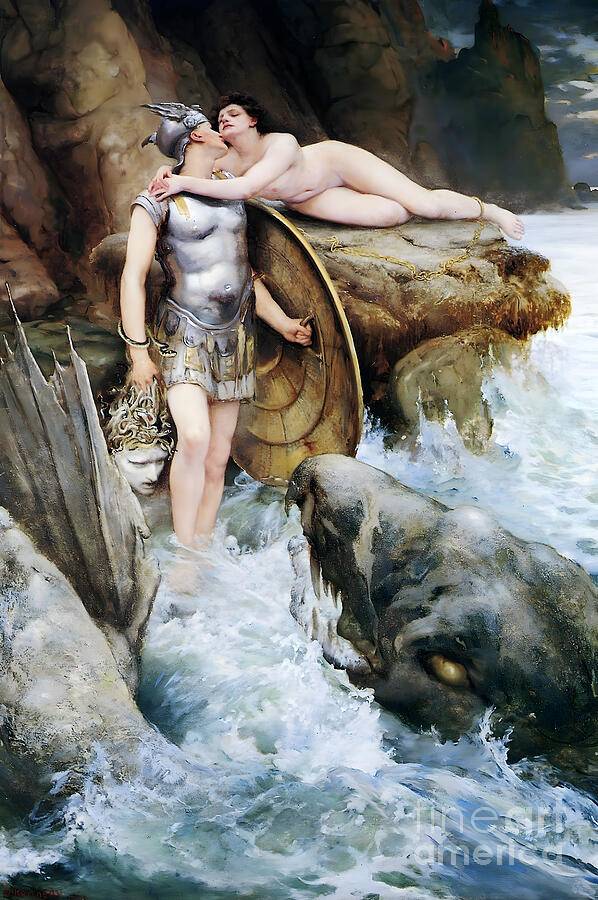
The monster is already dead when the picture begins. In Charles Napier Kennedy’s Perseus and Andromeda (1890), the fight that most painters of the myth race towards has happened just out of frame. What is left is the minute after: a hero in silver armour standing in the surf, a princess leaning down from the rock that was meant to be her grave, and a kiss between them. The Gorgon’s head still hangs from his hand. The beast’s eye is still open. Kennedy paints the rescue as an embrace and lets the sea keep the violence.
🖼️ Get this painting as a print →
Artist: Charles Napier Kennedy (1852–1898)
Title: Perseus and Andromeda
Date: 1890
Medium: Oil on canvas
Subject: Perseus and Andromeda after the slaying of the sea monster, from the story told in Ovid’s Metamorphoses, Book 4
Present location: Not publicly recorded
Status: Public domain.
The myth, one minute late
Ovid tells it quickly. Andromeda, daughter of Cepheus and Cassiopeia, is chained to a sea rock to pay for her mother’s boast. Perseus, flying home with the head of Medusa, sees her from the air and at first takes her for a marble statue, until the wind moves her hair and he sees she is crying. Before he draws his sword he asks her parents for her hand. Then the monster comes, and he kills it.
Ovid adds a strange, quiet coda. Perseus washes his hands in the sea and lays the Gorgon’s head face down on a bed of seaweed, and the weed hardens into coral. Kennedy chooses the space between those two moments. The sword work is finished, the coral has not yet begun. The only action left is the one the bargain promised.
Reading the rock
The painting is built on one long diagonal. It starts at Andromeda, stretched pale along the top of the rock, runs down through Perseus, and ends in the lower right at the monster’s great grey head, half sunk in foam, its eye still catching the light. A finned shape rises on the left like a broken sail. The hero sits at the hinge of the picture: winged helmet, silver cuirass, round shield set behind him, and in his lowered hand the snakes and face of Medusa.
That lowered hand is the clever part. The weapon that could turn anyone to stone hangs at knee height, harmless for the length of a kiss. Andromeda does not cling like a victim. She reaches down and takes his head in her arms, and the embrace runs from her side of the rock to his. Behind them the cliffs go dark and the water turns cold green and white. All the warmth in the canvas is in her skin and the metal of his armour.
A Victorian favourite
Perseus was one of the great myths of late Victorian painting. Edward Burne-Jones spent years on a Perseus cycle commissioned by Arthur Balfour, and Frederic Leighton showed his own Perseus and Andromeda at the Royal Academy in 1891, the hero swooping over a dragon with the princess below. Those are pictures of flight and threat. Kennedy’s version, painted a year before Leighton’s, turns its back on the chase. There is no Pegasus here and no struggle, only arrival.
The myth also gave Victorian painters a respectable frame for the nude. Andromeda had to be bare, chained and exposed, because Ovid said so. Kennedy keeps that convention but changes its temperature. His Andromeda is no longer on display for the monster or for the viewer. She is turned towards one person, and the picture is about her answer.
The painter behind the picture
Charles Napier Kennedy was born in London in 1852 and trained at the Slade School. He became a member of the Royal Institute of Oil Painters in 1883 and an associate of the Royal Hibernian Academy in 1896. He painted portraits, genre scenes and historical subjects, but he was best known for mythology, and the sea runs through that work. His wife, Lucy Kennedy (née Marwood), was a painter too. He died in St Ives, Cornwall, in 1898, at forty-six.
His name is not famous today, and the present home of this canvas is not publicly recorded. That is part of its appeal. It belongs to the large, half-forgotten shelf of Victorian mythological painting, where a minor name can still produce a picture that stops you. Here it is the dead monster’s open eye, and above it, two people who have stopped looking at it.
For another journey through the history hidden behind a masterpiece, explore the Sapiens Verbum essays on the artists, paintings and collections that shaped European art.
Hang Kennedy’s Perseus and Andromeda — the silver hero, the kiss on the rock, the sea that keeps the monster — as a print, canvas or poster from the Sapiens Verbum print shop.
 Choose your size and frame →
Printed and shipped by Fine Art America · 30-day money-back guarantee
💬 Over to you: A love story, or a bargain kept? Ovid’s Perseus asks for her hand before he fights. Which do you see on the rock? Tell us in the comments.
Sources
Wikipedia — Charles Napier Kennedy
Cornwall Artists Index — Charles Napier Kennedy
Wikimedia Commons — Perseus and Andromeda, 1890 (public domain)
Ovid, Metamorphoses, Book 4 (Theoi Classical Texts Library)
Sapiens Verbum — Perseus and Andromeda, 1890, Charles Napier Kennedy
Comments
Post a Comment