


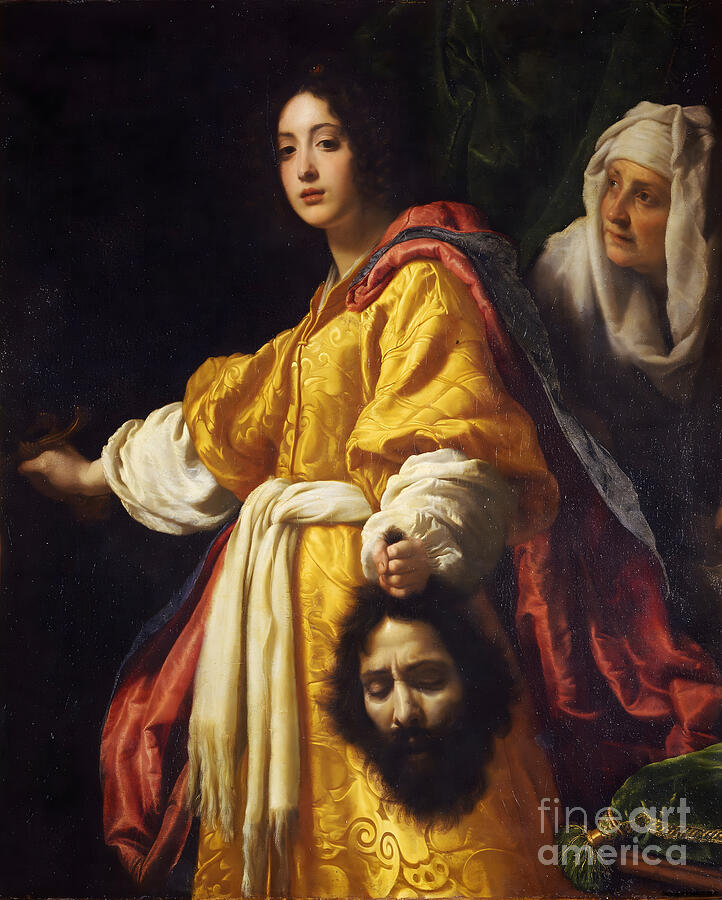
Judith with the Head of Holofernes by Allori: The Painter Who Lost His Head (1610-12)
A young woman in a gown of shimmering gold turns towards us with perfect calm. In her right hand she holds a sword; in her left, gripped by the hair, she holds the severed head of a bearded man. Behind her, an old woman in a white veil waits with a sack. It is one of the most famous paintings in Florence, and one of the most personal. According to the Florentine biographer Filippo Baldinucci, the head belongs to the painter himself, Cristofano Allori; the beautiful executioner is the woman he loved, and the maid is her mother.
🖼️ Get this painting as a print →
Artist: Cristofano Allori (1577–1621), Florentine painter
Title: Judith with the Head of Holofernes (Giuditta con la testa di Oloferne)
Date: 1610–12
Medium: Oil on canvas, 139 × 116 cm
Collection: Palazzo Pitti, Galleria Palatina, Florence (Gallerie degli Uffizi), inv. 1912 no. 96, Sala dell’Educazione di Giove
Notable fact: Baldinucci records that the severed head is a self-portrait of Allori, and that Judith and her maid are his mistress “La Mazzafirra” and her mother.
A story of courage, told in silk
The subject comes from the Book of Judith. When the Assyrian general Holofernes laid siege to the Jewish town of Bethulia, a young widow named Judith dressed in her finest clothes, walked into the enemy camp with her maid and won the general’s trust. After a banquet, when he lay drunk in his tent, she took his own sword and cut off his head. The maid carried it home in a food bag, and the leaderless army fled.
In Florence the story had a political edge. Since 1494 Donatello’s bronze Judith and Holofernes had stood in Piazza della Signoria as an emblem of the city’s freedom from tyrants. Painting Judith in Florence meant painting a civic heroine as much as a biblical one.
Looking at the picture
Allori chooses the moment after the killing, not the killing itself. There is no blood on the gown and no struggle. Judith stands almost in profile, turns her face towards us and looks out with a steady, slightly distant gaze. Her dress is the real protagonist: a heavy yellow brocade with a swirling pattern, a red mantle lined in blue, white sleeves and a long cream sash. The Uffizi reads this luxury as an open tribute to Florence’s great silk and textile industry.
All that splendour sits against a dark background, so that three things glow: the pale face of Judith, the anxious face of the old maid behind her shoulder, and, at the centre of the canvas, the grey face of Holofernes with his eyes closed. Allori makes us look from the beauty to the horror and back again.
The painter as Holofernes
What makes the picture unforgettable is the story told about it. Writing later in the seventeenth century, Baldinucci identified the model for Judith as Maria di Giovanni Mazzafirri, known as “La Mazzafirra”, a beautiful woman with whom Allori had a passionate and unhappy affair. Her mother, he said, posed for the maid. And the head of Holofernes, eyes shut and hair grasped in his lover’s fist, was the painter’s own face.
The Royal Collection describes the painting as “reportedly a response to Allori being deserted by his mistress”. The Uffizi is careful to call the autobiographical reading a popular belief. Either way, the idea was irresistible to Allori’s contemporaries. The poet Giambattista Marino wrote verses on the picture in which Judith tells her victim he will fall by two deaths: “first by my beautiful face, then by my strong hand”.
Caravaggio, Artemisia and a Florentine answer
Allori was not the first to put his own face on a severed head. Caravaggio had painted himself as the head of Goliath in his David with the Head of Goliath, a picture Allori knew. Allori shares Caravaggio’s strong lighting and dark ground, but not his violence.
The contrast is even sharper with Artemisia Gentileschi, who was working for the Medici in Florence in the same years and painted two fierce Judiths for Grand Duke Cosimo II. Artemisia shows the struggle and the blood. Allori shows the calm afterwards: a heroine proud of her act and sure of divine protection, as the Uffizi puts it, beautiful and untouched by what she has done.
Two originals: Florence and the Royal Collection
The composition was an instant success and was copied again and again. Two versions are considered by Allori himself. The one shown here hangs in the Galleria Palatina of Palazzo Pitti; after the painter’s death in 1621 it entered the Medici collections and reached Pitti in 1666. The second, signed and dated 1613, belongs to the Royal Collection in Britain. It was bought by Charles I from the Duke of Mantua, sold for £60 after his execution and returned to the Crown at the Restoration. The two are easy to tell apart: in the British picture Judith’s white sash has coloured stripes and the background is a plain brown, while the Florence canvas sets her against a dark green curtain.
How to read it today
Seen today, Allori’s Judith works on two levels. It is a superb piece of Florentine painting, all silk, light and controlled drama. And it is a confession: a man painting the woman who left him as the heroine who destroyed him, and offering his own head to her as the trophy. Whether every detail of Baldinucci’s story is true matters less than the fact that the picture makes us believe it.
Hang Allori’s Judith — the golden brocade, the calm gaze, the painter’s own head in her hand — as a print, canvas or poster from the Sapiens Verbum print shop. The museum image and the commercial print are separate.
 Choose your size and frame →
Printed and shipped by Fine Art America · 30-day money-back guarantee
💬 Over to you: Do you read Allori’s Judith as a heroine, or as a portrait of a broken heart? Tell us in the comments.
Sources
Gallerie degli Uffizi — Cristofano Allori, Judith with the Head of Holofernes (inv. 1912 no. 96)
Royal Collection Trust — Cristofano Allori, Judith with the Head of Holofernes, 1613 (RCIN 404989)
Sotheby’s — Cristofano Allori, Judith with the Head of Holofernes, catalogue note (2015)
Zeitschrift für Kunstgeschichte — Cristofano Allori dans son dessin (2023)
Wikipedia — Judith with the Head of Holofernes (Cristofano Allori)
Sapiens Verbum — Judith with the Head of Holofernes, Cristofano Allori
Watch: Judith and Holofernes, Gentileschi vs Allori
Comments
Post a Comment