
When Peter Began to Sink: Gustave Brion’s Jesus and Peter on the Water
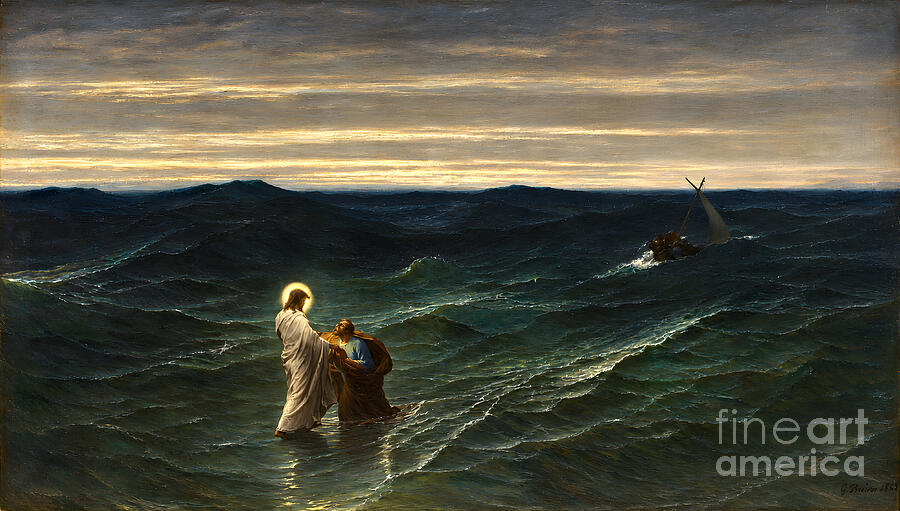
What happens when faith lasts only as long as we can still see where we are going? In Gustave Brion’s Jesus and Peter on the Water (Jésus et Pierre sur les eaux, 1863), the answer is played out on an almost unnaturally vast sea. Two human figures occupy a tiny space in the middle of the storm: Christ stands above the waves, reaching down to Peter, while the disciple struggles to remain afloat. The boat of the other disciples is barely visible in the distance. The result is not a calm religious scene but a painting about fear, trust and the terrifying gap between courage and doubt.
🖼️ Get this painting as a print → License Artwork
Artist: Gustave Brion (1824–1877)
Title: Jesus and Peter on the Water / Jésus et Pierre sur les eaux
Date: 1863
Medium: Oil on canvas
Dimensions: 112.1 × 184 cm (44 1/8 × 72 1/2 in.)
Exhibition: Paris Salon of 1863, no. 284; Exposition Universelle, Paris, 1867, no. 100
Subject: Christ rescuing Saint Peter after Peter begins to sink while walking on the water
Status: Public-domain artwork
The Sea Is the Main Character
Look at the painting before looking at Jesus or Peter. The first thing you encounter is the water.
Brion gives the sea enormous visual authority. Dark, heavy waves rise across the picture in long diagonal masses, creating a sense of depth, movement and imminent danger. The two figures appear almost impossibly small against this environment. The effect is deliberate: the drama does not depend on theatrical gestures. It depends on scale.
Against the dark water, Christ’s pale robes become the visual focus. His body is relatively calm, almost vertical, while Peter is lower and more unstable, his figure partly swallowed by the waves. Christ reaches toward him with one hand. That simple gesture becomes the centre of the entire composition.
Far behind them, a tiny boat carries the remaining disciples. Its distance matters. Peter is no longer protected by the boat. He has stepped away from safety and is now completely dependent on the person reaching for him.
When Faith Begins to Sink
The episode comes from Matthew 14:22–33. After Jesus approaches the disciples walking on the water, Peter asks to come to him. Jesus tells him to come, and Peter steps out of the boat. For a moment he succeeds. Then he notices the force of the wind, becomes afraid and begins to sink. He cries out, and Jesus immediately reaches out and takes hold of him.
Brion chooses the decisive instant rather than the beginning or end of the episode. That makes the painting psychologically powerful. Peter has not yet disappeared beneath the water, but he is no longer secure. Christ’s hand is already there.
The image therefore works on two levels. It is a literal representation of a Gospel episode, but it is also a visual metaphor for the instant when confidence collapses under pressure. The sea becomes the physical expression of doubt.
Gustave Brion at the Paris Salon
Brion was a French painter born in Rothau in 1824 who worked primarily in Paris and became known for historical, religious and genre subjects. His career combined scenes of everyday life with more ambitious historical compositions.
Jesus and Peter on the Water was exhibited at the Paris Salon of 1863 as number 284. The same year was important for Brion’s career: archival biographical records note that he received a first-class medal at the Salon and was made a Chevalier of the Légion d’honneur. The painting was subsequently shown at the Exposition Universelle in Paris in 1867.
The surviving dimensions make clear why the sea dominates the composition: the horizontal canvas is more than 1.8 metres wide, giving Brion enough space to turn the biblical episode into an expansive landscape drama.
Realism, Symbolism and the Power of Scale
Brion’s solution is striking because Christ is not presented as a gigantic supernatural figure dominating the scene. Instead, he remains physically small within the landscape. The miracle is therefore communicated through contrast: the sea is enormous, the men are vulnerable, and yet one calm figure moves through the chaos without being overcome by it.
The illumination also contributes to the symbolism. Christ’s pale clothing separates him from the surrounding darkness, while Peter is caught closer to the colour and texture of the waves. The visual hierarchy is unmistakable: the eye travels through the storm until it finds the hand that offers rescue.
This is where the painting becomes more than an illustration. Brion turns a familiar Gospel story into a study of human perception. Peter does not begin sinking because the sea suddenly becomes more dangerous. He begins sinking when fear changes the way he sees the situation.
A Painting About Trust
One of the most compelling aspects of the work is that Peter is not rescued from a comfortable distance. Christ reaches into the same violent water. There is no separation between them. The act of salvation is physical and immediate.
That makes the tiny gesture of the outstretched hand more powerful than any monumental religious symbol could have been. The entire painting seems to converge on it.
Seen from this perspective, the waves represent more than nature. They become uncertainty itself: circumstances too large to control, moving too quickly to predict. Peter’s body records the consequences of fear; Christ’s posture represents stability.
How to Look at the Painting
Start with the distant boat. Then move toward Christ and Peter. Notice how little space the two figures occupy compared with the sea around them. Follow the diagonal movement of the waves toward Christ’s pale figure, and finally stop at the hand reaching toward Peter.
Then step back mentally and look at the entire composition again. The painting has turned a single gesture into the answer to an enormous problem.
Brion’s question is therefore still remarkably clear more than a century and a half later: when fear tells us that we are sinking, what do we choose to look at—the waves, or the hand reaching toward us?
Sources
Gallery 19C — Gustave Brion, Jesus and Peter on the Water, 1863
Wikimedia Commons — Gustave Brion, Jesus and Peter on the Water, 1863
Archives du musée d’Archéologie nationale — Gustave Brion
Official Salon of 1863 catalogue — Gustave Brion, no. 284
Bring Gustave Brion’s dramatic vision of Jesus and Peter on the Water to your wall as a museum-quality print, canvas or poster from the Sapiens Verbum print shop.
 Buy Fine Art PrintLicense Artwork
Original artwork by Gustave Brion, 1863 · Public Domain
Explore More Art →
Part of the Religious Art and Art History collections at Sapiens Verbum.
Comments
Post a Comment