

Hylas and the Water Nymphs by Henrietta Rae: The Pool That Kept Him (1909)
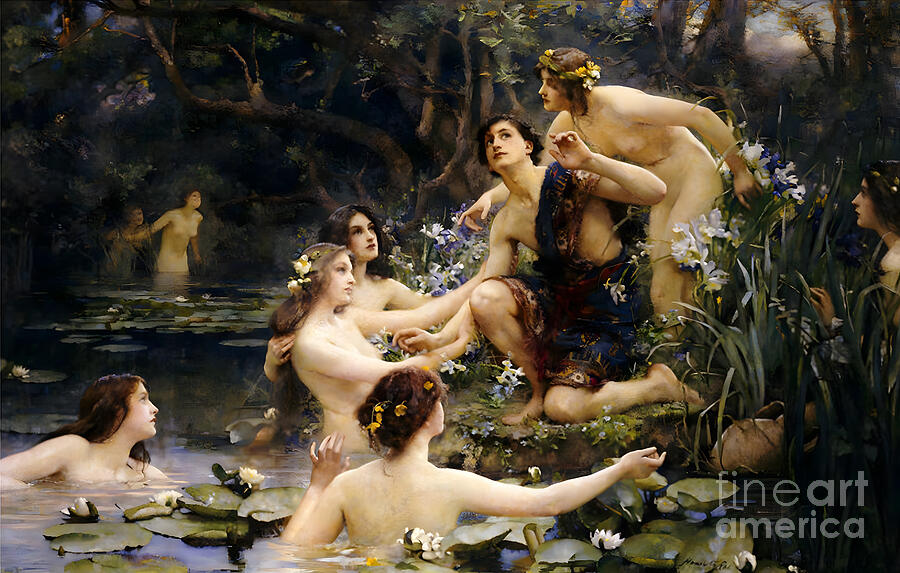
What happens when beauty asks you to come closer, and the water is already doing the asking? In Henrietta Rae’s Hylas and the Water Nymphs (1909), the answer is a pool under trees, not a struggle. Hylas kneels on the bank in a blue tunic, one hand lifted, while the naiads rise out of the lilies and reach for him. No one is dragging him yet. The picture stops on the moment before he disappears.
🖼️ Get this painting as a print → License Artwork
Artist: Henrietta Rae (1859–1928)
Title: Hylas and the Water Nymphs
Date: 1909
Medium: Oil on canvas
Dimensions: 142.3 × 222.8 cm (56 × 87¾ in.)
Exhibition: Royal Academy Summer Exhibition, London, 1910, no. 447
Subject: Hylas, companion of Heracles, at the spring where the naiads take him
Status: Public-domain artwork · private collection
The Pool Does the Persuading
Look at the painting before looking for a struggle. There is not one. Hylas is still on the bank, kneeling among irises, and the hands that will take him are still offers.
Rae builds the danger out of welcome. A nymph seen from behind stretches an arm across the lily pads. Another, crowned with small flowers, leans in from the water and reaches for his knee. A third stands behind him, a wreath in her hair, one arm along his shoulder. Farther off, two more figures bathe under the trees, already at home in the pool he has only just found.
The bank is the last solid thing in the picture. Water lilies, pale irises and overhanging branches close the space around him. He looks up, not down. The hand near his face has not yet decided.
The Youth Who Went for Water
The story is told by Theocritus, in Idyll 13, and by Apollonius in the Argonautica. Hylas was the young companion of Heracles on the voyage of the Argonauts. When the ship put in at Mysia, he was sent to fetch water. He came to a spring where the naiads were bathing. Taken by his beauty, they drew him down. He was not seen again.
Heracles searched until the Argo sailed without him. The myth is an abduction, not a rescue, and not a seduction in which Hylas chooses. Rae paints the instant before that fact is complete. He is still kneeling. The water has not closed over him.
That choice of moment matters. A later second would be a drowning. An earlier one would be a picnic of nymphs. She keeps the threshold: desire on one side, disappearance on the other.
Henrietta Rae at Fifty
Henrietta Emma Ratcliffe Rae was born in Hammersmith on 30 December 1859 and died at Upper Norwood in 1928. She entered Heatherley’s in 1874, the school’s first woman student, and went on to the Royal Academy Schools, where she studied alongside the painter she married in 1884, Ernest Normand. She exhibited under her own name.
Classical subjects on a large scale, with the female nude at the centre, were her ground. Psyche before the Throne of Venus (1894) was the canvas that marked her return to it. Hylas and the Water Nymphs came later, painted when she was fifty, and shown at the Royal Academy in 1910 as number 447. A label on the reverse gave her address at 4 Fox Hill Gardens, Upper Norwood, and the name under which the Academy still knew her: Henrietta Rae (Mrs Ernest Normand). The picture is signed lower right.
It found a buyer at once. Sir Alfred and Lady Newton, her patrons, took it to Weycroft Hall, near Axminster. It stayed in the family until the house sale of 21 October 1988, and was sold again at Christie’s in 2000. It remains in a private collection.
After Waterhouse, a Larger Pool
John William Waterhouse had exhibited his own Hylas and the Nymphs at the Royal Academy in 1897. Rae would have known it. The likeness is real: a youth at the water’s edge, nymphs rising to meet him, lilies doing part of the work.
The differences are the picture. Waterhouse’s pool is a still stage, and Hylas stands. Rae’s canvas is wider, 142.3 by 222.8 centimetres, and more crowded. Hylas kneels. The nymphs are not a single ring. One is behind him, one is in his lap of vision, one reaches from the foreground with her back to us. Christie’s catalogue of the picture noted the larger scale and the more complex design, and the late mix in her handling of academic drawing with a looser, open-air touch.
When it hung at the Academy it drew little comment. Literary subjects were already scarce on those walls, and reviewers were saving their lines for pictures that looked more modern. Silence is not the same as failure. The Newtons bought it.
A Painting About Being Wanted
Nothing in the pool looks like violence. That is the point. The hands are open. The faces are calm. The flowers are in season. Rae makes the abduction look like an invitation, which is how the episode feels in the second before it ends.
Hylas is the only dressed figure, and the only one still on land. The blue and red of his tunic are the last note of the ship he came from. Around him the bodies repeat, each a little closer to the water than the last. The eye travels from the distant bathers to the arm across the lilies and stops on his raised hand.
Heracles is not in the picture. The search, the abandoned Argo, the name called into the trees: all of that happens after the frame. Rae paints the reason he will not be found.
How to Look at the Painting
Start with the two figures bathing at the left. Then cross the lily pads to the nymph whose back is toward you, and follow her arm. Move up to the kneeling youth, then to the standing nymph behind him, and only then to the irises that close the right edge.
Step back and the design becomes a ring that has not quite shut. He can still stand up. The hands say he will not.
Rae’s question is still plain, more than a century on: when the water asks nicely, how late is too late to notice that it means to keep you?
Sources
Christie’s — Henrietta Rae, Hylas and the Water Nymphs, 1909, exhibited Royal Academy 1910, no. 447
Wikimedia Commons — Henrietta Rae, Hylas and the Water Nymphs, circa 1909
Wikipedia — Hylas and the Water Nymphs
Victorian Web — Jo Devereux, Henrietta Rae (1859–1928)
Wikipedia — John William Waterhouse, Hylas and the Nymphs, 1896
Bring Henrietta Rae’s dramatic vision of Hylas and the Water Nymphs to your wall as a museum-quality print, canvas or poster from the Sapiens Verbum print shop.
 Buy Fine Art PrintLicense Artwork
Original artwork by Henrietta Rae, 1909 · Public Domain
Explore More Art →
Part of the Mythology and Art History collections at Sapiens Verbum.
Comments
Post a Comment