
The Kiss by Gustav Klimt: Nobody Actually Knows Who's Kissing (1907–1908)
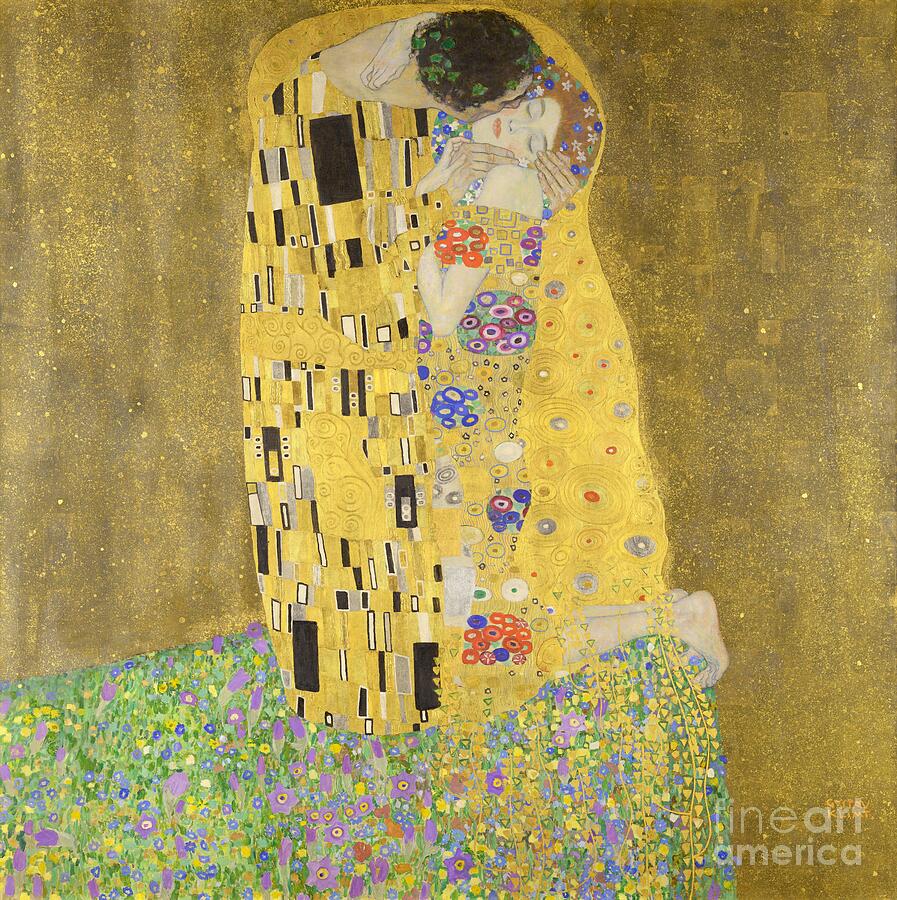
There are no faces to speak of — just a jaw in profile, a cheek pressed shut, a pair of closed eyes. Gustav Klimt buries almost everything else under a wall of gold: hard black-and-white rectangles wrapping him, soft spirals of flowers wrapping her, the two figures fused into a single glowing shape kneeling at the edge of a flower-strewn cliff. Painted in Vienna between 1907 and 1908, Der Kuss (The Kiss) is the image most people picture the instant they hear the word "Klimt" — and more than a century later, historians still can't say for certain who is actually being kissed.
Artist: Gustav Klimt (1862–1918)
Date: 1907–1908
Medium: Oil, gold and silver leaf on canvas, 180 × 180 cm
Collection: Österreichische Galerie Belvedere, Vienna
Notable fact: Bought by the Austrian state before Klimt had even finished painting it
Who Was Gustav Klimt?
Klimt was Vienna's most successful painter twice over, in two completely different careers. Trained at the city's School of Arts and Crafts, he spent his twenties and thirties producing polished, classical murals for public buildings — ceiling paintings for the Burgtheater, allegorical panels for the Kunsthistorisches Museum — the kind of respectable work that earns state medals. Then, in 1897, he walked away from it. Klimt co-founded the Vienna Secession, a breakaway group of artists who rejected the conservative academy in favor of Symbolism, ornament and frank eroticism, and spent the rest of his career being alternately celebrated and denounced for it. A 1903 trip to Ravenna, where he stood inside the sixth-century Basilica of San Vitale and saw its Byzantine mosaics glowing in real gold, pushed him toward the style that made him famous: flat, glittering, pattern-drenched paintings now known as his "Golden Phase." The Kiss, completed when Klimt was in his mid-forties, is that phase at its absolute peak.
A Kiss With No Faces
Look closely and the intimacy is almost accidental — the actual kiss happens off to the side of the canvas, her face turned away and down, his mouth pressed to her cheek rather than her lips. Everything else is surface. Klimt dresses the man in a robe of black-and-white rectangles and dark spirals, hard-edged and architectural; the woman wears a robe of circles and flowers in pinks, greens and violets, soft and organic. Critics have read this contrast as male versus female, or intellect versus nature, ever since the painting was finished, though Klimt left no notes explaining it himself. The couple kneels on a bed of flowers at what appears to be the edge of a drop, her toes curled over empty space — a detail almost nobody notices on a poster, but one that turns a purely decorative embrace into something more precarious.
Nobody Agrees on Who's Kissing
Klimt never titled the painting The Kiss. When it was first exhibited in 1908, the catalogue listed it as Liebespaar — "the lovers," or "the couple in love" — a generic label that gave nothing away, and the identity of the two figures has stayed genuinely unresolved ever since. The most popular theory holds that the couple is Klimt himself and Emilie Flöge, the fashion designer who was his closest companion for the last decades of his life. Other names have been floated over the years, including the composer Alma Mahler, though none of these attributions rest on anything Klimt confirmed. Some art historians prefer to skip biography altogether and read the couple mythologically, as Apollo and Daphne caught mid-transformation, or Orpheus reaching Eurydice one last time. The painting itself refuses to settle the question — which may be exactly why it still gets asked.
Gold Leaf in a City Running Out of Time
The Kiss belongs to a Vienna that had perhaps a decade left. It was the city of Freud, newly publishing theories of the unconscious a few streets from Klimt's studio; of Gustav Mahler conducting at the Court Opera; of a sprawling, multi-ethnic empire that would not survive the coming World War. None of that anxiety appears in the painting itself — Klimt gives his couple a private, self-contained universe of gold, sealed off from politics, sealed off from the century about to arrive. He would die in 1918, the same year the Austro-Hungarian Empire he'd spent his career decorating finally dissolved, and the same year his younger rival Egon Schiele died in the influenza pandemic. The Kiss now reads, in hindsight, like the last calm image a doomed world managed to produce.
Why the Painting Keeps Coming Back
Few images in art history have been more thoroughly flattened by their own popularity. The Kiss covers posters, umbrellas, phone cases and wedding invitations so routinely that it's possible to have seen it a thousand times without ever noticing the curled toes at the cliff's edge, or registering that the couple's faces are barely visible at all. Klimt built a painting about ambiguity — about who these people are, about whether the ground beneath them is even solid — and the culture around it responded by turning it into the single most generic symbol of romance available. The gold leaf, at least, hasn't dimmed. A century on, it's still the reason people stop in front of it at the Belvedere and, more often than not, the reason they leave without any better idea of who's actually being kissed.
Get The Kiss as a museum-quality print, canvas, or poster from the Sapiens Verbum print shop.
Shop This Print →
Watch the full video essay on @SapiensVerbum on YouTube.


Comments
Post a Comment