The Chess Players by Moritz Retzsch: Playing the Devil for a Soul (c. 1831)
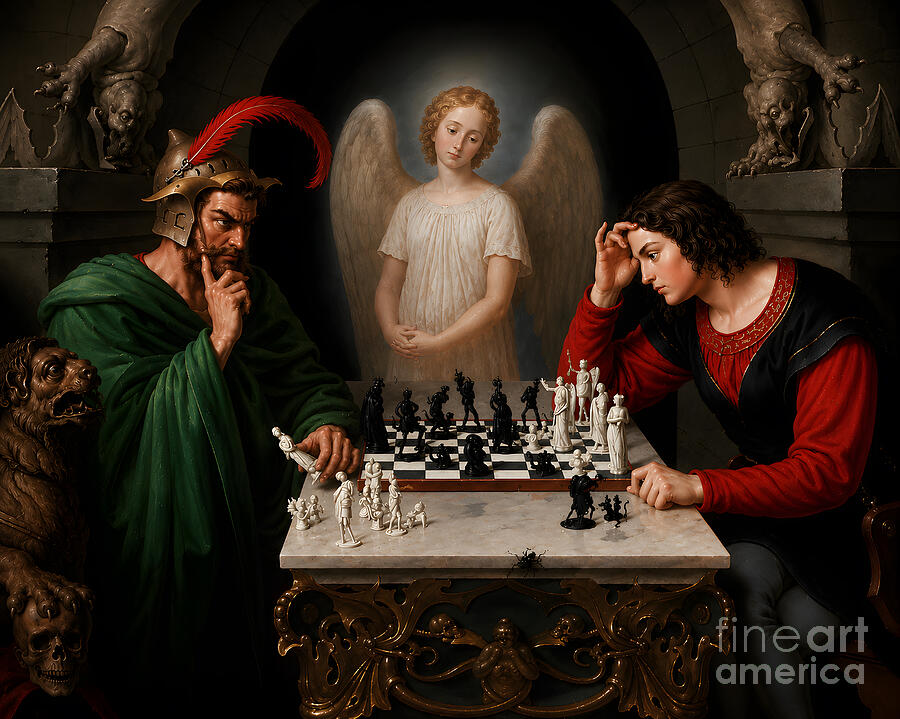
A young man sits at a chessboard, chin in hand, staring at the pieces as if the floor had just dropped away beneath him. Across the table his opponent leans back, calm and amused. It is the Devil, and the stake is the young man's soul. Behind the player stands an angel, silent and sorrowful. Moritz Retzsch's The Chess Players (c. 1831) is a small panel that has had an unusually long afterlife, first as a popular engraving and later as the painting everyone calls "Checkmate".
Artist: Friedrich August Moritz Retzsch (1779–1857)
Date: c. 1831
Medium: Oil on panel, about 32 x 39 cm
Collection: Private collection (sold at Christie's in 1999)
Notable fact: Also known as "Checkmate" or Die Schachspieler; it circulated widely as a print and became the subject of a famous chess legend
The Painter of Faust
Retzsch spent his whole career in and around Dresden, where he trained at the Academy of Fine Arts and became a professor in 1824. He was famous across Europe not for paintings but for outline engravings: clean, linear illustrations of Goethe's Faust, Schiller and Shakespeare that were republished in German and English editions for decades. The Faust plates in particular made him the visual interpreter of the most famous pact with the Devil in literature, and The Chess Players grows directly out of that world.
A Game With One Stake
The painting turns the Faustian bargain into a board game. The Devil plays calmly, sure of the result; the young man is lost in thought, unsure whether any move is left to him; the angel behind him can only watch. Retzsch makes the idea legible at a glance, which is why the image worked so well as a print: every viewer understands the rules, and every viewer knows what is being played for. The small scale and the careful, almost illustrative finish show his background as an engraver.
The Legend of "One More Move"
The picture is best known today because of a story. According to the version repeated in countless sermons and chess books, the great American player Paul Morphy was once shown the image, studied the board for a long time and then announced that the young man was not beaten: the king still had one more move. The anecdote has no reliable contemporary source and is usually treated as legend, and the pieces in the painting are not drawn clearly enough to reconstruct a definite position. But the story has made "the king has one more move" a proverb of hope, attached to this picture ever since.
Where Is the Original?
The oil itself is a small panel that has spent most of its life in private hands. It passed through Christie's in 1999, and its present owner has not been made public. Most people know it through reproductions of the painting and through the engravings made after it in the nineteenth century, which spread the composition far beyond Dresden.
Why It Still Speaks
Few paintings carry a single idea so directly: that when a situation looks hopeless, it may not be. Whether you read it as a religious allegory, a Romantic retelling of Faust or simply a scene about pressure and doubt, The Chess Players leaves the question open on the board. Retzsch does not show the next move. He leaves it to the viewer.
Get Moritz Retzsch's The Chess Players as a museum-quality print, canvas, or poster from the Sapiens Verbum print shop.
Shop This Print →
Watch on @SapiensVerbum: The Chess Players: Moritz Retzsch's Symbolic Masterpiece — the full Commented Paintings reading of the devil's chess game.
Comments
Post a Comment