
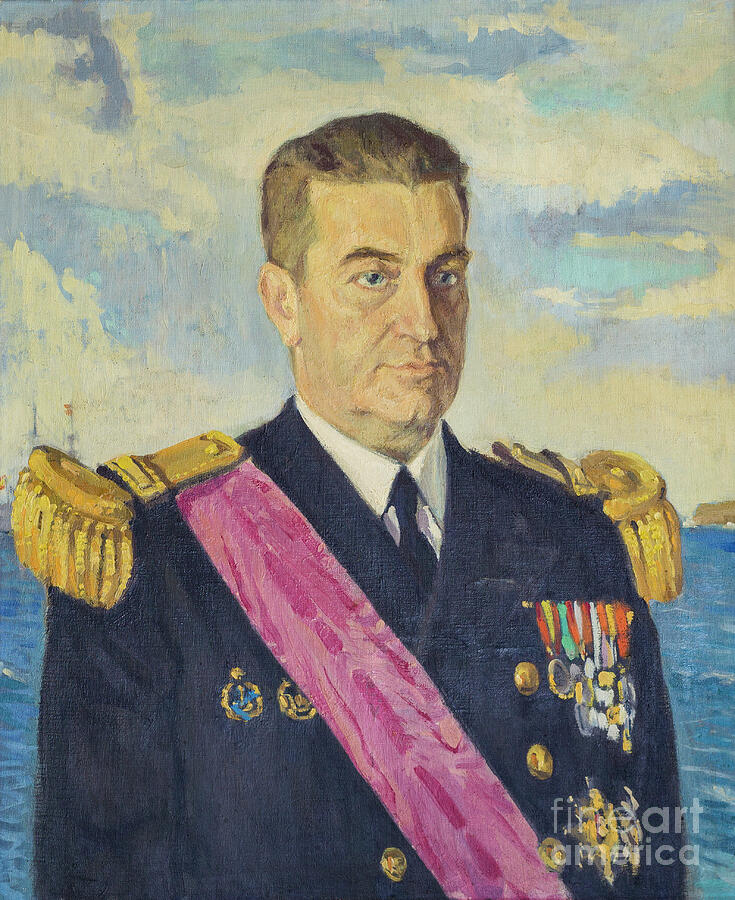
Portrait of José María González-Llanos y Caruncho: The Painted Face of Ferrol's Shipbuilding Legacy
An unsigned oil portrait of an older man in a dark suit could easily have stayed exactly what it looks like: a family keepsake with no story attached beyond the household that kept it. But the sitter here is José María González-Llanos y Caruncho (1899-1990), the Galician naval engineer who founded Ferrol's ASTANO and FENYA shipyards -- and whose family Sapiens Verbum has already traced across two Kindle biographies. This anonymous canvas, now offered as prints, canvas, and more through the Sapiens Verbum print shop, is the closest thing to a face that documented career has left behind.
Artist: Anonymous
Subject: José María González-Llanos y Caruncho (1899-1990)
Medium: Oil on canvas
Family: Son of Carlos González-Llanos y Alessón and Humbelina Caruncho
Available as: Prints, canvas, and more at the Sapiens Verbum print shop
From Naval Cadet to Electrical Engineer
González-Llanos came from a family where the sea was less a career choice than an inheritance: his father, Carlos González-Llanos y Alessón, had served as a naval officer through the 1898 disaster at Santiago de Cuba. José María entered the Navy himself at fourteen and trained as a midshipman at the Naval School from 1919, serving aboard the battleships Reina Regente, Alfonso XIII, España, Jaime I, Carlos V, and Cataluña, and commanding torpedo boat No. 2 of Ferrol's Submarine and Torpedo Flotilla. He saw combat in the Rif War aboard the Alfonso XIII during the recapture of Melilla and the campaigns at Tiguisas and Uad Targa, near Tetuán. Then, in his mid-twenties, he redirected that naval career into engineering: electrical engineering studies at the Montefiore Institute of the University of Liège in 1924-25, where he finished first in his class, followed by the Academy of Engineers of Ferrol, graduating in 1928.
Building ASTANO and FENYA Through Civil War and Dictatorship
In 1929 he joined the Sociedad Española de Construcción Naval (SECN) as head of electrical services, rising to chief engineer of the shipyard's works by 1931, chief engineer of the shipyard in 1933, and director in Ferrol by 1935. He left that post after the military uprising of 18 July 1936 and served aboard the cruiser Canarias during the blockade of the Strait of Gibraltar, returning to the SECN directorship before the war's end. Over the following years he modernized the shipyard -- founding an apprentice school and a turbine factory -- and in 1941 established FENYA (Fabricaciones Eléctricas Navales y Artilleras) and ASTANO (Astilleros y Talleres del Noroeste), the two companies that would anchor Ferrol's shipbuilding industry for decades. He left his position at Bazán in 1949 and spent 1947 to 1961 teaching at the Escuela de Ingenieros Navales in Madrid.
One Family, Two Books, Now a Portrait
This is not the first time this family's history has surfaced on Sapiens Verbum. His father's path through the wreck of Spain's Caribbean fleet is the subject of Carlos González-Llanos y Alessón: A Spanish Naval Officer's Life Through the Disaster of 1898 on books.sapiensverbum.com, and José María's own career as engineer and shipbuilder is the subject of his grandson Ramón María Tenreiro's biography, covered separately as José M.ª González-Llanos y Caruncho: The Engineer Who Rebuilt Ferrol's Shipyards. Read together with this portrait, the two books and the anonymous canvas form a small, coherent record of one Galician family's century in the Spanish Navy and its industry -- one written in ink, the other in oil.
Get this portrait of José María González-Llanos y Caruncho as a museum-quality print, canvas, or poster from the Sapiens Verbum print shop.
Shop This Print →


Comments
Post a Comment