

Giuseppe Arcimboldo Painted Emperors Out of Fruit — And Meant It as a Compliment
Giuseppe Arcimboldo spent three decades painting portraits that fall apart the moment you look closely. A cheek is a peach. An eyebrow is a pea pod. A beard is a tangle of roots and chestnuts. Step back and it's a bishop, an emperor, a season of the year. Step in and it's a very strange still life. His patrons were Holy Roman Emperors, and they didn't just tolerate the joke — they commissioned more of it. Six of his paintings, below, still do exactly what they did in the 1560s: convince you they're one thing, then make you look twice.
Artist: Giuseppe Arcimboldo (1526–1593)
Theme: Human faces built entirely from fruit, vegetables, flowers, fire, and roots
Paintings in this guide: Spring, Summer, Fire, Vertumnus (1591), Four Seasons in One Head (c. 1590), Self-Portrait Drawing (c. 1587)
Notable fact: He was the official court portraitist to three Holy Roman Emperors in Milan, Vienna, and Prague — the produce was diplomacy, not comedy
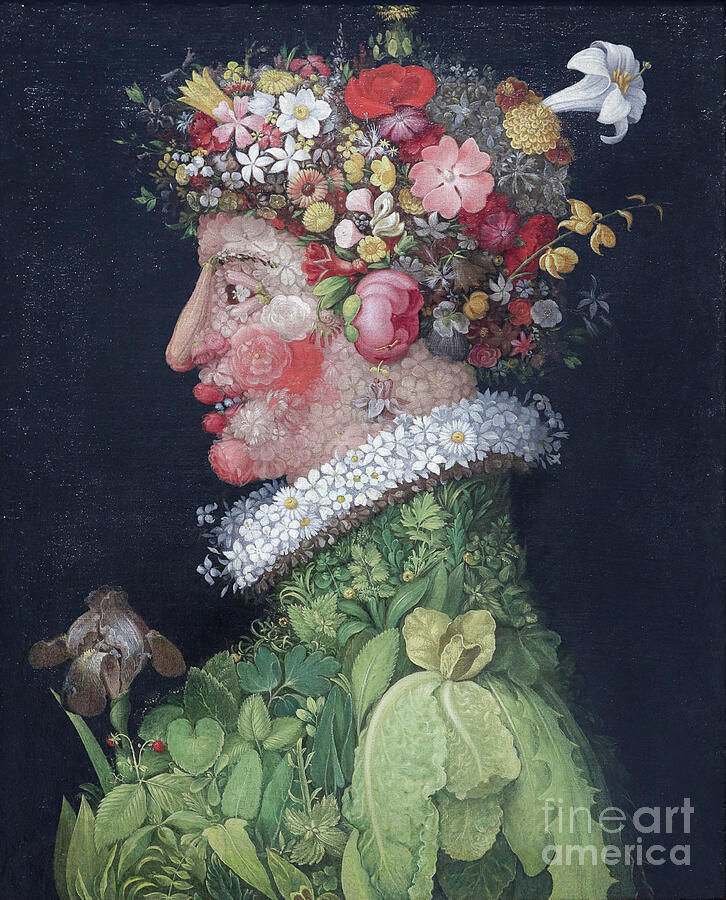
Spring: The Gift That Wasn't a Joke
In 1563, Arcimboldo presented Emperor Maximilian II with a young woman's profile built entirely from garden flowers — rosebud lips, a lily collar, a cheek made of blush-pink petals. It reads today like a visual pun. At the Habsburg court it read like flattery of the highest order: a portrait of the season in which the empire's gardens, and by extension its wealth, came into bloom. The emperor was delighted enough to commission a matching set. Print: shop Spring.
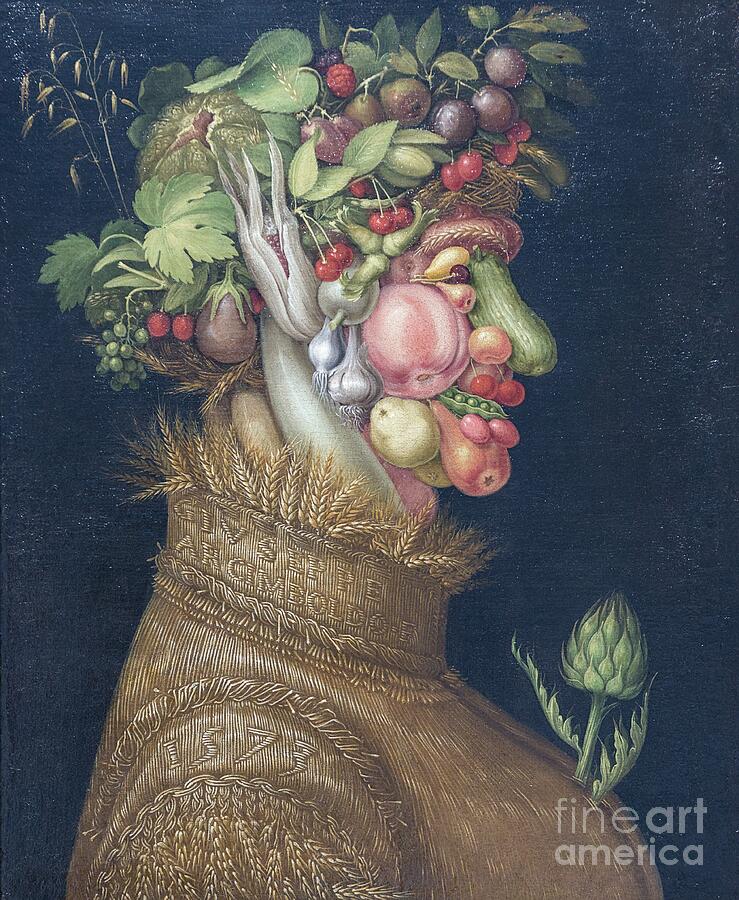
Summer: Ripeness as a Compliment
Corn husk for an ear, a cucumber for a nose, an artichoke for a shoulder pauldron: Summer is the season at its most confident, and Arcimboldo painted it that way on purpose. The Four Seasons were designed to be read together as a life cycle — youth, maturity, harvest, decline — mapped onto a single ruling house's fortunes. Signing his name into the woven collar wasn't vanity so much as a craftsman's wink: look how far a vegetable can go. Print: shop Summer.
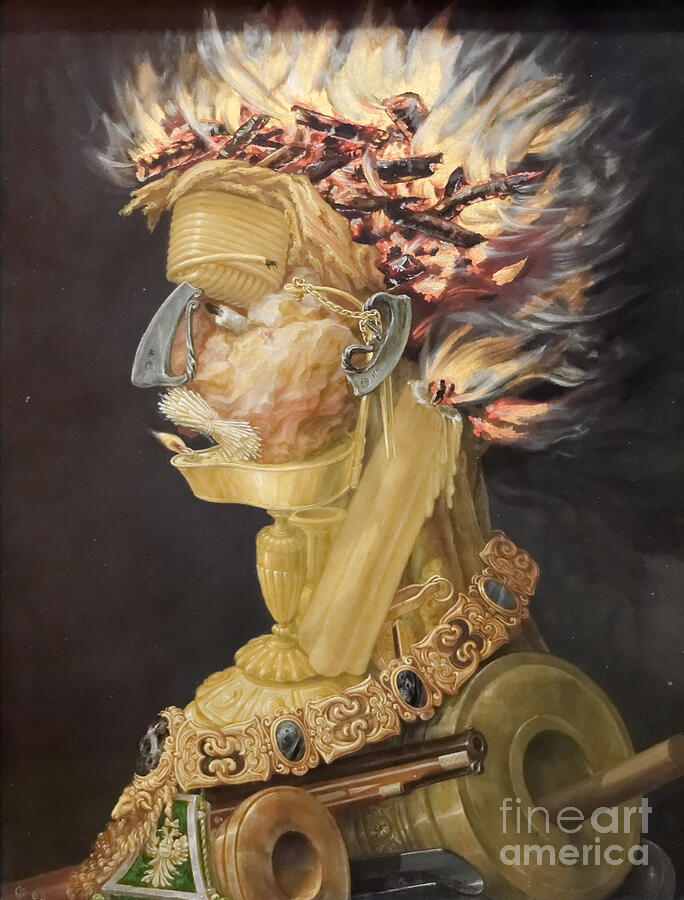
Beyond the Seasons: An Emperor Made of Weapons and Sparks
The Seasons had a companion set: the Four Elements. Fire is the fiercest of them, its face built from candles, flint, a smoking cannon barrel, and a burning log for a jaw, crowned with the collar of the Order of the Golden Fleece. Paired with Air, Water, and Earth, the cycle was a not-so-subtle political argument: the Habsburgs held dominion over every element in creation. It's the closest Arcimboldo ever got to painting a threat. Print: shop Fire.
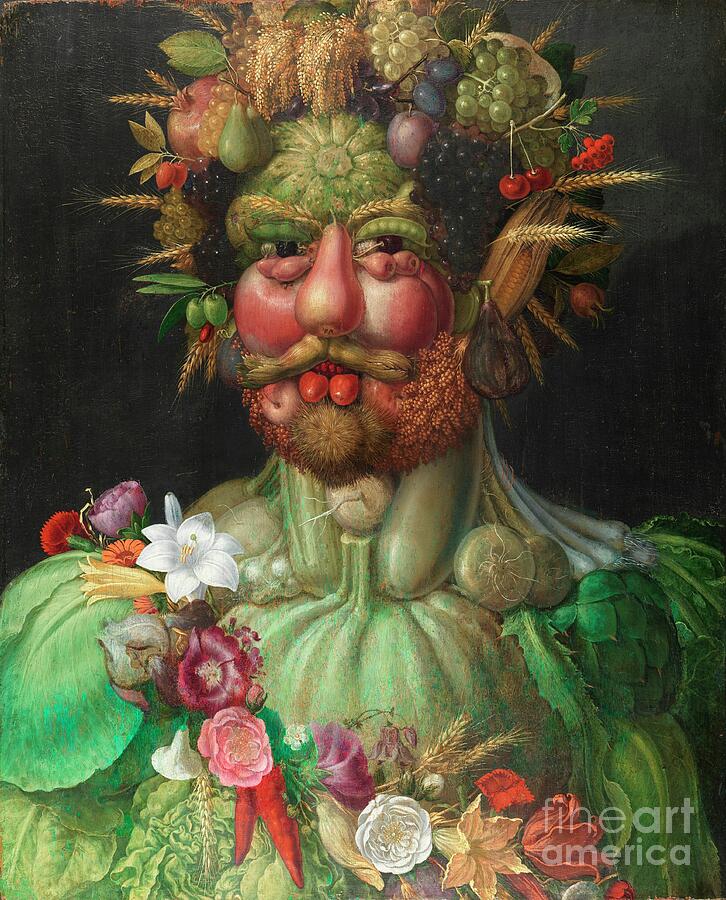
Vertumnus: When the Emperor Became a Harvest God
By 1591, Arcimboldo was working for Rudolf II — the most eccentric of his imperial patrons, a collector of curiosities who kept alchemists on staff. For him, Arcimboldo painted Vertumnus: Rudolf reimagined as the Roman god of seasons, growth, and transformation, his face assembled from roughly seventy fruits, vegetables, and flowers, a pea-pod eyelid and a pear for a nose. It's the single boldest gesture of his career — flattery so extreme it loops back around into something close to reverence. The painting hangs today at Skokloster Castle in Sweden. Print: shop Vertumnus.
The Trick Painting: One Head, Four Seasons, Two Ways to Look
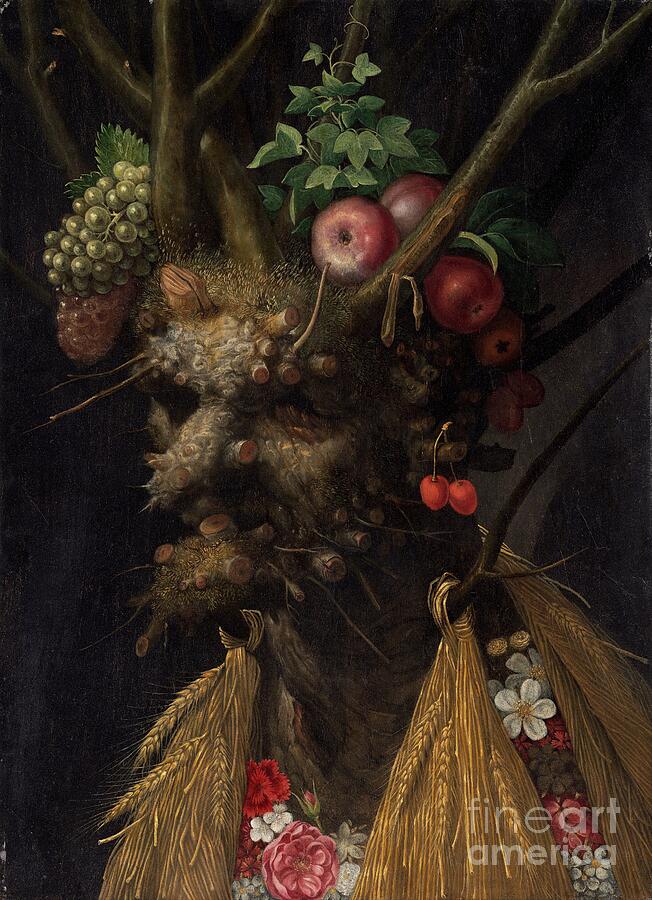
This one is a small piece of magic even by Arcimboldo's standards. Viewed one way, it's a dead tree stump studded with grapes, wheat, and bare winter branches — a still life of the year's turning. Turn the canvas upside down, and the trunk resolves into a grimacing human face, its features carved from the same wood and fruit. Arcimboldo didn't just paint composite portraits; he painted riddles, made for a court obsessed with wonder cabinets, automata, and visual sleight of hand. It now hangs at the National Gallery of Art in Washington. Print: shop Four Seasons in One Head.
The Face Behind the Fruit
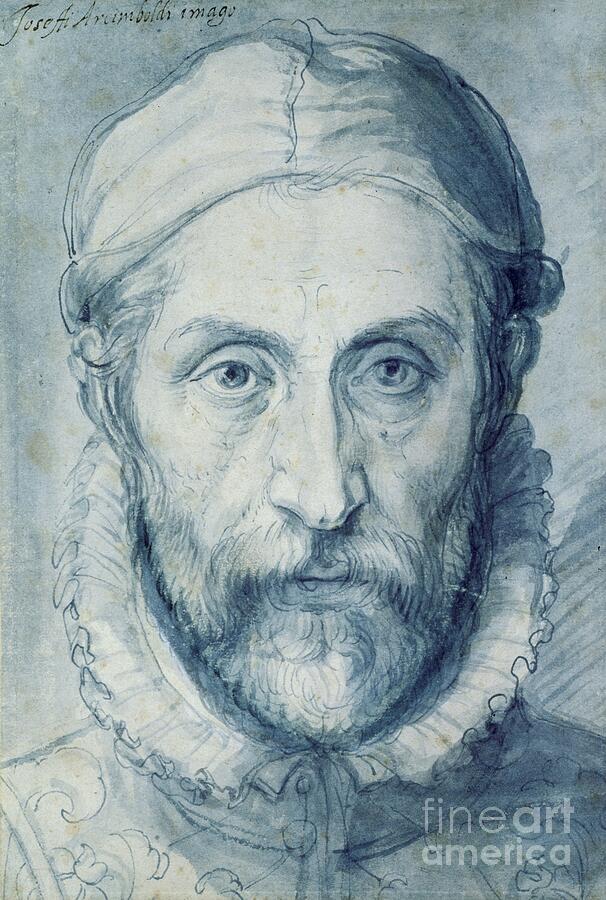
After decades of composite emperors and allegorical vegetables, Arcimboldo's own likeness survives in a single quiet ink-and-wash drawing, inscribed in his own hand: Josephi Arcimboldi imago — "the image of Giuseppe Arcimboldo." No pears, no roots, no visual trick. Just an old man's tired, direct gaze, drawn a few years before his death. It's the one time he let a face be only a face. Print: shop the Self-Portrait Drawing.
Why We're Still Looking
For nearly three centuries after his death, Arcimboldo was a footnote — a court curiosity, filed under "Mannerist oddity" and largely ignored by serious art history. It took the Surrealists, Salvador Dalí chief among them, to reclaim him as a kindred spirit: an artist who understood that a single image can hold two truths at once, and that the space between a face and a fruit bowl is exactly where the interesting questions live. His paintings still work as riddles, as flattery, and — five hundred years on — as some of the strangest, most instantly recognizable portraits ever painted.
Own These Paintings
Browse Arcimboldo prints — Spring, Summer, Vertumnus, and more — in one collection.
Follow @SapiensVerbum for more overlooked corners of art history.


Comments
Post a Comment