
Argos and Odysseus by Briton Riviere (1872): The Painting of Odysseus and His Dog
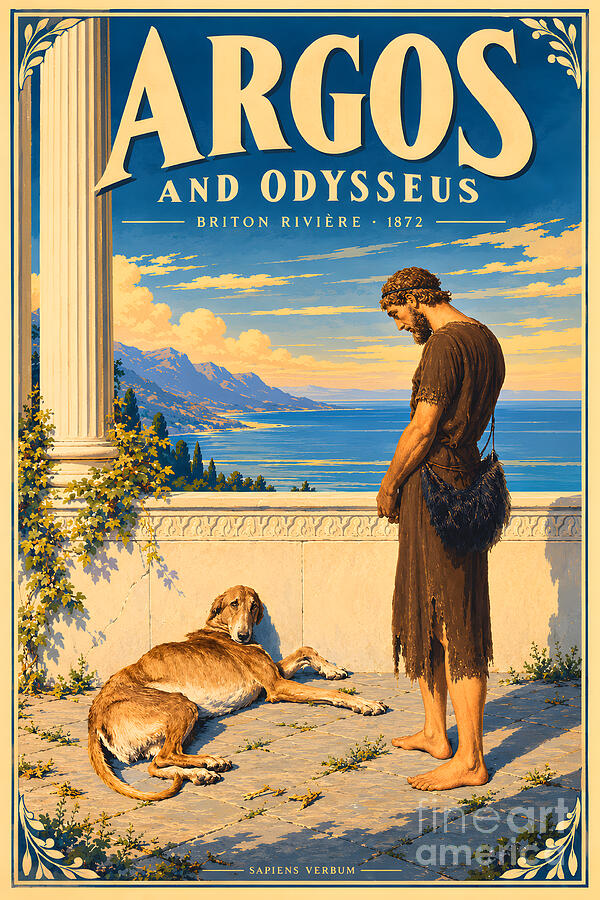
In Book Seventeen of the Odyssey, an old dog lies dying on a heap of manure outside his own house, crawling with ticks, too weak to lift himself off the ground. A stranger walks past in a beggar's rags — and this dog is the only living creature on the island of Ithaca who knows him. Twenty years earlier, before the Trojan War and the decade of shipwrecks that followed it, the dog had been a puppy raised by the hands that now hold a beggar's staff. In the half-second of recognition, he manages only to drop his ears and wag his tail once before death takes him. In 1872, at the height of his reputation as one of Victorian England's finest animal painters, Briton Riviere set out to paint the moment just before that — and produced one of the quietest, most devastating pictures of the nineteenth century. The picture below is our vintage poster version of the painting; the original is shown further down.
🖼️ Get the vintage poster →License this image →
Artist: Briton Riviere (1840–1920)
Date: 1872
Medium: Oil on canvas
Collection: Private collection
Notable fact: Homer never lets Odysseus touch the dog — recognized after twenty years, Argos dies while his own master is forced to walk past him as a stranger
The Only Recognition That Isn't a Test
Recognition is the engine of the second half of the Odyssey. Homer stages one scene after another in which someone has to work out that the ragged stranger standing in front of them is the king of Ithaca. Athena disguises Odysseus as an old beggar precisely so he can walk into his own palace — occupied for three years by suitors competing for his wife's hand — without being killed on sight. His son Telemachus needs the goddess to physically strip the disguise away before he believes it. Penelope tests her husband with a trick about their marriage bed that only the real Odysseus could pass. Even the old nurse Eurycleia only knows him by a childhood scar on his leg, and Odysseus has to seize her by the throat to stop her from shouting his name aloud. Argos needs none of it. No test, no proof, no set piece — he simply lifts his head from the dung heap, in the twentieth year of waiting, and knows.
A Dog Painted by England's Foremost Animal Painter
By 1872, Riviere had already built a career on refusing to treat animals as sentimental accessories to a human scene. Trained as a history painter, he spent his working life applying that same seriousness to lions, hounds, and sheepdogs, and would go on to paint some of the era's other great studies of animal fidelity — Sympathy (1878), a girl and her dog on a staircase, and Requiescat (1888), a hound keeping vigil over a dead knight. In Argos, that discipline shows in exactly the details a sentimental painter would have softened: the visible ribs, the forelegs splayed flat because the animal no longer has the strength to gather them under his body, the flat, clouded stare of an old dog that has stopped expecting anything. Behind man and dog, Riviere opens onto a sunlit Mediterranean terrace — marble columns, vine leaves, a bay stretching to the horizon — and it is precisely that brightness that makes the shadowed, motionless foreground so hard to look away from.
The Silence Odysseus Has to Keep
Homer is explicit about what the disguise costs in this scene. Walking into the palace grounds with the swineherd Eumaeus, Odysseus spots Argos on the refuse heap and cannot risk so much as a flicker of recognition — the suitors are inside, and he isn't ready for them yet. He turns aside and wipes away a tear, hiding it from his companion, then asks a flat, deflecting question about the dog rather than approach him. Riviere paints exactly that gap: several feet of empty marble pavement separate the standing man from the reclining dog, and neither one closes the distance. It is the one relationship in the entire poem that needs no dialogue and gets no touch — the loyalty runs in one direction, silently, and ends the moment it is recognized.
Loyalty Without Witnesses
Nearly three thousand years on, Christopher Nolan's big-screen adaptation of The Odyssey has sent a new audience back to Homer's monsters and set pieces — the Cyclops, the sirens, the suitors' slaughter. Argos rarely survives the trip to film or television, because there is no action in his scene: just a dog and a man who cannot speak to each other, for as long as it takes for one of them to die. That absence of spectacle is exactly why Riviere's canvas still lands. He isn't painting a battle. He's painting twenty years of patience, paid off in a moment the story doesn't allow anyone else to notice, let alone celebrate. No servant looks over. No suitor glances up. Argos is loyal without an audience, which may be the only kind of loyalty the Odyssey treats as beyond question.
🎁 Looking for a gift? Argos and Odysseus is one of the paintings in our art gift guide, with twenty-seven famous paintings as vintage posters, our best-selling prints and our book.
Briton Riviere’s Argos and Odysseus reimagined as a vintage art poster by Sapiens Verbum.
 Choose your size and frame →
See the vintage poster collection →License this image →
Choose your size and frame →
See the vintage poster collection →License this image →

Get Riviere’s Argos and Odysseus as a museum-quality print, canvas, or poster from the Sapiens Verbum print shop.
 Choose your size and frame →
Printed and shipped by Fine Art America · 30-day money-back guarantee
Watch the full video essay on @SapiensVerbum on YouTube.
Comments
Post a Comment