


Bal du moulin de la Galette by Renoir: Paris Dancing in Dappled Light (1876)
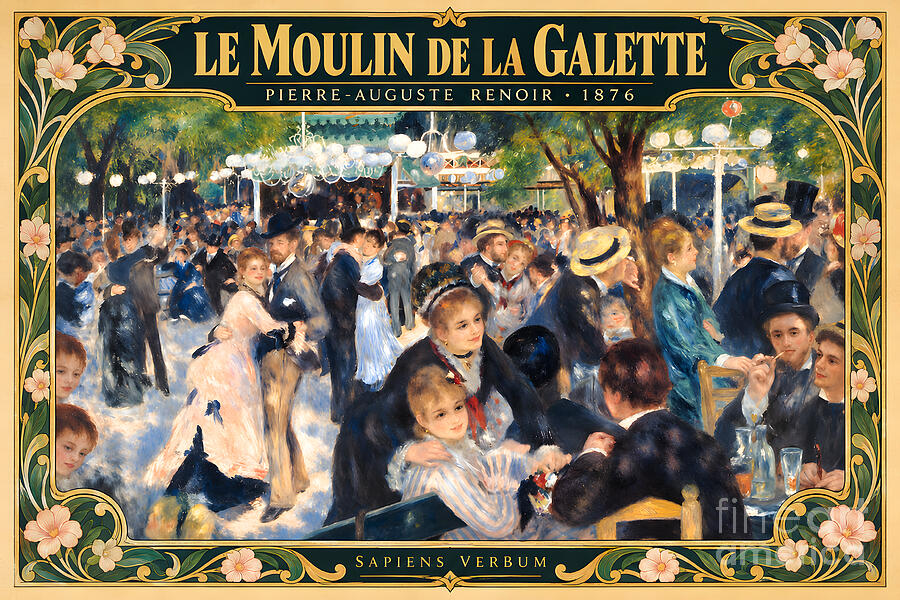
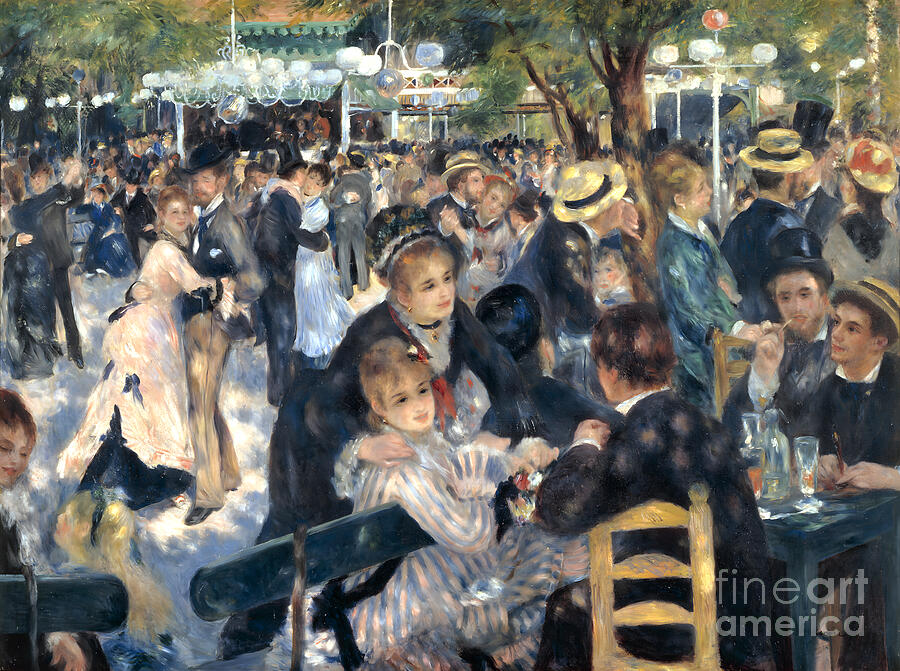
It is a Sunday afternoon in Montmartre, and the open-air dance floor is packed. Couples whirl under the trees, young women in striped dresses lean on benches and laugh with their friends, men in straw boaters and top hats crowd around the tables, and sunlight filters through the leaves, scattering patches of light over hats, faces and shoulders. Pierre-Auguste Renoir's Bal du moulin de la Galette, painted in 1876 and now in the Musée d'Orsay in Paris, is the great image of Impressionist pleasure: ordinary Parisians enjoying themselves on a summer day. The picture below is our vintage poster version of the painting; the original is shown further down.
🖼️ Get the vintage poster →License this image →
Artist: Pierre-Auguste Renoir (1841–1919)
Date: 1876
Medium: Oil on canvas, 131 × 175 cm
Collection: Musée d'Orsay, Paris (bequest of Gustave Caillebotte, 1894)
First shown: Third Impressionist exhibition, Paris, 1877
Where is the Moulin de la Galette?
In the nineteenth century, Montmartre was still a village on a hill on the northern edge of Paris, with vineyards, gardens and windmills. One of the mills, the Moulin de la Galette, had become a popular open-air dance hall, named after the galettes, small flat cakes, served there. On Sunday afternoons it filled with working people, artists, seamstresses and shop girls who came to dance, drink and flirt. Renoir rented a studio nearby in 1876 and spent weeks painting the scene, partly on the spot.
What does the painting show?
There is no single subject. The canvas is a crowd seen from close up, cut off at the edges as if by a camera, with figures receding into the depth of the garden. In the foreground, a group sits around a table on the right: a young woman in a striped pink and blue dress leans over the back of a bench to talk to a girl beside her, while the men listen, one with a pipe. Behind them, couples dance in the shade; at the left, a young man in a straw hat leads his partner in a pink dress. Above, gas lamps hang from the branches and the light shines through the leaves.
That light is the real protagonist. Renoir paints sunlight falling through trees as spots of yellow and white scattered over clothes, faces and the ground, and shadows in blue and violet rather than black. The brushwork is quick and broken, so that the whole scene seems to flicker with movement and sound. Many of the people are Renoir's friends, painters, writers and young women from the neighbourhood, who posed for him in their Sunday clothes.
Why was it important?
When the painting was shown at the third Impressionist exhibition in 1877, it was one of the most ambitious works in the show: a large, multi-figure canvas of the kind normally reserved for history painting, devoted instead to modern life and simple happiness. It remains one of the defining images of the movement, alongside the landscapes of Monet, whose Houses of Parliament, Sunset shows the same fascination with light applied to a very different subject.
The painting was bought by Renoir's friend, the painter and collector Gustave Caillebotte, who owned it from 1879 until his death in 1894 and left it, with the rest of his collection of Impressionist works, to the French state. It was shown in the Musée du Luxembourg and the Louvre before moving to the Musée d'Orsay when it opened in 1986. Renoir also painted a smaller version of the scene; it was sold at auction in New York in May 1990 for about 78 million dollars, then one of the highest prices ever paid for a painting.
Where can you see it?
The painting hangs in the Impressionist galleries on the top floor of the Musée d'Orsay in Paris. Our guide to the paintings you can see in Paris will help you plan the visit, and the street where the dance hall stood is still there, on the slopes of Montmartre below the windmills, a short walk from Sacré-Cœur.
Hang Pierre-Auguste Renoir’s Bal du moulin de la Galette as a vintage art poster from the Sapiens Verbum print shop.
 Choose your size and frame →See the vintage poster collection →License this image →
See Renoir’s Bal du moulin de la Galette framed on your wall: a museum-quality print, canvas or poster from the Sapiens Verbum print shop.
 Choose your size and frame →
Printed and shipped by Fine Art America · 30-day money-back guarantee
Bal du moulin de la Galette is one of the thirty pictures in our book The 30 Most Famous Paintings in the History of Art: The Myths They Hide, the History They Reveal. Each chapter takes one painting, the myth around it and the history behind it. On Kindle, in paperback, in hardcover and as an audiobook.
Get the book →See all 30 paintings →
Watch the video essay (in Spanish) on @SapiensVerbum on YouTube.
Sources
Wikipedia, "Bal du moulin de la Galette"; Musée d'Orsay, collection record.
Comments
Post a Comment